At six years old, Brandon Ridley was already in the family shop, assembling printed circuit boards. Childhood rarely hands out career metaphors so neatly. A circuit board is a map of consequences: route the signal badly, miss a connection, or ignore a constraint, and the system answers without tact. Ridley would spend his first career learning that discipline in power electronics. He would spend the next applying it to a field less famous for wiring diagrams - marketing.
The route between those careers was not a fashionable pivot from engineer to storyteller. It was closer to a long apprenticeship in how difficult products acquire meaning. At Ridley Engineering, the company founded by his father, power-electronics engineer Ray Ridley, Brandon worked in product development from 2010 to 2021. He led the RidleyBox from concept through testing, according to his account of the project. The finished instrument combined a four-channel frequency-response analyzer, a 200 MHz oscilloscope, a signal injector, an embedded computer, and design software in one portable test center.
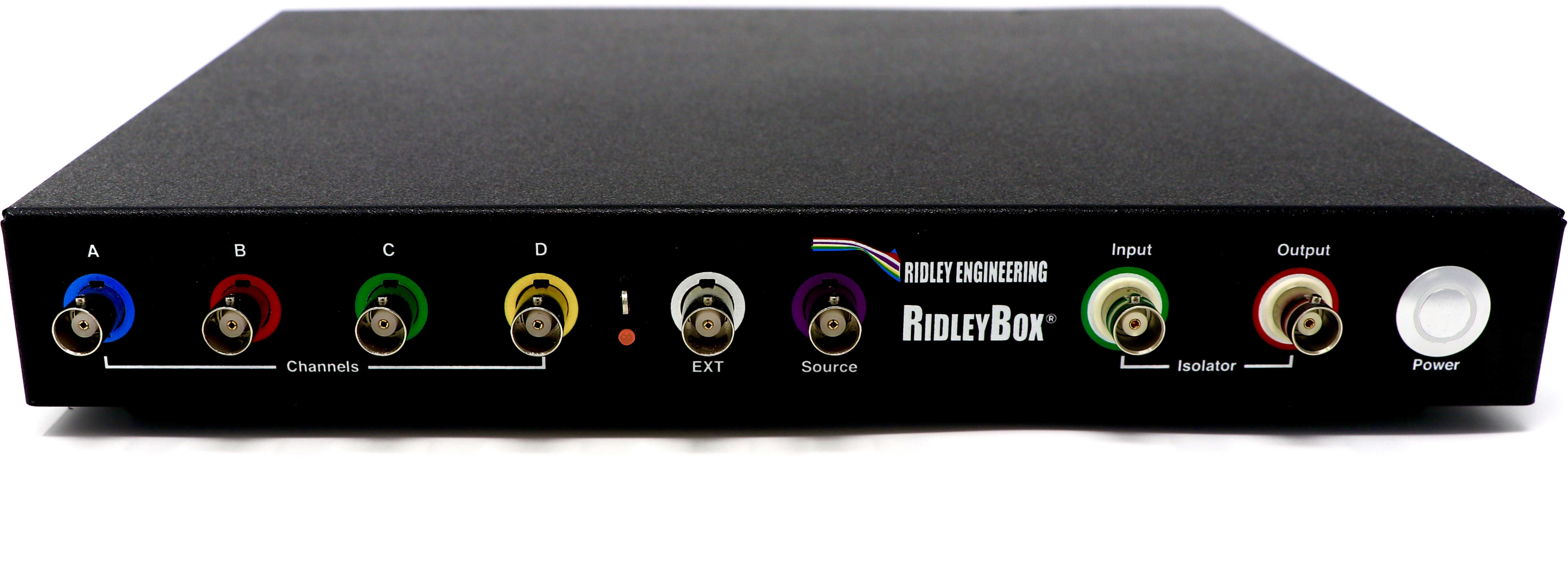
That is specialized machinery for people who distrust vague answers. A power-supply designer wants to know what the loop will do, where the noise lives, and whether the device on the bench will behave outside a demonstration. Ridley absorbed the temperament along with the technology. His current language about marketing is full of inputs, constraints, failure modes, feedback loops, signals, and instrumentation. The vocabulary did not come from a brand workshop.
“The market isn't judging your product. It's judging what it can understand about your product.”Brandon Ridley
A technical education in two languages
In the middle of his Ridley Engineering years, Ridley studied Computing and Systems Development at Oxford Brookes University. He describes the qualification as equivalent to a US associate degree in computer science, with work in programming, networking, database design, and security analysis. He also ran track and field. The international chapter fits another part of his present pitch: he is a UK citizen, based in Long Beach, and bilingual in English and French.
By 2016 he was also running marketing work through Ridley Solutions. The assignments included websites, e-commerce, user interfaces, data analysis, and B2B and consumer campaigns. The overlap lasted five years. Engineer and marketer appeared on the same résumé at once, as if Ridley were reluctant to surrender either side of the bench.
His full crossing came at industrial scale. As marketing director for Plastpro and JM Eagle from 2022 to 2024, Ridley had to explain products that move through dealers, distributors, and contractors. The buyer may never visit the manufacturer's website. Every intermediary creates another chance for a technical distinction to dissolve into mush.
Ridley's answer was to package specification-level differences so the dealer network could repeat them accurately. He built a target set of more than 2,000 companies for the sales organization and directed the JM Eagle LA Championship program, an LPGA event. The golf sponsorship could easily have become expensive scenery. He treated it as a commercial system, connecting hospitality and follow-up to named relationships. His résumé says the role also involved more than $12 million in budgets and six commercials that ran on Golf Channel.
The booth belongs in the middle
Motivo brought Ridley back into rooms full of engineers. The Southern California product-development firm works across mechanical, electrical, software, controls, fabrication, and manufacturing problems for robotics, aerospace, maritime, and mobility clients. Its technical range was broad. Its new-business engine was narrow: founder networks and referrals.
Ridley built the missing operating layer. Each of four verticals received a named-account plan and company-specific engagement approach. An automated workflow watched for funding, hiring, product news, and conference activity, then sent promising signals into a prioritized outbound queue. CRM reporting tracked influence on opportunities. Business development gained a memory.
funding · hiring · news
outbound queue
and meeting
and next action
Trade shows became sequences rather than isolated dates on a calendar. For Robotics Summit, ACT Expo, VFS Forum, and SEMA, the team identified accounts and made contact before anyone arrived. Meetings were booked in advance. Follow-up had a structure after the crates went home. The booth sat in the middle of the process, where it belonged.
Ridley's retrospective is refreshingly specific about what he got wrong. He says signal monitoring should have started in month one, before the account plans, because the triggers became the best input for choosing accounts. He would also have built a content engine earlier. Engineers responded better when outreach carried a useful technical artifact, yet those pieces were being made by hand and arriving late. There is more character in a precise correction than in a dozen claims of flawless execution.
For Ridley, a conference booth is neither the beginning nor the end. It is the physical midpoint of research, outreach, meetings, follow-up, and recorded learning.
A consultant plans his own disappearance
In the summer of 2026, Ridley left Motivo and introduced The Marketizer. The company targets Series A and B businesses in robotics, aerospace, automotive, mobility, advanced manufacturing, and power electronics. The central promise is not a grand transformation. It is a boundary: six months.
Clients enter through one of three tracks. Ridley can lead a team already in place, build a marketing function from zero, or run an outsourced function with a route to bringing it inside. Month one begins with a diagnostic across twelve areas. Month six ends with documented systems, a job specification for the person who might replace him, and a 30-day handoff plan. The client can renew, change tracks, or leave with the machinery running.
“I write the plan and then I do the work while documenting it so you can eventually run it without me.”Brandon Ridley
The proposition borrows a little theatre from consumer branding, but its mechanics are sober. Agencies are often paid to keep executing. Advisers often deliver a deck and depend on somebody else to perform it. Ridley places himself between the two: a senior operator who writes the plan, does the work, and records how the work is done. His preferred proof is a system that survives his departure.
The six-month limit also turns a soft service into a sequence of visible obligations. Diagnosis comes before activity. Ownership has to be named. Measures need a baseline. The eventual operator needs to be hired or promoted with enough time to learn the system. An exit date makes documentation urgent; folklore will not survive a handoff. It is the consulting equivalent of designing a product that another technician must be able to repair.
Ridley is especially alert to a common early-stage arrangement: a hardware company hires another engineer because the product remains the hardest problem, while marketing is left to everybody and therefore owned by nobody. The founder describes the vision to investors. Sales edits the story around the last promising conversation. Engineering preserves the qualifications and caveats. Soon the website, deck, and demo sound as though they represent neighboring companies.
His remedy begins with coherence rather than volume. Before buying more attention, the organization decides which customer problem it can own, which evidence earns belief, and which words survive a journey through procurement. Only then do conferences, outbound messages, articles, and account research become parts of one machine. A clearer sentence may look trivial beside a working robot. In the buying process, it can be the component that allows every other component to be seen.
He has even chosen Ridley Engineering as a live demonstration. Rather than invent a polished fractional-CMO case study, he is publishing an engagement log for the company where he grew up. The promised entries include starting traffic, search visibility, list size, workshop registrations, launch results, and the systems behind them. The choice is personal and slightly dangerous in the productive sense. Family businesses remember every boast.
The machine must survive the room
Ridley's recent notes from the Robotics Summit reveal what still catches his attention. He came away thinking about robots negotiating elevators, cable harnesses, manufacturability, thermal performance, and power. Artificial intelligence drew the crowd, but the harder threshold was whether hardware could survive contact with the real world. A dazzling demonstration is a beginning. Reliability makes it a product.
His marketing diagnosis follows the same pattern. Technical companies often have three stories. The founder has the version that raised capital. Sales has the version shaped by the latest prospect. Engineering has the most accurate version and frequently the least portable. All three may contain truth, but nobody has decided which truth the buyer can carry.
That gap explains the odd coherence of Ridley's career. A test instrument makes invisible system behavior legible. A good go-to-market function does something similar for a company. It detects signals, records response, and reveals where the story fails under load. The work is less about decorating complexity than preserving its useful parts while removing needless friction.
Ridley began with hardware that talks back. He now works with organizations that often do not. His wager is that marketing can be made observable enough to improve and orderly enough to transfer. If the experiment succeeds, the final evidence will be his absence - and a system still doing its job.