Before there were nearly $2 billion of borrowings to remove from a balance sheet, there was a Christmas tree to choose with his mother. Brad Weston remembered that childhood ritual years later, while running a company that sold the ingredients of other people’s celebrations. Selecting the tree. Decorating it. The pleasure was in the preparation as much as the day itself.
In December 2021, he described a household unusually well prepared for the season: tree up, decorations finished, Christmas shopping done. His favorite holiday activities included cooking and relaxing with his wife and dogs. Anyone who has watched December approach with an untouched shopping list may regard this as an executive achievement in its own right.
The detail matters because Weston’s working life can otherwise disappear into titles. Chief merchant. President. Chief executive. Board director. His employers have sold clothing, sporting goods, pet supplies, party decorations and home furnishings. Behind that assortment sits a fairly recognizable customer, trying to make an ordinary life a little more enjoyable without making the shopping unnecessarily difficult.
By 2026, the same career had taken him through two corporate restructurings and a retirement announcement at At Home. The route between that childhood tree and those boardroom decisions is a story about the changing job of an American retailer. Knowing what belongs on the shelf gets you a long way. Eventually, the obligations behind the shelf demand attention too.
A trainee learns to read the floor
Weston studied business administration at the University of California, Berkeley, with an emphasis on finance and marketing. His early career began in an executive training program at Robinsons-May in Los Angeles. He worked upward through the department-store organization, eventually becoming a senior vice president and general merchandise manager.
Those titles describe a particular apprenticeship. Merchandise has to appeal to someone, arrive in the right quantity and earn its place on the floor. The attractive item and the profitable item must somehow become the same item. Finance and marketing, his academic interests, meet rather literally at the price ticket.
His department-store career also included May Merchandising Company in St. Louis. He moved to Dick’s Sporting Goods in 2006, spending five years there and becoming chief merchandising officer. His remit extended across Dick’s, Golf Galaxy and the company’s online business. Physical shops and a website were already parts of the same assignment.
The sequence is useful. Weston did not arrive in the chief executive’s office from a distant specialty and discover retail upon opening the door. He came through the merchant organization. Buying, assortment, inventory and presentation were the work before they became lines in a corporate biography. That background would travel with him even when the merchandise changed beyond recognition.
- 1988Department storesThe training ground
- 2006Dick’s Sporting GoodsA different kind of equipment
- 2011PetcoChief merchant to CEO
- 2019Party CityThe business of occasions
- 2024At HomeAnother room to understand
Two dogs, several ways to shop
Petco hired Weston in 2011 as executive vice president and chief merchandising officer. The responsibilities were broad: buying and sourcing, planning and inventory, private brands, store design, marketing and e-commerce. A product’s route from supplier to shopping basket belonged within the same field of vision.
In 2014, he also became president of Unleashed by Petco, the company’s smaller-store concept. A year later, he became Petco’s president. The succession plan announced in September 2016 named him to follow Jim Myers as chief executive on February 1, 2017. It was a progression through the business rather than an abrupt arrival at its top.
There was also a customer’s familiarity with the category. In 2016, Weston owned two French bulldogs. A Petco publicity photograph put him on a staircase with two dogs, one settled on his lap and the other in front of him. For once, an executive photograph contained colleagues quite uninterested in the organizational chart.
His Petco years included work on new store formats, private brands and connecting digital shopping with stores. In San Antonio in 2016, he discussed a program of remodeled locations and new openings. The customer might encounter the business through a neighborhood shop or a screen; both required merchandise and a reason to return. Weston remained at Petco until 2018, having moved from choosing the offer to directing the company.
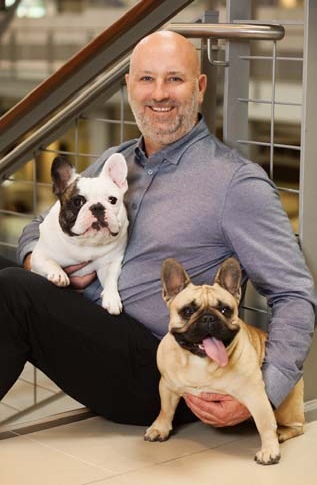
Weston in a Petco-era publicity photograph.
Photograph: Petco, 2016.
Making a celebration easier to buy
Party City brought Weston in during July 2019 as president of the holding company and chief executive of its retail group. James Harrison remained the parent company’s CEO. The distinction mattered: Party City combined manufacturing and wholesale operations with the shops where customers bought balloons, costumes and tableware.
On April 1, 2020, Weston became chief executive of the whole company. A business organized around occasions now had a merchant in charge of its broader machinery. Its promise, “Make Joy Easy,” was pleasantly brief. Delivering it involved a less brief list of decisions about inventory, channels and the experience inside a store.
Consider the Halloween assortment he discussed in late 2021: more than 500 costumes, alongside accessories, outdoor decorations and party kits. He credited advance planning with keeping stores stocked despite supply-chain disruption. The preparation behind a seasonal display begins long before a customer starts wondering whether last year’s costume still fits.
In September 2022, Party City published its first environmental, social and governance report. Weston connected the company’s celebration business with waste, recycling, energy and the treatment of employees. A retailer selling disposable party supplies had practical questions to address about the afterlife of the party. His stated ambition extended to helping customers celebrate more sustainably, although the report marked the beginning of that work.
The open-door policy, in plain clothes
Weston’s account of leadership was considerably less elaborate than the assortment. In January 2022, he singled out employee recognition, empathy and approachability. He encouraged leaders to acknowledge small accomplishments, consider the pressures faced by colleagues in different jobs, and make themselves available to people throughout the organization.
“Talk less and listen more to the people around you,” he wrote. The practical examples were modest: step outside the office, ask about someone’s weekend, attend a company gathering, send a message. They describe accessibility as a habit a manager can practice, rather than a quality to announce in a speech.
There is a merchant’s logic here, too. A store manager sees inconveniences that an executive presentation may tidy away. A suggestion from someone close to the customer can change a decision made far above them. Listening creates a route for that information to travel. Whether every employee experienced the ideal is a separate question from what Weston advocated.
The humane part of his public writing sits alongside the operational part. He wrote about enjoying the success of people he led, both personally and professionally. It is an aspiration with a useful scale: the team member, the conversation, the completed project. Corporate leadership is often photographed at a podium. Much of the work he described would happen without one.
“Talk less and listen more to the people around you.”
Brad Weston · January 2022
When the balance sheet takes the floor
In January 2023, Party City filed for Chapter 11 protection. The company completed its restructuring that October, removing nearly $1 billion in debt, negotiating leases and exiting less productive stores. It emerged with nearly 800 Party City locations. Weston announced he would step down on November 3, with president and chief commercial officer Sean Thompson becoming interim CEO.
That outcome deserves its proper boundaries. Restructuring created financial breathing room and kept a substantial store network operating. It did not settle the company’s future. Party City returned to Chapter 11 in December 2024 to wind down its business, more than a year after Weston’s departure. The dates distinguish the restructuring he led from the later collapse.
At Home appointed him in May 2024, effective June 3. The Dallas-based chain then described an offering of up to 45,000 products across 266 stores in 40 states. Rugs, mirrors, furniture, housewares and seasonal decorations supplied another version of a familiar assignment: make a large assortment feel useful to someone with a particular project and budget.
The assignment changed sharply. At Home filed for Chapter 11 in June 2025. On October 24, it emerged after eliminating substantially all of nearly $2 billion in funded debt and securing $500 million in exit financing. Ownership moved to a group of lenders. These were company-wide outcomes involving employees, financial stakeholders and advisers; they belong in the record alongside Weston’s role as CEO.
The two episodes expose the distance between merchandising and corporate survival. A persuasive display cannot renegotiate a lease. A cleaner balance sheet cannot choose a cushion for a customer. Weston’s later career placed those different demands inside one job. The stores needed a reason for shoppers to visit while the company needed the financial room to keep serving them.
PARTY CITY
AT HOME
The next person gets the keys
On May 15, 2026, At Home announced that Weston had decided to retire as CEO, planning to remain through the end of June before moving into an advisory role. Aaron Rose was promoted to president and chief commercial officer. The board began searching for the next chief executive. The announcement described a retailer operating 229 stores in 39 states.
Weston’s board work supplies another thread through the changing executive roles. He joined Boot Barn’s board in 2018. He also served on Vera Bradley’s board during 2024 and previously on the National Retail Federation’s board. The products differ again, but the questions about customers, merchandise and running stores remain familiar.
There is no neat victory parade through this career. The merchant’s apprenticeship led to expansion, new formats and digital shopping, and eventually to creditors, store portfolios and succession. Growth announcements and restructuring announcements both belong to the same working life. Leaving either out would make the story easier and less useful.
Return instead to the Christmas tree. Choosing it with his mother was a small act of anticipation: an object bought for the experience it would help create. Years later, Weston still wrote about that memory. Across the stores he ran, the goods changed. The shopper’s hope that a purchase might make a day, a gathering or a room feel better remained an intelligible place to begin.