A cup of pool water is an odd thing to take shopping. It has no brand, no barcode and, to the untrained eye, very little information. At Leslie’s, it becomes a report. A machine analyzes the sample. A treatment plan identifies what needs adjusting. The shelves hold products that can make those adjustments. The customer arrived with a question and can leave with an answer in a bucket.
- The hook: free water testing turns uncertainty into a treatment plan.
- The business: recurring chemicals, equipment, parts and services, sold in stores and online.
- The reckoning: falling sales preceded a September 2026 Chapter 11 filing.
That little exchange explains much of Leslie’s appeal. Pool ownership comes with decisions people would rather settle quickly. The retailer supplies both the goods and the explanation. Yet its current predicament exposes a limit: knowing what the customer needs does not settle what the customer will pay.
A sample becomes a shopping list
Phil Leslie Jr. founded the business in Southern California in 1963. By April 2023, Leslie’s was celebrating its thousandth store, in North Port, Florida, and more than 50 million cumulative water tests. Its useful ritual had traveled a long way from one Los Angeles location.
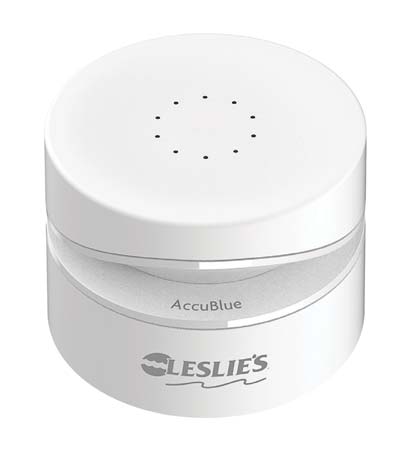
The modern version is AccuBlue. Leslie’s advertises a free, 10-point in-store analysis in 60 seconds, followed by a water-health score and treatment recommendations. Its explanation is specific: light measures chemical reactions in the sample, while additional in-store measurements help complete the picture. The results make a complicated purchase easier to discuss.
The range extends well beyond chlorine. There are pumps, filters, heaters, automatic cleaners, replacement parts, covers and poolside accessories. Customers include household owners, pool professionals and commercial property operators. Technicians install and repair equipment; seasonal services and weekly maintenance depend on location. The service menu explicitly excludes hot-tub servicing, underground leak detection and vinyl-liner replacement.
Against a general retailer or a bare online listing, the distinction is the connection between advice, available stock and practical help. An independent pool shop can offer similar intimacy. Professional distributors serve another overlapping audience. Leslie’s attempts to combine specialist attention with a national store-and-digital network. That combination takes staff knowledge, inventory and a reason to make the trip.
The human part needs maintenance too. In a September 2026 company update, Leslie’s reported more than 3,200 team members participating in 56 virtual summer training sessions. Further sessions with Hayward and Raypak covered winterization and equipment. Those are company-reported participation figures, but they reveal the work involved: someone at the counter must understand the recommendation well enough to explain it. A test result alone cannot answer every question about a particular backyard.
The counter moves to the kitchen
AccuBlue Home takes the same commercial logic into the house. The current membership program launched commercially in May 2023, following earlier trials. Fill a test disk, put it in the device and start the test through the smartphone app. Results become a customized treatment plan; recommended products can then be ordered for delivery or pickup.

The advertised price is $50 a month, with $50 in merchandise credit each month. For someone already buying that much from Leslie’s, the arrangement can make sense: planned shopping helps pay for testing convenience. For the retailer, it creates a recurring commitment before the next pool problem appears.
$50 in monthly merchandise credit.
Replacement disks purchased separately.
But credit is useful only if you want the merchandise. Twelve uninterrupted monthly payments total $600. Credits expire after a year. Five single-use test disks come initially; replacements cost extra. The listed five-pack was $10.99 when checked in October 2026. Cancellation requires returning the device. Those details make the offer easier to evaluate than the claim that it pays for itself.
This also remains a task, rather than invisible automation. Someone collects the water and fills the disk. The resource center cautions that sample age, temperature and collection timing can affect comparisons. Owners content with conventional test kits, or spending little at Leslie’s, may find less reason to subscribe.
The pool kept needing chlorine
The company’s financial history supplies the uncomfortable part. A group led by L Catterton, with GIC investing alongside it, agreed to acquire Leslie’s in 2017. The 2020 IPO priced 40 million shares at $17, a $680 million gross offering. Some shares belonged to an existing holder; Leslie’s expected approximately $465 million in net proceeds, principally for debt repayment.
Then sales contracted. Revenue fell from $1.451 billion in fiscal 2023 to $1.330 billion in 2024 and $1.242 billion in 2025. The 2025 filing attributed that year’s decline primarily to reduced traffic and fewer transactions. The recurring need for pool supplies had survived. The customer’s shopping habit was less dependable.
Management’s response made pricing central. In February 2026 it announced a shift toward value pricing, supported by the campaign “New Low Prices, Same Great Quality.” Expertise would still help build the basket. Lower prices were supposed to help bring people back to it.
By August, third-quarter sales were down 8.4% from a year earlier, and Leslie’s withdrew its full-year outlook. Eighty stores and one distribution center had closed earlier in fiscal 2026. The company reported $8.3 million of related year-to-date non-cash impairment. A useful customer service had not insulated the wider business from financial strain.
For a specialist, this is an awkward bargain. Advice costs money to provide, while a chemical’s price is easy to compare. The diagnosis has to create enough convenience and confidence to justify the complete purchase. When traffic falls, the stores still carry the cost of being ready with an answer.
An answer worth coming back for
On September 30, Leslie’s filed for Chapter 11. Its lender-supported proposal targeted roughly $685 million of funded-debt reduction, alongside commitments for $90 million in new-money bankruptcy financing and $60 million in equity financing. It separately announced 76 store closures. These were restructuring terms and plans, with an early-2027 emergence goal, rather than a completed recovery.
“Leslie’s is here to stay”
Jason McDonell, CEO / September 30, 2026
For customers, the company says remaining stores and digital channels continue operating, with gift cards and loyalty benefits honored. Check the locator before making a journey. The practical lesson for other retailers is portable: give customers a useful diagnosis before asking for their money. Then make the remedy worth buying from you. The water test can earn attention. The whole transaction has to earn the return visit.