The commercials arrived late. People making their own Doritos advertisements were reluctant to surrender their ideas before the deadline, and Jason McDonell was left watching an experiment approach its moment of truth. A snack brand had offered ordinary people a chance to get their work onto the Super Bowl. The invitation was wonderfully simple. Receiving everything in time was another matter.
“The last 12 hours were a bit unnerving,” he recalled years later. McDonell had been an early advocate of the project while overseeing Doritos marketing in 2006. The first winning commercial, “Live the Flavor,” finished fourth in the USA Today Ad Meter. An anxious wait became an argument for doing it again.
Almost two decades later, McDonell has a different audience to persuade. He became chief executive of Leslie’s in September 2024. On September 30, 2026, the pool and spa retailer announced a prearranged Chapter 11 restructuring. The executive associated with inviting customers into advertising now has the less photogenic job of keeping them shopping through a corporate reorganization.
The shop floor came first
Retail entered his life in Chatham, Ontario, through two local grocery stores and his family’s furniture business. He worked on the sales floor and learned about warehouse operations while watching his parents market their business. Long before national campaigns, there were goods to move and people to serve.
The furniture connection gives his subsequent career a useful point of reference. A shop has several versions of reality: what the customer sees, what the warehouse holds, and what the business can afford. McDonell’s later roles would carry him through marketing, sales and operations, across the boundaries separating those views.
He graduated from Wilfrid Laurier University in 1996 with a business degree and began in brand management at Procter & Gamble. PepsiCo followed. His early brand assignments included Lay’s, Doritos and Cheetos; his work also included developing Munchies Snack Mix. It is an unusually edible entry on an executive résumé.
There is a practical distinction between inventing something customers might buy and delivering it through a retailer. His PepsiCo career eventually gave him responsibility for both sides. That breadth matters when considering his move into specialist retail, where an appealing promise has to survive an encounter with the shelf.
Giving the audience the expensive slot
“Crash the Super Bowl” asked consumers to make Doritos commercials, with the possibility of seeing them broadcast during the game. More than 1,000 entries arrived for the initial contest. Five finalists were selected, and people viewed and voted for their favorites online. Advertising had acquired an audition room.
Speaking at OMMA Hollywood in 2007, McDonell described consumers interested in self-expression, independence and belonging. He spoke about “building a relationship with consumers.” The contest gave those ambitions a concrete form: someone outside the professional advertising establishment could earn a place on its conspicuous stage.
“An ad campaign is timely, whereas a brand campaign is timeless.”
Jason McDonell, OMMA Hollywood, 2007
At that same gathering, he discussed extending consumer participation into names and flavors. The commercial could start a relationship that continued after the game. It was a broader ambition than producing a single entertaining interruption between plays.
He also showed footage of the finalists watching the game in a bar, waiting to discover whose work would air. The winners erupted in celebration. It was an advertising presentation with the emotional machinery of a talent contest: suspense, recognition and a roomful of people whose evening had suddenly changed.
The campaign grew into a ten-year global program. McDonell’s role belongs within a team effort, with filmmakers, colleagues and agency partners all part of the story. Its relevance to his career is nevertheless clear. He had helped run a marketing experiment in which customers supplied something a conventional campaign would have commissioned from professionals.
A return ticket to Canada
At Frito-Lay in the United States, McDonell moved from marketing into customer strategy and then a broader PepsiCo sales assignment serving Safeway. These jobs took him closer to retail channels, accounts and the commercial arrangements behind the products on display.
He returned to Canada as PepsiCo Foods Canada’s chief marketing officer in 2011, moved into an Ontario field-sales assignment in 2013, and became president and general manager in 2015. By the end of his PepsiCo tenure, he was responsible for a $2.5 billion business encompassing Frito-Lay and Quaker. He spent 21 years at the company.
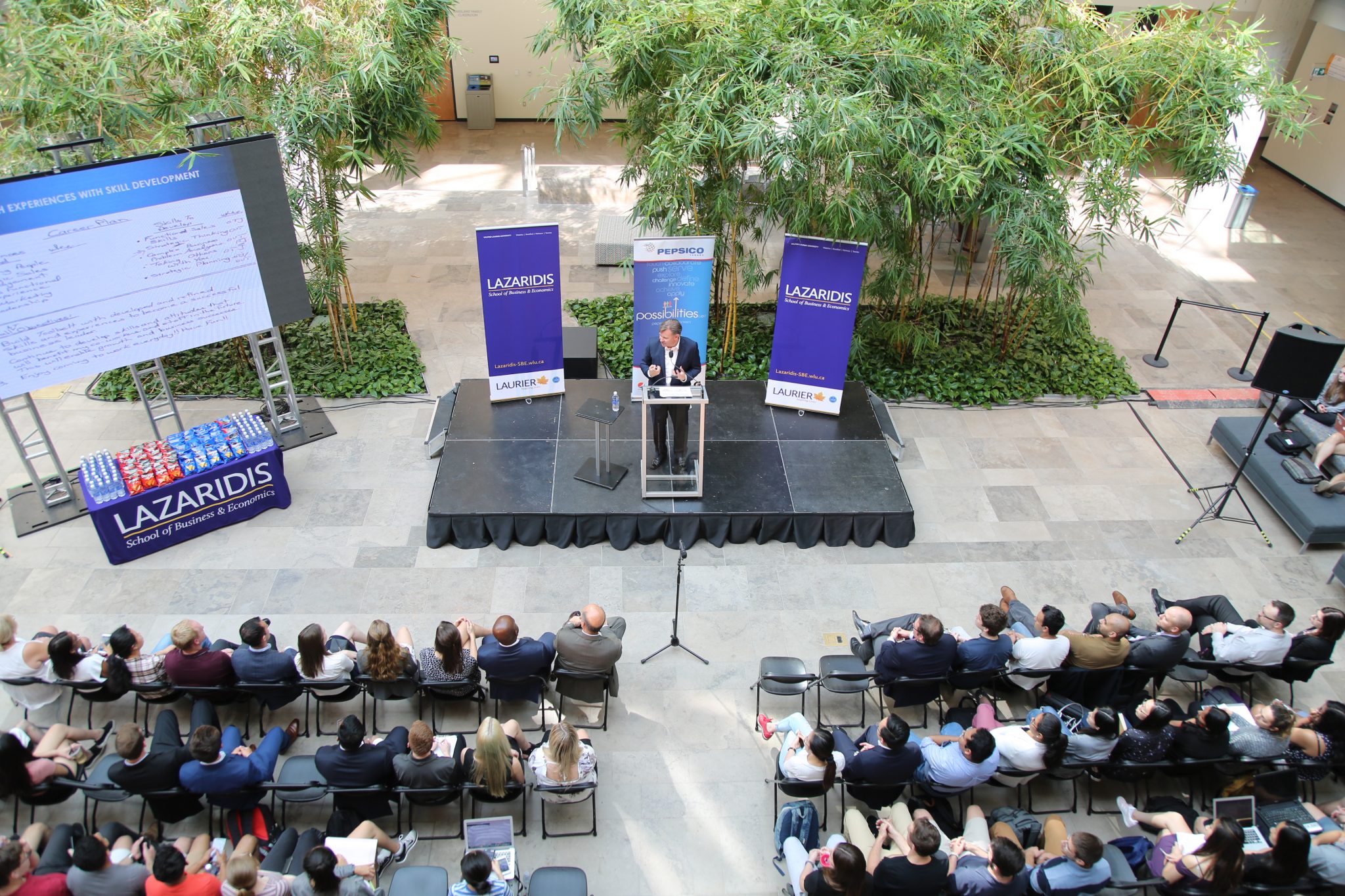
His relationship with Laurier continued after graduation. In September 2017, he returned to speak to students in the Lazaridis Hall atrium, sharing stories from university and PepsiCo before taking questions. He served as the Lazaridis School’s CEO in Residence for 2017/18 and received its J. Alex Murray Award in 2018.
The campus photograph catches an executive in a particularly ordinary act: standing at a lectern, addressing people at an earlier stage of their careers. It supplies a quieter counterpart to the Super Bowl episode. One audience wanted its commercial on television; another was working out what to do after university.
From snack bags to spare parts
Advance Auto Parts appointed him executive vice president and chief marketing officer effective July 29, 2019. The assignment covered marketing across Advance, Carquest, Worldpac and Autopart International. He joined under chief executive Tom Greco, moving from packaged food into a business serving professional installers and people repairing their own vehicles.
His responsibilities expanded in March 2021 to include merchandising and sourcing alongside marketing and e-commerce. This brought the selection and procurement of merchandise into the same brief as the messages encouraging customers to buy it. The connection between promise and availability became part of his formal job description.
His Advance work included the DieHard relaunch and the introduction of Advance Same Day. He also represented the company in its racing relationships. At the 2022 NASCAR Awards, he spoke about short-track racing as Advance received the Marketing Achievement Award. National exposure and local enthusiast communities shared space in the same marketing brief.
A smaller example explains the commercial logic. In January 2022, Advance introduced fuel savings at participating Shell stations through its Speed Perks program. McDonell said members had requested that benefit. Loyalty, in this instance, involved a useful discount on the next tank of gas. Customers had suggested something specific, and the retailer had acted on it.
The customer has another shop
Leslie’s appointed McDonell in August 2024, with his start and board membership effective September 9. Chairman John Strain served as interim CEO until he arrived. The appointment brought together a consumer-brand background and experience managing the machinery of a specialist retailer.
His early public posts included visits to Leslie’s teams in the Boston and New Hampshire market and in Fort Myers, Florida. He emphasized feedback and the ideas of frontline employees. Those visits placed him near the people handling the daily consequences of decisions made elsewhere in the company.
By fiscal 2026, the questions included what customers would pay and whether they would return. In February, McDonell explained that Leslie’s had tested different price points, bundles and offers across markets. The company was lowering regular prices on important items and moving toward more consistent competitive pricing.
The logic was straightforward, though the execution carried costs. Lower prices could improve the reason to visit, while reducing what the business collected on each purchase. Closing weak stores could save money while making another location less convenient. Each decision affected the next. A customer relationship had become a series of operational trade-offs.
An editorial view of the connected demands in McDonell’s retail brief.
A few good numbers, then a harder turn
The second quarter offered encouragement. For the period ended April 4, 2026, sales rose 4.3% to $184.7 million and comparable sales increased 6.6%. McDonell pointed to pricing, targeted marketing and the consultative approach in stores. The company still recorded a net loss of $52.5 million. Progress on customer response and financial recovery were moving on different clocks.
The third quarter was more difficult. Sales fell 8.4% to $458.5 million, and comparable sales declined 6.2%. In August, Leslie’s withdrew its full-year outlook and disclosed that it was exploring strategic alternatives with financial stakeholders. McDonell’s assignment now explicitly included finding greater financial flexibility.
Separate quarterly comparisons with the prior year; bars show magnitude. The improvement did not hold through the following quarter.
On September 30, Leslie’s announced its restructuring agreement and Chapter 11 process. The plan sought to eliminate approximately 90% of debt and secure $150 million of new capital. It also announced 76 store closures, while saying remaining stores and digital operations would continue serving customers. The stated goal was emergence in early 2027.
Those were plans and commitments, with their outcome still ahead as of October 22, 2026. They put a different weight on McDonell’s longstanding interest in customer relationships. A successful promotion can attract attention quickly. Reassuring shoppers, retaining employees and rebuilding the finances of a retailer require the promise to hold through many ordinary transactions.
Back at the counter
There is a line connecting the family furniture business, the Doritos competition, the fuel-rewards benefit and the pool-supply counter. In each setting, the customer has a choice about participating. McDonell’s career has repeatedly placed him in charge of making that choice more appealing.
The scale and the stakes have changed. At Doritos, people competed for the privilege of making the advertisement. At Leslie’s, the work is to give them sufficient reason to make the next purchase. His next chapter will be judged in the accumulated detail of those decisions: a competitive price, a stocked shelf, a helpful conversation, and someone coming back.
Follow the next chapter
Jason McDonell on LinkedIn ↗Leslie’s: products and pool care ↗The September 2026 restructuring announcement ↗Watch: McDonell talks short-track racing ↗His return to Laurier ↗Inside the Doritos advertising experiment ↗Profile updated October 22, 2026. Financial comparisons use Leslie’s fiscal quarters. Restructuring objectives describe the announced plan.