In 2024, Macy's had an awkward piece of arithmetic to confront. The roughly 150 stores it had identified for closure occupied about 25 percent of the company's gross square footage, yet generated less than 10 percent of net sales in 2023. Imagine paying to light, clean and stock all that space. Somewhere between the escalator and the cash register, the department store's promise of abundance had become an expensive habit.
- The problem: too much space doing too little business.
- The experiment: improve selected stores, then expand what customers respond to.
- The stakes: make the shopping trip useful enough to earn another one.
The trouble with all that space
Tony Spring, who became chief executive in February 2024, called the response A Bold New Chapter. The plan paired exits from underproductive locations with investment in roughly 350 retained Macy's stores, alongside growth at the parent's luxury businesses. Its announcement said comprehensive customer research informed the strategy. The practical question was where a department store still earned its keep.
That distinction matters because Macy's had already tried pruning. Its 2020 Polaris program proposed approximately 125 closures, a smaller corporate organization and investment in healthier stores. Four years later, another closure plan showed that the estate still needed work. It does not prove every earlier initiative failed. It does make a celebratory ribbon-cutting an inadequate measure of success.
The new approach started with the First 50: a selected group receiving changes in staffing, merchandising, presentation and events. By the third quarter of 2024, those locations reported 1.9 percent comparable sales growth while the Macy's nameplate's owned-plus-licensed-plus-marketplace measure fell 2.2 percent. The contrast gave management evidence to keep expanding. It was encouraging, although a selected group is not a randomized experiment.
A store that learned to stage a show
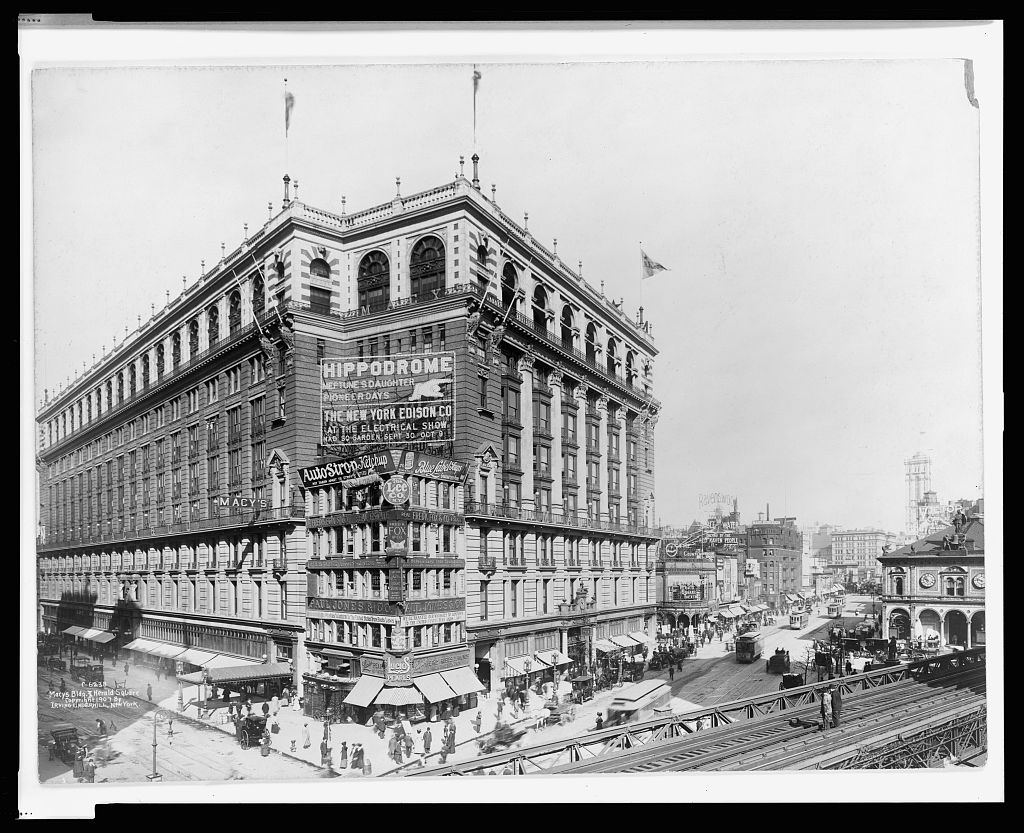
Rowland Hussey Macy opened his New York dry-goods shop in 1858 at 14th Street and Sixth Avenue. Herald Square came later, in 1902. The distinction is pleasing: a company so associated with one enormous building began somewhere else, on a much smaller scale.
In 1924, employees helped launch what was originally the Macy's Christmas Parade. The procession included live animals from the Central Park Zoo. Balloons arrived in 1927. A retailer had found a way to become part of the calendar, giving families a reason to think about its name before they thought about a particular purchase.
That history explains something a price comparison misses. Macy's competes for the occasion: the wedding outfit, the new home, the holiday present. Spectacle supplies recognition. The store must supply the rest. A balloon cannot locate your size.
One basket, several businesses
Today's Macy's sells clothing, shoes, jewelry, beauty, furniture and home goods through stores, its website and app. National brands share space with exclusive labels such as On 34th and Charter Club. Its customers include families, occasion shoppers and tourists; the attraction is assembling several decisions in one place.
A shopper can book a free personal stylist, with no minimum purchase, online or in person. A couple can create a gift registry and get help from a consultant. These services tackle an ordinary problem: having plenty of choice does not mean knowing what to choose. For the retailer, guidance can help turn browsing into a sale.
Competition arrives from several directions. Nordstrom, Dillard's and Kohl's offer department-store alternatives. Amazon competes for convenience; off-price chains compete for bargains; beauty specialists compete for expertise. Macy's proposition depends on making its particular combination of selection, value and human help worth choosing.
It also borrows expertise. The WHP Global partnership brought Toys R Us online in 2021 and into Macy's stores in 2022, complete with demonstration tables and Geoffrey the Giraffe. The attraction is understandable: parents recognize the name, children can try things, and a department store gains another destination inside its walls.
The digital version works differently. Macy's launched its Mirakl-powered marketplace in 2022 with more than 20 categories and 400 new brands. Selected outside merchants expand the assortment without requiring equivalent new selling space. Behind the basket sit several income streams: merchandise margins, licensed and marketplace commissions, credit-card net revenue, and advertising through Macy's Media Network.
The price of paying attention
The bills are substantial. In fiscal 2025, Macy's, Inc. spent $373 million on property and equipment and capitalized $367 million of software: $740 million combined. That is companywide investment, including Bloomingdale's and Bluemercury, rather than a price tag for the store experiment. Salaries and other operating expenses sit elsewhere.
“We are making the necessary moves to reinvigorate relationships with our customers”Tony Spring / February 2024
There is also the sales relinquished when a store closes. Fiscal 2025 group net sales fell 2.4 percent to $21.8 billion, even as comparable sales rose 1.5 percent. Both can be true. A smaller operating base can improve while the company's overall merchandise sales shrink. Readers should keep both numbers in view.
By September 2026, the selected-store program had become Reimagine 200. In the second quarter, those stores grew comparable sales 1.9 percent; the Macy's nameplate grew 1.1 percent. Improvement had spread, though the closure timetable had also stretched to 2028. Neither result is a reason to declare the work finished.
Copy the experiment, then earn the expansion
For another business, the useful move is to separate the average from the promising. Find where customers still respond. Make a specific improvement, compare results and expand cautiously. Macy's published culture describes testing, iterating and scaling; the store program gives that language something measurable to answer to.
There are limits. Better service cannot rescue every weak location, and additional staff must generate enough value to justify their cost. Falling discretionary spending or higher merchandise costs can overwhelm local improvements. Customers may simply prefer a specialist. The next useful test for Macy's is whether better shopping becomes an everyday habit across more stores. The parade already has its audience.