The most revealing customer in BoxCast’s history was not a television station, a famous creator or a professional league. It was a funeral home. Around 2009, while Gordon Daily was helping rebuild the home’s website, its director asked for a way to broadcast memorial services to people who could not attend. Daily and his future co-founders, Justin Hartman and Ron Hopper, recoiled. Streaming a funeral sounded, in Daily’s later telling, creepy. Then they watched the idea do something humane: it let geography lose an argument with grief.
That change of mind became the company. The first assumption to fail was that live video belonged mainly to media professionals or cheerful public events. The funeral broadcast showed that the more specific, scheduled and emotionally important an event is, the less acceptable a missed start becomes. A city council cannot move Tuesday’s meeting because the encoder is sulking. A church volunteer cannot ask a congregation to come back after lunch. A school game does not pause while someone searches a forum for the correct bitrate.
BoxCast built for those rooms: places with a camera, an internet connection, a fixed calendar and no appetite for becoming a television network. Its business sits between free social streaming and a staffed broadcast truck. The company sells the missing operational layer - encoding, transport, transcoding, distribution, playback, storage and support - as one system.
Three automation engineers walk into a livestream
Daily and Hartman came from Rockwell Automation; Hopper had led the Cleveland software consultancy Adelphus Solutions. That background matters. Most consumer video products begin with the screen. Industrial automation begins with the process: What should happen, at what time, under which conditions, and what does the operator need to know when something goes wrong?
The founders worked on a pocket-sized encoder, filed patents in 2010 and sold the first branded BoxCaster to Case Western Reserve University in 2011. In 2013 they left their day jobs and launched BoxCast full time. The early product was not merely a smaller video box. Its appeal was that a customer could schedule a broadcast and let the system handle the repetitive choreography around it.
“It was really a tool to help connect people together in these very, very trying times.”Gordon Daily, on the original funeral-home use case
What failed next was the ordinary internet. Live video is ruthless about packet loss and fluctuating bandwidth, especially in sanctuaries, gyms and municipal buildings where the network was rarely designed around a production crew. In 2015, BoxCast introduced BoxCast Flow, its patented transport protocol. The company says Flow can maintain quality with less congestion and roughly a third of the bandwidth, adjusting the stream when conditions wobble. Standard streams carry about 30 seconds of latency, a conscious exchange: less immediacy than an interactive call, more room to deliver a stable public broadcast.
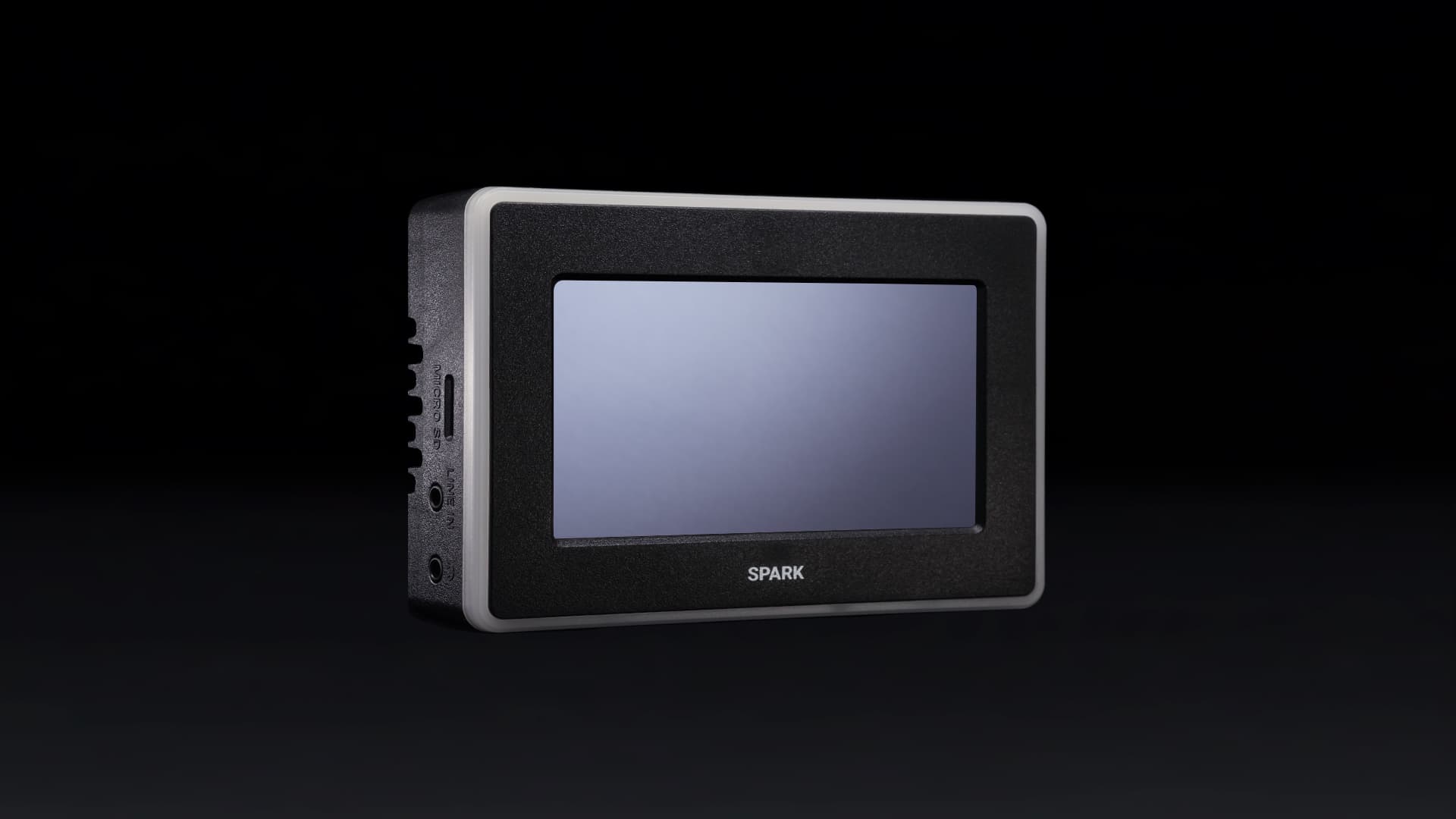
The box is only the front door
The current Spark encoder starts at $999 and requires a paid BoxCast plan. It accepts HDMI 2.0 or, in another model, up to 12G-SDI; encodes HEVC; previews the feed on a 4.3-inch touchscreen; tests network speed; records a local backup to microSD; and now streams up to 4K60. It has one video input, so a multi-camera production still needs a switcher upstream. At 4K60 it cannot stream and record locally at the same time. Those caveats are useful because they show the product’s actual job: take a finished feed and move it out reliably, not replace an entire control room.
One feed, five automated handoffs
Customers can skip the hardware. Producer turns a web browser and capture device into an encoder; Broadcaster sends video from an iPhone; OBS, vMix and other RTMP or SRT tools can feed the platform. Once inside, BoxCast schedules starts and stops, produces adaptive versions for viewers, sends the same event to a website and social platforms, adds captions, stores recordings, shows diagnostics and analytics, and supports ticketing. The promise is not a magic camera. It is fewer seams.
That platform has spread sideways. Sites is a no-code website builder. OTT Apps creates branded web, mobile, Apple TV and Roku destinations with subscriptions or pay-per-view. Sharing uses AI to suggest post-event clips and descriptions, while still letting an editor choose manually. Mixing Station Anywhere, introduced through a 2026 partnership, securely controls compatible digital mixers over the internet for $19 a month or $99 a year. A senior audio engineer can help several campuses without driving between them.
It sells insurance against the awkward silence
BoxCast’s public streaming prices begin at $109 a month when billed annually. Higher tiers are listed at $169, $249 and $449, with custom Premium plans above them. All carry annual commitments and at least 10,000 viewer hours a month. More expensive tiers add longer storage, 1080p60 or 4K60, concurrent events, white-labeling, live captions, stronger access controls and API features. OTT apps and ticketing can add more.
Public streaming tiers / monthly equivalent, billed annually
That is plainly more than pressing Live on YouTube. It is also the wrong comparison. BoxCast charges for the tasks surrounding YouTube: training an occasional operator, starting exactly on schedule, publishing to several destinations, keeping an archive, diagnosing failure, handling viewer formats and getting a human on support. Its economic buyer is often calculating the cost of a ruined service, meeting or game - plus the staff hours spent preventing one.
The model mixes recurring software revenue, one-time encoder sales and add-ons. Public company data places the team around 75 people. BoxCast has raised about $23.4 million, including a $250,000 JumpStart seed investment in 2013 and a $20 million Series A led by Updata Partners with Shure in December 2020. A supplied third-party estimate puts annual revenue around $10 million, though BoxCast does not publicly confirm it.
The niche was hiding in plain sight
Churches became BoxCast’s largest market because they combine every useful constraint: weekly recurrence, volunteer crews, emotionally invested viewers and buildings with unpredictable connectivity. But the same shape appears in school athletics, local government, nonprofits, conferences and company events. Case Western used the early system to show sports that could not justify conventional coverage. First Baptist Opelika uses the service across nine Sunday services. FILO delivered a conference to nearly 1,400 online attendees in 128 countries. KHM Travel Group uses live video to educate a network of more than 5,000 travel advisers.
The pandemic made that niche briefly look like the whole world. Daily says BoxCast viewership rose 20 times in a single month in 2020. Even with sporting events cancelled, News 5 Cleveland reported a five-to-twelvefold increase over normal viewing. The important change was not the spike; it was that engagement remained strong after in-person life returned. Streaming stopped being an emergency substitute and became the second door into the room.
BoxCast spent into that behavior. It bought worship specialist Sunday Streams in 2019, acquired Florida platform Stream Monkey in 2021 and partnered with governance-software company Diligent to power Video Manager HD for local governments. The acquisitions brought customers and capabilities into the same organizational-video thesis rather than chasing consumer entertainment.
What a builder can copy
Find the scary minute
BoxCast focused on the instant before a scheduled event begins. Automating a high-anxiety moment is often more valuable than adding ten pleasant features.
Design for the occasional operator
A weekly volunteer does not build muscle memory like a daily professional. Use schedules, status lights, defaults, diagnostics and reachable support to carry the missing expertise.
Own the handoffs
The defensible product is not just encoding. It is the path from camera to transport to player to archive to clip, with fewer vendors to blame in between.
There is a fourth lesson in the funeral-home story: take an odd request seriously enough to observe it in use. The founders’ first reaction was cultural, not technical. A successful broadcast changed the frame from “Why would anyone stream this?” to “Who is being excluded if we do not?” Good vertical software often begins when an edge case reveals a general job.
When the box does not fit
Good conditions
Recurring events, fixed start times, mixed-skill crews, multiple destinations, unreliable networks, compliance needs, valuable archives and a real cost of failure.
Look elsewhere
Occasional low-stakes streams, a solo expert happy in OBS, extremely tight budgets, or interactive events where sub-second latency matters more than broadcast resilience.
It also will not manufacture a good show. Spark takes one finished video feed. A multicamera event still needs cameras, switching, sensible lighting and competent audio upstream. Automation can begin the stream on time; it cannot make the sermon shorter or teach a scoreboard operator the rules. Teams with stable fiber, existing engineering staff and a carefully assembled cloud stack may reproduce much of the workflow for less marginal cost.
For everyone else, BoxCast’s position is unusually legible. Resi is the closest reliability-focused alternative in worship and organizational video. Vimeo, Dacast, StreamYard and Restream cover overlapping software ground. OBS, YouTube and Facebook can form a capable free or cheap stack. BoxCast differs by combining purpose-built hardware, patented transport, automation, support, organizational publishing, OTT distribution and now remote audio under one account.
The company’s expansion into AI clips and remote mixing could become sprawl if the pieces stop serving the same operator. So far, the thread holds. The person in the booth still has too many jobs. BoxCast keeps looking for one to remove.