A person with a library of films is not yet in the streaming business. First comes encoding. Then a player, a website, logins, subscriptions, tax, apps for phones and televisions, content protection, analytics, customer support and the small horror of learning that Samsung and LG do not run the same operating system. Muvi sells a way around that initiation ritual.
The company makes white-label streaming software. A broadcaster, educator, sports league, filmmaker or enterprise can upload video or audio, arrange it in a content-management system, choose how viewers pay and publish a branded service across web, mobile and connected televisions. The viewer sees the customer's name. Muvi is the machinery backstage, wearing black and trying not to appear in the shot.
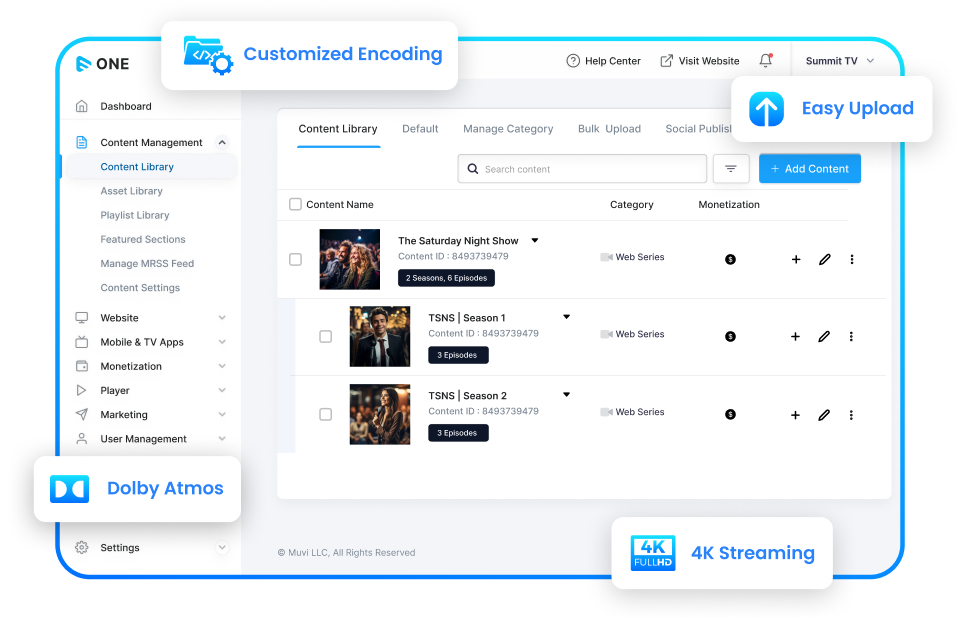
That invisibility is the product. Muvi One, the flagship, combines a CMS, hosting, apps, payments, subscriptions, advertising, pay-per-view, analytics, DRM and cloud delivery. Around it sits a shelf of narrower products: Live for events, Flex for hosting and secure sharing, Playout for scheduled linear and FAST channels, Player SDK for developers, TV for individual pay-per-view sales, Meet for branded calls, and TrueComply for AI-assisted video compliance.
The business is a bundle
Muvi's cleverest decision was not inventing video hosting. It was drawing a box around the whole job. A media founder can buy cloud storage from Amazon, a player from JW Player, video APIs from Mux, subscription software elsewhere, then commission Roku, iOS and smart-TV apps. Every component may be excellent. The founder still owns the seams.
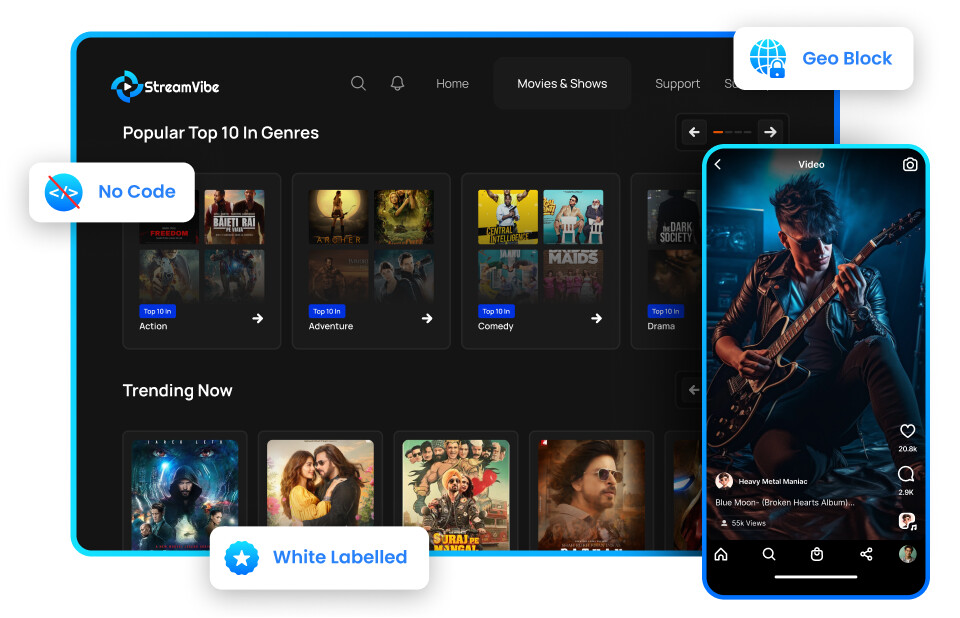
Muvi sells the seams too. Its dashboard is the operating desk; its templates and visual designer handle the storefront; its native apps carry the brand to more than 16 ecosystems. Subscription, transaction and advertising models can coexist. DRM, watermarking, geo-blocking and VPN detection guard the catalog. A built-in CDN moves it. For an organization whose advantage is content rather than code, that is a sensible exchange: recurring money for time, coverage and fewer vendors.
The customers on Muvi's site show how far the use case travels: IROKO in entertainment, Philips in equipment training, Expo City Dubai in events, Pickbox in regional television, Cambridge Sleep Sciences in health and branded examples involving Intel, MGM and the Sacramento Kings. The common need is not “be Netflix.” It is “put controlled video in front of a known audience, on the screens they already use, and measure what happens.”
The price of the shortcut
There is no honest single answer to “What does Muvi cost?” That is partly because there is no single Muvi. Published entry tiers for Muvi Live and Muvi Player begin at $99 a month, with higher tiers at $299 and $799. Muvi One is more instructive: the company's billing guide says the monthly total combines a platform subscription, a separate subscription for every purchased app and infrastructure usage above included allowances.
One example in that guide prices an Android app at $299 a month on the Standard plan; Android plus iOS becomes $598 before overages. Storage, bandwidth, encoding and DRM are metered. DRM is listed at one cent per view. Priority support starts at $499 a month or 10 percent of monthly fees, whichever is higher. Custom integrations, design and engineering can add project fees. Pay-per-view on Muvi Live carries a 9 percent commission.
An illustrative $99 product can grow legs
*Illustrative published charges from separate Muvi plans. They are not one universal quote. Infrastructure, customization and overages can sit on top.
This is not a trick. Streaming cost follows usage, and television apps require continuing work. But it changes the buying question. A founder should not compare $99 with the salary of an engineering team. The comparison is a modeled 24-month Muvi bill - apps, expected viewing, storage, encoding, DRM, support and customization included - against a build that also needs maintenance, app-store certification and on-call operations.
No-code removes the need to write the first version. It does not remove catalog work, product decisions, audience acquisition or the invoice.The practical Muvi bargain
What failed first
A revealing story appears in Muvi's own employee blog. Sunil Kund recalled joining when the company had eight or nine people and one product. He wrote that Sony generated most of its revenue, then built its own platform and left. The first thing to fail was not streaming technology. It was the assumption that a large platform customer would rent forever.
That episode clarifies Muvi's subsequent shape. The company kept improving quality, security, performance and stability, Kund wrote. It also expanded from one do-everything product into a portfolio. A customer may begin with hosting, later add live events, a player, linear channels or compliance. Breadth is both customer convenience and vendor insurance.
The contemporary friction is visible in customer reviews. Muvi One has a strong overall score on G2, where customers praise responsive migration help, feature coverage and willingness to customize. The same review summary says beginners can find the CMS complex. A harsh 2024 review described a slow, year-long implementation and argued that a custom build would have been comparable in cost. Trustpilot contains complaints about account management, estimates and inflexibility for unusual audio requirements.
Those accounts do not cancel the favorable ones; they locate the fault line. The closer a customer stays to the platform's established patterns, the more convincing the shortcut. The more unusual the interface, content model or integration, the more “no-code” can turn into a custom software project with another company holding the tools.
AI arrives at the operations desk
Muvi7, released in late 2025, rebuilt the dashboard around unified uploads, assets, security, billing, analytics and developer tools. Its AI layer, Alie, generates subtitles, translates them, proposes metadata, creates posters and banners, detects people, chapters video and answers questions about a recording. TrueComply checks video for compliance issues, while a SafeWatch feature can let viewers skip approved sensitive scenes without altering the source file.
This is a better use of AI than bolting a chat bubble onto the corner. Streaming operations contain repetitive transformations between raw file and finished release. Each automated handoff can save time. Muvi charges through credits, including materially more credits for dubbing than metadata or artwork, so the copyable lesson is equally operational: price AI by the unit of work whose cost it replaces.
A crowded shelf, a wide box
Muvi sits between turnkey creator platforms and raw developer infrastructure. Uscreen and Vimeo OTT also help brands launch subscription video services. Brightcove and Kaltura sell enterprise video capabilities. Dacast and Wowza are familiar live-streaming choices; JW Player specializes in playback and monetization. Mux, Cloudflare Stream and Amazon's media services give engineering teams lower-level components from which to assemble something more original.
Muvi's differentiation is coverage. It wants one customer relationship to stretch from a first video upload to a branded television app, a live ticket, a FAST channel and an AI compliance pass. That breadth reduces procurement and integration work. It can also make the product feel dense beside a specialist. Buyers should choose according to the source of their advantage: content businesses benefit from a broad ready-made box; software businesses may prefer smaller primitives they can shape.
What another founder can steal
Muvi's most reusable ideas have little to do with video. First, sell an outcome broader than a feature. “Host a file” is a commodity; “launch a branded streaming business” has a budget. Second, make integration part of the product. The seams are where buyers lose weeks and vendors create defensibility. Third, let customers start with a trial and expand across a shelf rather than forcing the entire suite on day one.
Map every vendor, handoff and spreadsheet between the buyer's idea and a working outcome. Own the ugly middle.
Publish variable units. Customers accept usage pricing more readily when they can model it before launch.
White-label infrastructure earns trust by making the customer look capable, not by demanding credit.
SDKs, APIs, migration help and partner services keep advanced buyers from treating SaaS as a cage.
The model will not work everywhere. A company whose user experience is the core invention may resent templates. A global hit with enormous predictable traffic may gain leverage from owning infrastructure. A team with deep video engineering and years of runway can build precisely what it wants. And a small creator without an audience may discover that distribution, not technology, was the real bottleneck.
For everyone else, Muvi offers a disciplined test: rent the machinery, launch the catalog, learn what viewers will pay for, then decide which parts deserve ownership. The company does not make a streaming business inevitable. It makes one available sooner - which is useful because the audience, unlike the app, cannot be provisioned from a dashboard.