AlphaOTT sells the plumbing behind two million streams
The Miami company doesn't run a streaming service. It builds the middleware, apps, delivery network and anti-piracy layer that let telcos, ISPs and businesses run their own - quietly, in more than 40 countries.
Ask a hundred founders what they want to build and a good number will say some version of "the Netflix of something." Ask them who is going to write the subscriber billing, the digital-rights management, the transcoder that turns one video into a dozen bitrates, and the app that behaves the same on a Roku as it does on a ten-year-old Samsung, and the room gets quiet. That quiet is where AlphaOTT lives.
AlphaOTT, run out of Miami under the name Alpha US Technology Inc, does not want your eyeballs. It wants to be the thing behind the thing you watch. The company builds IPTV and OTT software - the middleware, the apps, the content delivery network, the security - and licenses it to the operators and businesses who actually put a logo on the screen. When the setup works, you never learn AlphaOTT was there. That is the point.
01 / THE JOBWhat AlphaOTT actually does
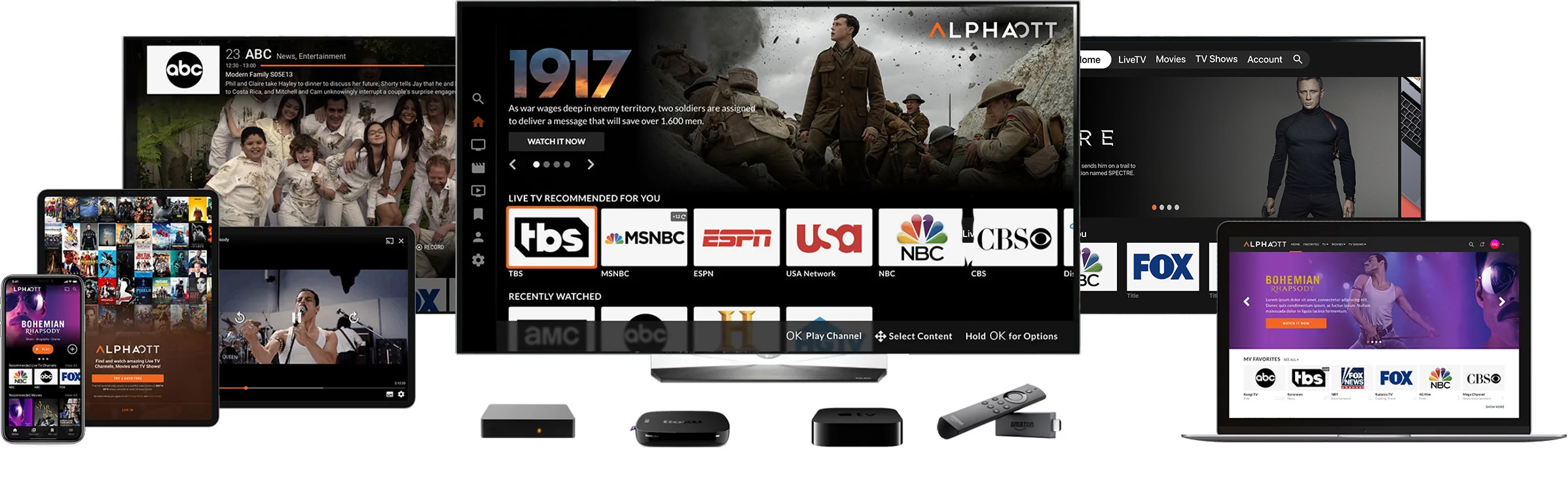
Strip away the acronyms and the pitch is concrete. An operator - say a regional internet provider, or a hotel chain, or a cable company watching its coax business shrink - wants to offer television over the internet. AlphaOTT hands them a kit that covers the whole path from a video file to a viewer's couch. Content goes in one end; a branded app on someone's TV comes out the other.
There is hardware too - AOSP Android TV set-top boxes for operators who want to hand a physical device to subscribers - plus the unglamorous but decisive services of integration, content ingest and consultancy. That last part matters more than it sounds. A lot of AlphaOTT's customers are not video companies. They are internet and phone companies bolting on television, and they need someone who has done it before.
02 / THE BUYERWho is actually on the other end
The obvious customers are telcos and ISPs. A telco already sends you a bill for phone and internet; adding TV turns two products into the classic triple play, and it does that without hiring a video engineering team. Cable operators are the other big group - they have subscribers and content rights but are stuck on aging technology, and AlphaOTT sells them a bridge from coax to streaming that keeps the subscribers and swaps the plumbing underneath.
Then it gets strange, in the good way. The same middleware runs television for hotels, cruise ships, hospitals, university campuses, government facilities and churches. A cruise ship is a small, mobile, offline-prone country with its own channel lineup. A hospital wants patient-room TV that a nurse can manage. AlphaOTT's argument is that they are all the same problem wearing different clothes: manage content, manage users, deliver video, keep it secure.
03 / THE PROBLEMWhy this is hard enough to sell
If launching a streaming service were easy, there would be no AlphaOTT. The video is the simple part. The hard part is everything wrapped around it. You need to know who is watching and whether they paid. You need to stop the account that one household is quietly sharing with six others in three time zones. You need the same login to work on an iPhone, an Apple TV, a Fire TV stick and a Samsung set from 2018, each of which has its own opinions about how apps should behave.
AlphaOTT's answer to piracy is not a bolt-on. VPN detection, cloned-device detection and geo-blocking sit inside the platform, alongside multi-DRM. For an operator selling regional rights, that is not a nice-to-have; it is the difference between keeping a content deal and losing it.
A viewer picks up whichever screen is nearest. FRONT apps aim to make that choice invisible.
04 / THE EDGEHow it differs from the alternatives
There is no shortage of ways to stream video. Large platforms like Brightcove and Kaltura serve enterprises; middleware systems compete for the operator market; a wave of white-label vendors promises to launch your app by Friday. AlphaOTT's position sits in a specific slot: end-to-end and modular at the same time. An operator can take the whole stack or bolt individual pieces onto what they already run, cloud-hosted, on-premise or hybrid.
The other quiet differentiator is size. Roughly sixteen people support a platform serving more than two million subscribers across more than forty countries. That ratio only works if the software carries the weight - if a new operator can be brought up mostly by configuration rather than by a fresh custom build each time. The modular, component-based design is not a marketing word here; it is the reason the headcount stays small.
05 / THE MODELSelling the engine, not the ticket
AlphaOTT makes money the way infrastructure companies do: it licenses software and sells the services around it. Managed cloud, on-premise, or a hybrid of the two, plus custom development, integration and consultancy, plus set-top box hardware when an operator wants a device in the living room. Third-party estimates put annual revenue somewhere around $6.6 million, and the company raised a Series A in May 2021. It has stayed lean and largely out of the headlines since.
The white-label choice is the whole strategy in one decision. By keeping its name off the screen, AlphaOTT lets every customer look like a fully-fledged media brand while the same underlying engine hums along behind all of them. The operator gets the applause. AlphaOTT gets the renewal.
06 / THE PLACEWhere it sits in the market
Streaming has split into two worlds. There are the giants everyone names, and there is the long tail - the regional operator, the niche sports channel, the diaspora broadcaster, the hotel group - who together add up to a very large audience and who cannot afford to build a Netflix from scratch. AlphaOTT aims squarely at that tail. Its stated mission is to help small and medium operators move off traditional cable and onto IPTV and OTT, and its footprint - Latin America, the Middle East, Asia, run from Miami - reflects exactly the markets where that transition is still underway.
It is not a household name and does not appear to want to be. The company's own GitHub organization is a fair snapshot of the character: quiet, practical, a handful of maintained forks of React and React Native tooling used to build the Smart TV apps. No manifesto. Just the parts that make the screens work.