The request arrived from a funeral director, which is not where bright-eyed founders usually go looking for their first market. He wanted families who could not travel to be able to watch a memorial service online. Gordon Daily and his future BoxCast partners recoiled at first. “At first blush, we're like, oh my goodness, that is the creepiest thing I've ever heard in my life,” Daily later recalled. Then the engineering question gave way to a human one. Distance was keeping people from a room they badly wanted to enter.
“It was really a tool to help connect people together in these very, very trying times,” he said. That reversal contains the useful part of the BoxCast origin story. The idea did not begin with a forecast about creator video, a pitch deck about total addressable markets, or the discovery of a fashionable acronym. It began with an awkward request that became less awkward when Daily paid attention to the person on the other side of it.
Daily already knew how to make complicated systems behave. A double graduate of Case Western Reserve University, with bachelor’s and master’s degrees in computer engineering, he spent more than a decade at Rockwell Automation. His work crossed software development, hardware testing, product marketing, and international business. An assignment in Singapore took him across the Asia-Pacific region. Factories had taught him a plain lesson: complexity belongs inside the system, not in the operator’s hands.
A factory idea, pointed at a camera
Live video in the late 2000s was rich in failure points. A camera had to speak to an encoder. The encoder had to find a network. Somebody had to configure the settings, start the event, distribute the feed, watch the health of the stream, and hope no cable or menu had a private crisis. Daily and his co-founders Justin Hartman and Ron Hopper looked at the chain and saw the broadcast equivalent of a production line waiting to be automated.
In 2009, the trio began building. Patents for the original BoxCaster followed in 2010. Case Western Reserve bought the first branded unit in 2011. The product was a pocket-sized encoder, but the promise was larger than the hardware: schedule the broadcast in advance, send the signal into the cloud, and let the system handle jobs that once demanded a technician.
They did this while Daily still had a career at Rockwell. Only in 2013 did the co-founders leave their day jobs and launch BoxCast full time. JumpStart invested $250,000. The company moved into a 4,000-square-foot office at Burke Lakefront Airport and began hiring. Daily’s quote from that period is refreshingly unvarnished: “The JumpStart funding was the jump start of our company, it really was.” A good pun, unlike a live stream, is permitted a small glitch.
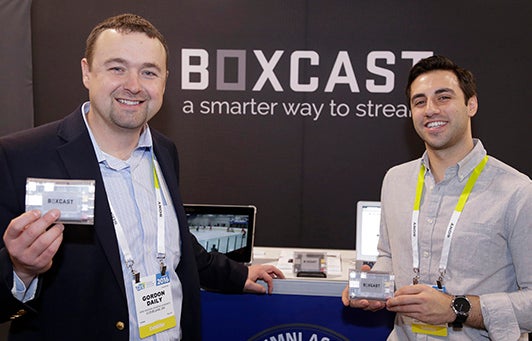
The box was only the visible bit
The little encoder made for a useful trade-show prop, yet Daily insisted that it was one piece of a platform. BoxCast combined hardware, cloud software, distribution, analytics, and support because customers did not wake up yearning to own an encoder. They wanted a council meeting, game, service, or performance to reach people who were not in the room. Selling only the component would have left the anxiety intact.
The customers were wonderfully unalike. Schools streamed sports. Churches streamed services. Municipalities streamed meetings. One report found the platform carrying virtual safaris from Sri Lanka. The content could be solemn, procedural, competitive, or mildly baffling. The shared requirement was reliability at a fixed time. A video on demand can be uploaded again. A kickoff and a wedding refuse to reschedule themselves for the router.
By 2015, Daily had received a patent for systems and methods for autonomous broadcasting and had been named to Crain’s Cleveland Business Forty Under 40. BoxCast added its Flow protocol for maintaining broadcasts over imperfect connections, then released more capable hardware. It acquired Sunday Streams in 2019, deepening its work with houses of worship.
Then 2020 arrived and removed the room from nearly every gathering. Daily called it a watershed moment. At peaks, usage ran about ten times its pre-pandemic level. BoxCast streamed millions of events a year while its team grew from fewer than 40 people before the surge to 56 by the end of 2020. That December, Updata Partners led a $20 million Series A with participation from audio company Shure.
The financing looked sudden from a distance. The infrastructure beneath it had taken eleven years. Hardware companies keep a stern calendar: parts must be sourced, tested, assembled, shipped, and supported. Live-video companies add another clock, the one counting down to an event that will happen whether the equipment feels emotionally prepared or not. BoxCast had spent a decade making that deadline less dramatic.
After the picture, the neglected sound
BoxCast kept widening its definition of the job. It acquired Stream Monkey and partnered with Diligent in 2021, adding reach in streaming services and local-government video. In 2024, it introduced branded OTT apps for web, mobile, Roku, and Apple TV. Organizations could present programming under their own identity instead of living entirely inside a social platform.
Daily’s attention then moved from what viewers saw to what they heard. The audio in many live streams is simply the venue feed. That mix is designed for loudspeakers in a physical room, where drums, voices, and amplifiers already contribute sound. Send it unchanged to a television, car, or pair of earbuds and the balance can collapse. “The remote audience deserves a mix tailored for them,” Daily argued.
The constraint sounded familiar: the person with the needed expertise was attached to a place. RemoteMix, launched in 2025, let an engineer control supported digital consoles through a browser from somewhere else. In January 2026, BoxCast and the widely used Mixing Station app announced a partnership. RemoteMix became Mixing Station Anywhere, extending remote control into tools audio engineers already knew. Daily demonstrated the system at NAMM by controlling a Midas console located on another floor.
It is a revealing second act. Daily did not wander from video into a random neighboring category. He found another production system full of physical constraints, scarce expertise, and nervous volunteers. Then he applied the BoxCast habit: keep the equipment people use, move control into software, and make geography matter less.
Cleveland, competition, and the long game
Daily’s career has stayed tied to Cleveland and to Case Western Reserve. He played four sports at the university, captained teams, and set a Spartans baseball home-run record that the alumni magazine reported as still standing in 2023. He helped establish the campus chapter of Phi Kappa Tau and served as its president. The boyhood plan was center field for Cleveland’s baseball club. Engineering furnished a different place to keep score.
He has returned to Case as a speaker, mentor, alumni-board member, Meritorious Service Award recipient, and, since 2023, university trustee. Asked about his success, he pointed away from himself: “When I think about the secrets to my own success, it really comes down to the people I surrounded myself with.” His co-founders were Case classmates. The first customer was Case. Many BoxCast engineers have come from Case. Networks, in Daily’s story, are not only the cables and protocols.
That loyalty to one city also gave BoxCast a distinct path through the startup years. The company did not need to imitate a coastal software story. It could recruit from an engineering school Daily knew, work with regional investors, assemble physical products nearby, and learn from customers whose events were ordinary but consequential. A school board meeting does not trend. A small-college game rarely attracts a national crew. A weekly service is familiar by design. Yet each has an audience with a real reason to watch. Daily built for that broad middle of live experience, where the production budget is modest and a missed broadcast still disappoints somebody.
Public descriptions from colleagues emphasize trust, encouragement, product sense, and creative problem-solving. His older event biographies add a competitive streak expressed through skiing, kayaking, and table tennis. Those details make the patient company-building easier to understand. Daily appears to enjoy a contest, but he chose one measured in decades: reduce the gap between an event and the person who wants to be there.
The original BoxCaster put a broadcast workflow into a small piece of hardware and a cloud service. Mixing Station Anywhere now tries to loosen the sound engineer from the console. Different equipment, same irritation with distance. Seventeen years in, Daily is still working on the funeral director’s problem. The room is somewhere else. The system’s job is to make that fact less important.