Binu Girija paid $39 to park his car in San Francisco. A short distance away, another lot advertised three hours for $12. The meeting he had come for was over. The more consequential business of the day, as it turned out, was waiting outside.
He had bought something ordinary without knowing what it ought to cost. The cheaper space was close enough to make the discovery particularly irritating. Most drivers would file the experience under expensive lessons and remember the other lot next time. Girija began thinking about everyone else arriving late, choosing a space, and learning the price of their haste afterward.
That complaint became the premise of Way.com, which he co-founded with Bhumi Bhutani. Compare the options before paying. Begin with parking, then follow the other expenses attached to owning a car. It is an unromantic corner of motoring. Nobody puts a photograph of their insurance renewal on the bedroom wall. Yet those recurring bills have given Girija a business to build, and a reason to reconsider what building a business requires of him.
Two nearby lots. One expensive discovery.
Prices recalled by Girija; different parking offers.
A civil engineer, a taxi, and an example
Girija comes from the Anchal area of Kerala’s Kollam district. He studied computer science in Bengaluru and moved to the United States in 2001 after spending time in Dubai. His professional background includes enterprise architecture at BEA Systems, Oracle and Computer Sciences Corporation. Before asking people to trust an app with their car expenses, he had worked on the systems companies use to organize their own operations.
His first example of enterprise was closer to home. His father, a civil engineer, also pursued businesses alongside his job. At one point he bought a taxi and ran a taxi business while continuing to work. Girija remembers a father who started with little, watched his spending and helped build houses for the siblings who had helped him get an education.
There is a practical quality to that inheritance. A taxi needs passengers. A piece of software needs someone with a reason to use it. The son’s career would eventually bring those two requirements together: the engineer’s ability to make a system work and the business owner’s need to find somebody willing to pay.
Starting Way also involved a conversation at home. Girija says he warned his wife that he might earn nothing for five years and asked whether she could support the family. She agreed. A founder can call that a long-term commitment; the household still has to manage the short term. Behind the public ambition sat a private arrangement about who would keep things going.
The engineer had to change jobs
Girija had already experienced ventures that worked and ventures that failed. He has described a particular trap in his earlier work: becoming so absorbed in solving technical problems that he neglected his responsibilities as an entrepreneur. It is an understandable temptation. Code offers something to fix immediately. A business can ask much less comfortable questions.
By 2022, he was describing his approach at Way as more focused on the business itself. One conspicuous decision concerned the name. He said the company paid $350,000 for Way.com. His explanation was that a memorable brand could reduce the need to keep buying attention through advertising. Three letters carried a considerable invoice.
The name purchase shows that his thrift has limits, or at least a theory. He was willing to spend on something he expected customers to remember. The corresponding question is whether a memorable address produces a useful destination. An attractive name can bring someone to the door once. A parking reservation has to work when the driver arrives.
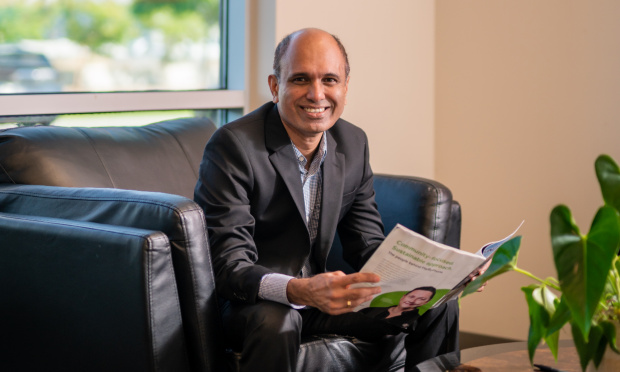
He also became more explicit about the cost of accepting a decision he doubted. In his account of a 2017 technology overhaul, the business moved toward an app strategy, encountered persistent bugs and repeatedly postponed a launch. He eventually agreed to release the site despite his reservations. He says revenue fell by 80 percent and took three to four months to recover.
That is his retrospective account of the episode. Its lesson, for him, was about responsibility: the person running the company has knowledge that may be hard to convey in a meeting, and must sometimes hold a position under pressure. Agreement can feel like progress right up to the moment customers encounter the product.
Parking was the introduction
Parking brought customers into Way. Girija has described it as the entry point from which people discovered other services. In a 2022 explanation of the product, he pointed to integrations with partner systems for parking, insurance and financial services. The work was to connect transactions that drivers would otherwise arrange separately.
The breadth has a straightforward commercial logic. Someone reserving airport parking also has a car to wash, insure, finance and maintain. Those expenses occur on different schedules, but they belong to the same person. If the first transaction earns confidence, the next service has an introduction. The difficulty is earning that confidence again with each new provider.
Way+ added another approach in February 2022: a membership combining parking, car washes and roadside assistance. Its launch described tow-truck tracking and driver details visible in the app. For a customer waiting beside a stationary vehicle, seeing where help is coming from is a concrete form of reassurance. The screen has a useful job when it can answer the question being asked of it.
- Find a spaceCompare and reserve parking.
- Return for the running costsWashes, insurance, refinancing and roadside services.
- Connect the businessesSoftware for shops and benefits through partners.
A map of the business model, not a dated product-launch sequence.
The work that points back to Kerala
For Girija, building the company in America has also meant creating work in Kerala. When Way established operations at Technopark in Thiruvananthapuram, he connected the decision to his own earlier career there. He said he had been UST Global’s tenth employee and wanted to contribute to the place where he had worked.
His hiring ambitions extended beyond engineers. The operation needed people in marketing, content, finance, product management and business development. That list is a useful description of how far his own job had travelled. The technology remained essential; so did all the work that persuaded customers to use it and kept the organization functioning afterward.
By February 2024, he was discussing parking in Kerala as a public infrastructure question. He argued that better management could generate revenue and help support public transport. He was also discussing possible opportunities in India, while saying feedback needed study before commitments. The original irritation had grown into a question about how cities organize scarce space.
There is a difference in scale between helping one driver compare lots and changing the management of a city’s parking. Girija’s interest connects them through the same everyday friction: time spent looking, uncertainty about rules, and money spent without a clear view of the alternatives. His proposed solutions still require decisions beyond the app.
In 2026, the other side of the counter
The company’s recent direction takes that work inside automotive businesses. In September 2026, Way announced that its Way Repair Tech software had won a MOTOR Top 20 award. The product combines tasks including estimates, inspections, scheduling, invoicing and payments, with customer acquisition through Way’s marketplace. The company said it served an audience of more than 11 million drivers.
That is a company-reported audience figure, rather than a count of monthly purchases. The strategic point is the relationship between the two sides: repair businesses need customers, and customers need somewhere to take a car. Girija’s enterprise software background now has a visible counterpart in the tools his company sells to those businesses.
Other 2026 announcements show the network growing through partners. A June agreement added more than 1,200 Take 5 Oil Change locations to Way’s service network. In late September, Way and Insuresoft announced plans to integrate Way Advantage into Insuresoft’s platform, giving insurers and agents additional automotive benefits to offer customers.
These arrangements put the company in more places than its own app. A driver may encounter its benefits through another organization. For Girija, that means the next stage of the business depends on making connections useful to partners as well as to the person holding the car keys. The parking comparison was only the beginning of that negotiation.
Five customers before the grand plan
For all the expanding product lists, Girija’s test for a fresh idea remains small. He asks how the business would get its first five customers. He seeks views beyond the immediate team and tries to test an idea before devoting extensive engineering resources to it. His wife, he says, is especially difficult to impress.
“She’s very tough to impress!”
Binu Girija, on his wife’s feedback
It is a useful household service for someone surrounded by proposals. Enthusiasm is readily available at the start of a project. A convincing answer about who needs it can take longer. Girija’s version of the question brings the conversation back to five actual people, before anyone gets carried away describing millions.
In his account of a typical day, there is tea and quiet browsing before work, and washing plates after returning home. He likes writing things down to think. These are modest details beside an expensive domain and a growing services network. They also make the person behind the plans easier to recognize: an engineer still working through problems, with a household willing to tell him when an answer needs more work.
The $39 parking bill gave him a complaint worth investigating. The years since have required different skills: choosing what to build, living with earlier mistakes, hiring people to do work he cannot do alone, and asking customers to return. The next useful idea will have to survive the same test as the first. Somebody has to need it enough to pay.
Keep following the road
PROFILES, CONVERSATIONS & COMPANY NEWS
- Way.com The company and its services
- Binu Girija on LinkedIn Public professional profile
- Ideas, habits and the first customers April 2022 conversation
- Girija on learning from failure His October 2022 essay
- From Anchal to Silicon Valley Career and origins
- Way’s newsroom Recent product and partner announcements