Before Paolo Kalaw was telling other people how to work, he gave himself a rather modest assignment: say hello. He had been shy, he wrote, intimidated by talking to people. So he began with one greeting a day, then increased the number. Eventually he set himself a target of 50 people in a row. It took three days of trying.
It is an appealingly unglamorous exercise: the awkward business of approaching another human being and surviving the encounter. Kalaw connected the experiment to his martial arts training, particularly Kyokushin karate. Courage, in his telling, came from practising with fear present. The greeting was a small repetition, like a punch drilled until it felt familiar.
Today he is the founder and CEO associated with EviSmart, software for the work that moves through dental laboratories. His career has taken him through laboratory ownership, acquisitions, investment, and cloud software. But that early account offers a useful entry into his thinking: choose something difficult, break it into actions, and keep at it. Even a hello can have an operating procedure.
A newspaper ad opens a door
Kalaw was born in the Philippines and moved with his family to Richmond, British Columbia, in 1982. He was one of ten children. After Matthew McNair secondary school, he studied microbiology at the University of British Columbia, graduating in 1989. The route into his eventual industry was a newspaper advertisement for a sales job at a dental laboratory. He had been looking for work, rather than following a carefully plotted calling.
A partnership in Calgary's DTI Dental Technologies followed. Between 1997 and 2006, it grew from five employees to more than 1,000, largely through acquisitions. The business was sold to a private equity buyer in 2006. His subsequent ventures included Frontier Dental Laboratories and Crown Ventures, an investment firm established with Ryan Beedie.
The interesting turn is what he did with his familiarity with the industry. Owning a laboratory gave him a view of the ordinary work behind the finished product: files moving, information being checked, people coordinating. Over time, that operating experience became material for a different business. Software offered a way to work on the connections between companies, as well as the companies themselves.
DTI grows through acquisitions.
Named CEO following the acquisition of Evident.
EviSmart adds integrations and case communication.
The job that could be built around a person
His older writing spends considerable time on hiring. One post begins with a question every manager eventually asks: when should you hire the right person? Kalaw's answer was to remain on the lookout, even when the organizational chart had no convenient empty square.
He described interviewing people every week, including periods with no vacancies. Recruiters who knew his preferences sent candidates his way. He looked for people who could assess themselves, supply their own motivation, and connect with his plans for the business. Finding the combination could take six months, he wrote. Urgency was a poor substitute for fit.
Sometimes, he said, his companies hired someone and helped build a business around that person's abilities. It reverses the usual sequence of writing a job description and searching for a human who resembles it. The person arrives first; the business possibility follows. His account also acknowledged a practical complication: candidates might dislike his style, his vision, or the compensation. Recruitment remains a two-sided interview, however enthusiastically the founder is holding the pen.
This is a more specific version of the familiar advice to hire good people. It makes the search continuous and gives the founder responsibility for recognizing an opportunity before there is a vacancy to justify it.
“When the right person comes along.”
Paolo Kalaw, on when to hire
A curriculum with room for practice
Another post divides competence into four stages: knowing, knowing how, showing how, and doing. Reading about a subject puts you at the beginning. Being able to demonstrate a skill to someone else asks more of you. Repeated performance eventually makes the action familiar enough to happen without so much conscious effort.
Kalaw used a golf swing to explain the danger of practice without correction: repetition can make a bad habit more durable. Mentorship matters because somebody needs to notice the mistake. Teaching matters because explaining an action forces the teacher to examine it. His model gives learning a social component, well before his later arguments about office attendance attracted attention.
He has also pursued formal business education, including strategy and execution studies at London Business School and MIT Sloan. In March 2017, a conversation with podcast host Gary Takacs covered delegation, building teams, artificial intelligence, and the book Simple Rules. The range is revealing: an owner can be interested in a new technology and still need help deciding what to stop doing personally.
That year, Kalaw served as host city chair for YPO's Global Leadership Conference in Vancouver. It was a setting devoted to learning among executives, a larger version of the peer exchange his writing recommends. The familiar image of the founder issuing answers leaves out this part of the job: arranging to hear better questions.
Vancouver looks across the Pacific
His business geography links Canada and the Philippines. Nimbyx and the Asia Pacific Foundation of Canada partnered on Philippines Connect, a program giving Canadian students experience working in Manila. The opportunity included a four-month placement, placing the emphasis on living and working in another business environment.
Kalaw's stated purpose was to give students experience in a fast-moving Asian economy and help them develop skills and cultural awareness. This was learning by changing location, with a real office and real work attached. It also brought his Canadian business base into contact with the country where he was born.
That cross-Pacific connection remains visible in the organizations he leads. EviSmart describes a team spanning North America and Asia, with engineers, designers, laboratory technicians, and commercial staff. For a business selling coordination, the internal cast is appropriately varied. The practical problem is making those different kinds of knowledge useful to one another.
A sharp opinion, delivered from home
Kalaw's enthusiasm for learning has also produced a much less diplomatic public moment. In 2024, his remark, “Working from home will make you dumber every day,” went viral. It was a sweeping claim about other people's working lives, and it attracted criticism. People whose jobs happen perfectly well at a kitchen table had reason to object.
At the FutureProof Tech Summit that October, he explained his position. Remote employees could become more productive at familiar tasks, he acknowledged. His concern was that they might lose context as a company changed. He urged people to build relationships inside their organizations and devote time to learning AI tools. These were his arguments about professional development, rather than a settled verdict on remote work.
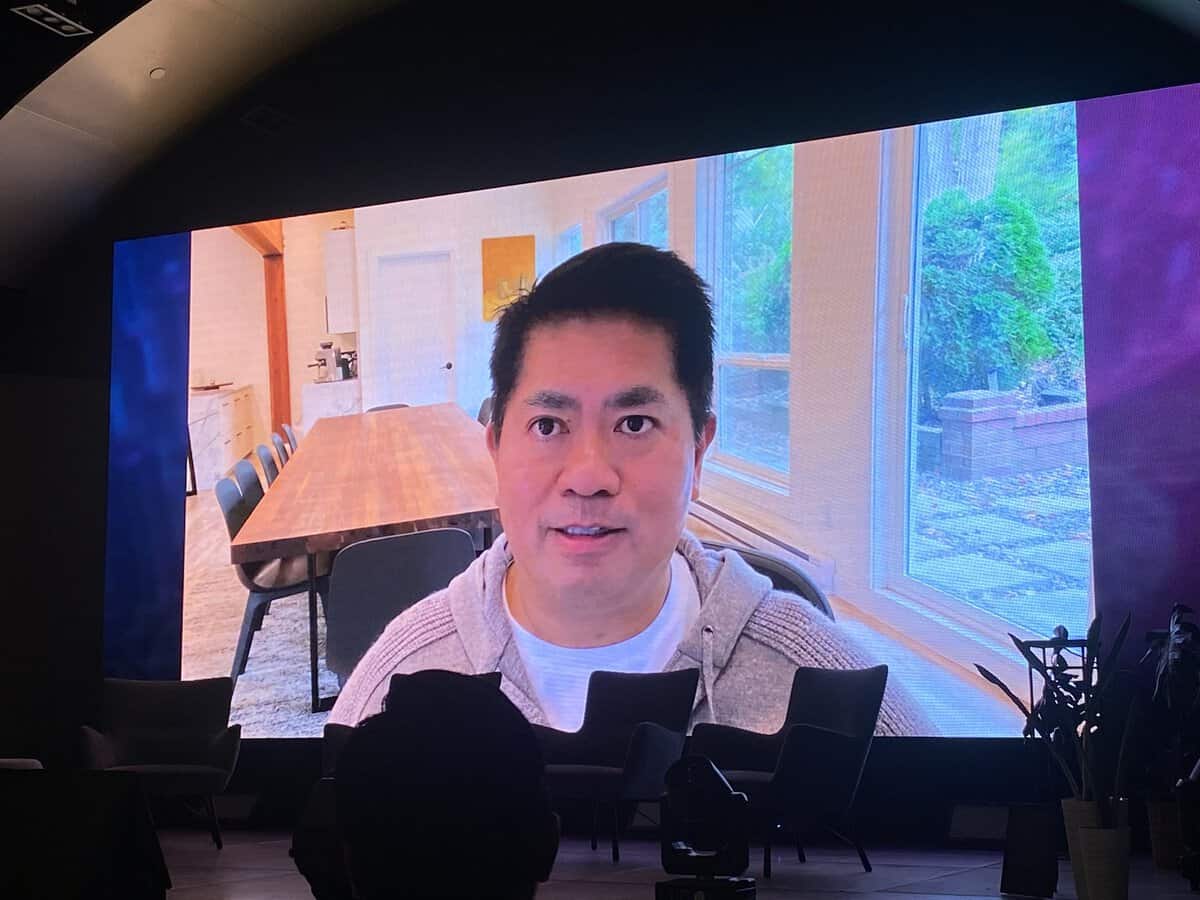
The setting supplied its own footnote: he delivered the summit address remotely from his home office because his travel arrangements had not worked out. A talk about showing up arrived on a screen. It is a useful reminder of how readily the practical demands of a working week complicate an executive's preferred theory of work.
Giving the handoffs a place to live
The software story has a longer history than the current enthusiasm for AI. In March 2016, Evident announced Kalaw as its new CEO, succeeding Rayne Verity. He said the business had been acquired and would receive capital to accelerate product development. That distinction matters in understanding his career: he came to Evident as a buyer and operator of an existing business.
By 2024, he was hosting The Next Wave of Digital Dentistry. Its eight listed episodes moved from an overview of technological change to concrete administrative tasks. The August episode described tools for downloading scans, checking incoming instructions, and routing cases. The subject had narrowed from the future in general to the work on someone's desk.
In April 2025, Evident announced an integration with Atlanta Based Systems, allowing laboratories to add EviSmart automation to their existing management software. The promise was continuity: improve the intake process while retaining the system already in use. Changing software can be its own project. A tool that fits around established work has to reckon with that inconvenience.
The following month brought EviSmart Comm, a module organizing messages around individual cases. Conversations, updates, and approvals could sit beside the work they concerned. The same idea runs through both announcements: make a handoff easier to follow. Kalaw's ambitions for automation acquire a fairly ordinary test here. Can someone spend less time chasing information?
- 01 Collect files
- 02 Create a case
- 03 Coordinate work
- 04 Keep the record
A simplified view of the platform's administrative workflow.
A crumpled note in the travel bag
For all his interest in technology, one of Kalaw's more memorable objects is a scrap of paper. He described finding it while clearing out his travel bag. He had scribbled down an observation about the difference between being interested and being committed, then forgotten where he had heard it. He later identified the thought as Ken Blanchard's.
Kalaw offered his guitar playing as an example. He was interested in it. Practising for two hours every day was another proposition. The admission lends some welcome scale to a founder's discussion of ambition. Everyone has activities they enjoy in principle and fail to schedule in practice; even the person giving the lecture has a guitar somewhere in the argument.
Read alongside the greetings experiment, the note gives his career a human-sized frame. Building companies involves capital, acquisitions, and systems. It also involves deciding which uncomfortable action to repeat tomorrow. Kalaw began one of those exercises with a single hello. His software now addresses a different kind of introduction: getting one piece of work safely into the next person's hands.
Follow the threads
Writing, conversations, and the companies behind the story.