The crown is glamorous. The download folder is not. Yet before a dental restoration can be designed, milled or printed, somebody has to retrieve the scan, pair it with the right prescription, decipher the instructions, create a case, check the files, chase an answer and tell the next person what happened. A digital product can enter a lab through a surprisingly analog obstacle course.
EviSmart has built its company around that obstacle course. The Vancouver business, a brand owned and operated by Evident Inc., describes itself as an autopilot for dental-lab operations. Its software does not stop at a lab-management dashboard. Eleven modules cover the path from intake to storage: Downloader collects files from intraoral-scanner portals; Digitizer turns handwritten prescriptions into structured data; QC inspects prescriptions and scans; CaseEntry opens the job in the lab’s management system; Comm keeps messages attached to the case; CAD and Nest help prepare production; LMS tracks the work; Pay handles billing; and Vault stores the record.
That list sounds sprawling until you notice the organizing idea. EviSmart is not primarily selling one more destination for a lab employee to visit. It wants to become the connective layer among the destinations the lab already has. The company says modules can plug into existing workflows with no wholesale data migration or hardware upgrade. Start with the maddening task, prove relief, then connect the next one.
The first failure is usually a handoff
Ask what fails first in a busy digital lab and the answer is rarely the expensive printer. It is the seam. A scan lands in one of several vendor portals. The prescription arrives elsewhere. A due date is typed twice. A margin looks wrong but nobody flags it until a technician is ready to design. A dentist’s clarification sits in an inbox while the physical schedule marches on.
EviSmart’s sharpest product logic is to intervene early, where a cheap error becomes an expensive remake. Downloader pulls and sorts incoming scan files. CaseEntry uses the prescription, notes and attachments to populate the lab-management system. QC looks for incomplete information or mismatches before the case reaches production. Comm gives the lab, dentist and internal team a shared, case-specific thread for messages, files and approvals.
The handoff map
This is a sensible place for machine learning because the question is constrained. Does the prescription contain the needed information? Do the patient name and scan match? Is something obviously missing? The model is not being asked to charm a patient or replace a technician’s judgment. It is being assigned the visual equivalent of checking the packing list before the truck leaves.
“Much of the delay and cost in digital dentistry can be traced back to miscommunication.”Paolo Kalaw, founder and CEO
Software in front, skilled humans behind it
EviSmart occupies an unusual middle ground. Part of the business is enterprise software. Part is an outsourced CAD design operation staffed by specialists. A clinic uploads an STL scan and prescription, reviews the proposed restoration in 3D, requests changes if needed, then downloads production files or sends the job to a fabrication partner. EviSmart says it does not fabricate clinic cases itself.
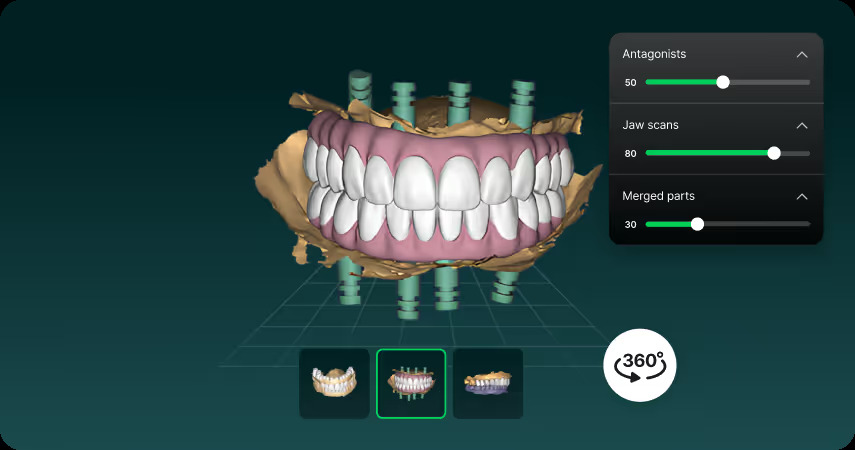
The human layer is part of the differentiation. The company says it builds a recurring CAD team around each customer, learns the lab’s preferences and assigns a concierge to check cases. That gives EviSmart two feedback loops: the service organization learns where work repeatedly snags, and the software team gets a menu of tasks worth automating. A pure software vendor may see a ticket. A design team sees the messy file that caused it.
The public price window is narrow but useful. EviSmart lists a single crown or diagnostic wax-up at $25 per unit for clinics and an All-on-X restoration at $300 per arch with prepayment. Completed cases are billed after delivery. Qualifying prepaid customers can receive discounts of up to 50 percent on single units, although unused prepaid amounts do not roll forward. The rest of the workflow suite follows the familiar enterprise motion: choose modules, book a call, get a proposal.
One visible price
EviSmart’s published reference for a single crown or diagnostic wax-up design. It is a service price, not the cost of the full platform.
The customer is a factory with patient data
EviSmart’s core buyer is the dental laboratory, from a small operation managing around 30 digital cases a day to a multi-site group handling more than 300. Clinics are a second audience, particularly for outsourced design and case collaboration. The company says it serves 28 countries, designs more than 10,000 units a day and is trusted by more than 92,000 labs and dentists combined. Those are EviSmart’s figures, useful as indicators of ambition rather than audited market statistics.
The customer problem changes with scale. A small lab needs leverage without another hire. A large lab wants consistent intake and fewer remakes. A multi-site group needs every location to name, check and route cases the same way. A clinic wants a fast design, a clear approval loop and fewer status calls. EviSmart packages the same underlying capabilities differently for each.
It also handles health information. EviSmart’s privacy policy says the platform may process scans, photos, surgical plans and prescriptions, alongside contact, purchase and payment data. That makes security and traceability part of the product, not decorative compliance copy. Vault promises encrypted long-term records, while Comm is marketed for secure case communication. For a buyer, the sober questions remain essential: where data travels, how long it is retained, which subprocessors touch it, and how integrations are monitored.
What changed the pitch: migration became the enemy
EviSmart’s own history starts with lab-management software and payment processing in 1995, moves into outsourced CAD design in 2008, international delivery in 2015 and an AI workflow platform in 2023. Paolo Kalaw became Evident’s CEO in 2016 after an acquisition. By 2025, the company’s privacy policy described EviSmart as the new name for the platform formerly known as Evident.
The arc matters more than the dates. A business that began by asking labs to manage work in software now emphasizes connecting the software labs already use. That is a market lesson hiding in plain sight: specialized companies accumulate specialized systems. The buyer may dislike the gaps between them but still fear a replacement project more. EviSmart lowers that psychological bill by making the first purchase a module rather than a revolution.
The product strategy is simple enough to steal: enter through the task everyone hates, earn trust, then automate the adjacent handoff.
What to copy - and when it breaks
Founders building vertical software can copy EviSmart’s sequence without copying dentistry. Map the customer’s work as a chain, not a collection of features. Find the repetitive step closest to revenue where mistakes are visible. Integrate with the incumbent system. Keep the first deployment narrow. Use service work, if necessary, to learn the exceptions before pretending software can handle all of them.
A reusable vertical-AI playbook
- Start at the ugliest manual handoff.
- Make the existing stack more useful.
- Catch errors before the costly stage.
- Sell modules in the order pain appears.
- Keep humans for preference-heavy judgment.
The model is not automatic magic. It works best when case volume is high enough for saved minutes to compound, inputs can be standardized, integrations remain stable and the lab will change its operating habits. It works poorly when a shop has few digital cases, already lives comfortably in one system, cannot dedicate an owner to implementation or receives data too inconsistent for reliable automation.
Conditions for lift
- High, repetitive digital case volume
- Several portals or disconnected tools
- Clear process owner and measurable baseline
- Enough standardization to train rules and teams
Conditions for drag
- Low volume and few handoffs
- Dirty or highly variable case data
- Fragile integrations with no monitoring
- Automation installed without workflow change
The hardest competitor is not another logo. It is the spreadsheet that mostly works, the technician who remembers where everything lives and the manager who cannot risk a bad Monday. Labtrac, ABS Evolution, Magic Touch, 3Shape, exocad and outsourced design centers occupy pieces of the same landscape, but EviSmart’s more important contest is against institutional muscle memory.
That is why the modest Downloader may tell the company’s story better than a grand AI demo. Nobody frames a screenshot of a neatly renamed file. But if it arrives every time, attached to the right prescription, before the technician asks, the lab notices. The future of dental work may indeed look like a perfect 3D crown. The business opportunity sits in everything that had to go right before anyone could print it.