Ale municipality had already done the apparently modern thing: it put the school transport application online. A parent could submit a form. Behind that pleasant front door, however, staff still handled the case manually across several systems. The request had become digital; the work remained fragmented. It is a wonderfully ordinary problem, and a useful place to meet SOKIGO.
- The job: connect municipal information to the work and decisions that depend on it.
- The range: resident services, inspections, permits, documents, school transport and GIS.
- The lesson: follow a case past the online form before deciding what needs fixing.
Ale introduced SOKIGO’s Vega Beslut in autumn 2022. Applications, assessment and decisions gained a common home. Straightforward cases meeting the rules could proceed directly to a decision; complicated ones went to a person. Case history and staff notes stayed together. The municipality then connected its own automation, affectionately called Robban, to find approved applications and order travel cards from Västtrafik.
Robban belongs to Ale. That detail matters. The customer built another step onto the software, extending the process beyond the decision itself. SOKIGO’s account reports less administration and shorter handling times. The practical idea is easy to borrow: examine the next handoff, then the next, until the person who applied actually receives the service.
01 / The municipal middle
SOKIGO develops software for municipalities and other public-sector organizations. Its territory includes building permits, environmental inspections, official documents, school transport and the geographic information beneath urban planning. These are jobs with records, deadlines, specialized rules and people who must be able to explain a decision later.
The company’s breadth makes more sense when viewed as a sequence. A resident submits something. An officer needs the relevant property or person. A department evaluates it. A document records the result. Information then needs to remain available to colleagues and, where appropriate, the applicant. SOKIGO sells systems for several parts of that sequence, together with advice on making them work.
- 01ApplicationResident or business
- 02AssessmentRules + officer
- 03DecisionOutcome + action
- 04RecordHistory + retrieval
02 / A portfolio assembled around the handoffs
The origin is a corporate combination. Addnode Group brought Tekis and Cartesia together under the SOKIGO name in 2016. Abou joined on 1 January 2017. At the time of the announcement, Abou’s e-service platform was already used by more than 60 Swedish municipalities. The stated ambition connected online services, administrative support and long-term digital storage.
In January 2024, Addnode announced the merger of SOKIGO and sister company S-GROUP Solutions. The combined business would have almost 300 employees. Forestry and basic-industry solutions were moving to Icebound, sharpening the municipal focus. Joining geographic expertise to administrative software is an understandable bet: the permit and the parcel of land ought to know about each other.
That history places SOKIGO in the market as a specialist municipal supplier within a larger software group. Its pitch rests on understanding the work across departments. A purchaser can seek an individual tool elsewhere, assemble several systems, or take on more integration work internally. SOKIGO offers a broader relationship around those connections.
03 / A form, an inspection, a paper trail
Abou lets public organizations create and publish e-services, from simple forms to more involved workflows. Its capabilities include authentication such as BankID, integration with other systems and a portal bringing an applicant’s cases together. Municipalities, regions and government agencies are the intended buyers. For residents and businesses, the attraction is a usable route into the organization.
Ecos deals with environmental and health inspections. An inspection object has a location, a history, planned visits, deficiencies and possible follow-up actions. Ecos connects cases to facilities and properties, supports documentation and fees, and keeps the surrounding geography visible. An officer needs the context of earlier work as well as today’s observation.
Evolution handles documents and cases, with modules for functions including workflows, signatures, meetings and archiving. The mundane virtue here is retrieval: keeping evidence attached to the work that produced it. Anyone who has hunted through a shared drive for the right version of a document will recognize the appeal before seeing a demonstration.
04 / Thirty seconds, with a person still looking
Nova provides process guidance and automation for municipal case handling. Its applications include building and planning work. SOKIGO also runs user co-working sessions, where people from different municipalities bring their working questions, and describes implementation projects with agreed roles, decision points and shared risk management. The software arrives with a method for introducing it.
Vinga, an AI assistant in the Nova family, has a tightly defined task: checking and registering mandatory ventilation inspection reports. SOKIGO estimates manual registration at 5–10 minutes, compared with 30 seconds using Vinga. Staff can review the interpreted information. The product page specifies Nova version 2025.1 as a prerequisite. Buyers should test the estimate against their own reports and review work.
05 / The map becomes a meeting place
Gaida is SOKIGO’s modular system for municipal information and GIS collaboration. Its areas include streets, water and wastewater, mapping, physical planning and GIS coordination. A municipality can start with a particular operational module or with the GIS platform. The information spans property records, population statistics, road networks, plans and utility networks.
SOKIGO is an Esri Gold Partner and holds Esri’s State and Local Government Specialty recognition. It builds municipal applications on ArcGIS and supplies Esri tools, including ArcGIS Urban. That distinction is useful: Esri supplies the underlying technology; SOKIGO contributes products, local operational knowledge and support around municipal uses.
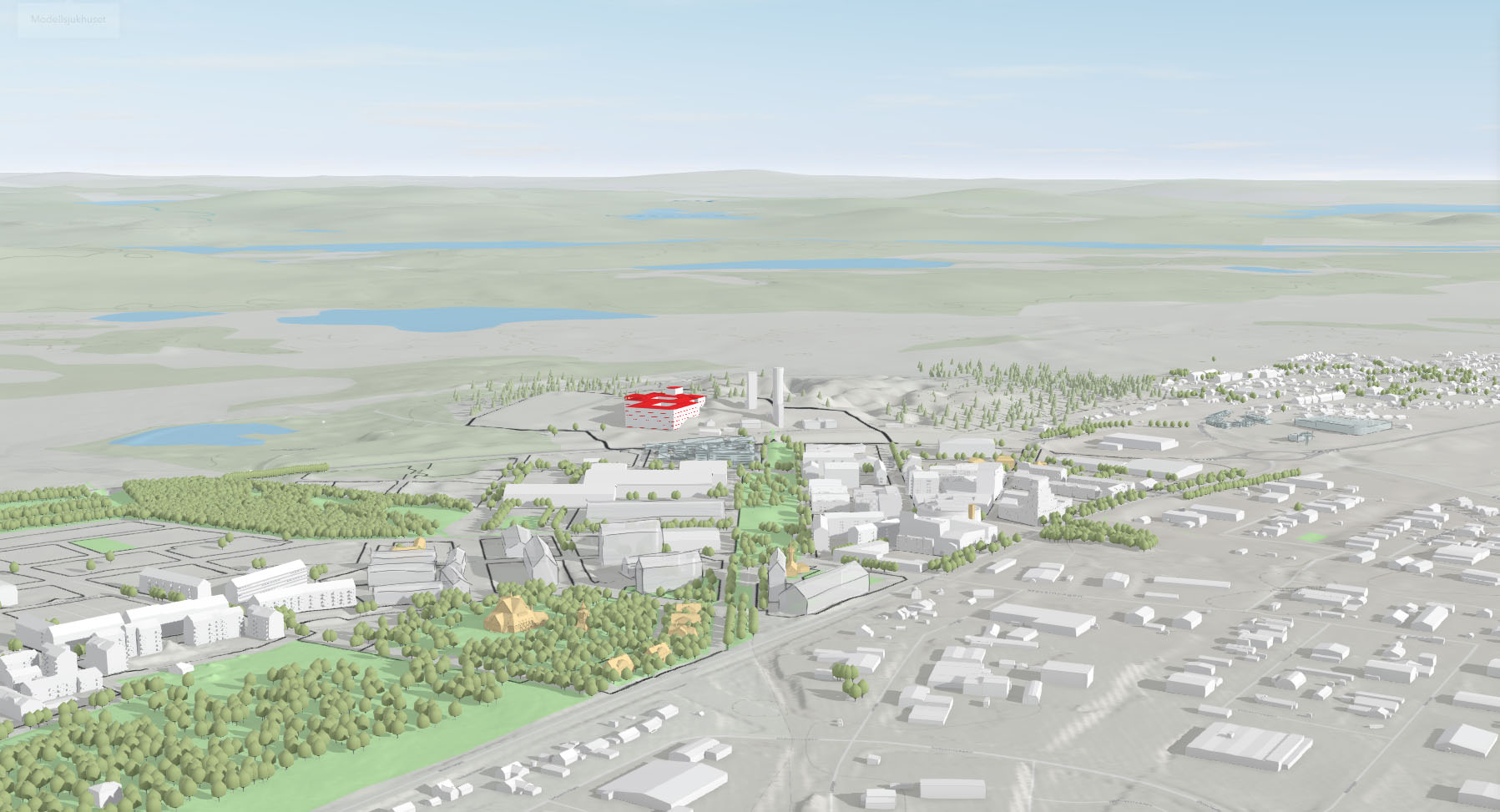
Kiruna’s planners Adam Palo and Martin Wallenius Kral use ArcGIS Urban while large parts of their city are being rebuilt elsewhere. They compare alternatives early and use simple 3D volumes to help people discuss the emerging place. Wallenius Kral says, in translation, “Simple models go a long way.” Elaborate renderings can suggest certainty the plans do not yet possess.
“Simple models go a long way.”
Martin Wallenius Kral, Kiruna planner
Translated from Swedish
The experience has limits. Establishing the model and joining data took time. Terrain makes some model placement difficult. Time constraints have narrowed use to selected parts of planning. The planners advise defining the objective first and involving GIS expertise early. It is an unusually helpful account because it lets the attractive image coexist with the labor behind it.
06 / Stockholm buys a responsibility, too
Stockholm’s published customer case describes choosing ArcGIS Enterprise as a central GIS platform. Departments had accumulated parallel solutions and, in some instances, separate copies of information. The city wanted a common foundation. It considered open-source alternatives, but building and maintaining a platform itself would have required a different organizational setup and more internal responsibility.
SOKIGO helped investigate the options and acted as a link to Esri. The choice reflected the city’s existing IT and external operations arrangements as well as technical needs. Benefits described in the case are largely expectations for the next phase. The lesson for another buyer is to compare who will maintain each alternative, and which people must change their working habits.
07 / The price includes getting people ready
SOKIGO’s commercial offer combines software, modules, implementation, consulting, training and support agreements. Product pages direct prospective buyers toward demonstrations and quotations. A sensible buying conversation therefore follows the intended workflow: required integrations, data preparation, staff training, support and ongoing maintenance. A license is one part of that conversation.
One employee story supplies a human example of the expertise being sold. Johanna Westerlund began in SOKIGO support, left for a municipal planning role that also involved GIS, then returned as an implementation project manager. Her experience now includes both the supplier’s product and the customer’s daily work. Knowing why someone hesitates at a step can be as useful as knowing which button comes next.
That is a reasonable way to judge SOKIGO itself. Bring a real application, report or planning problem to the demonstration. Follow the information through the awkward steps. Ask who reviews exceptions and who owns the data. The memorable outcome in Ale was a child’s travel card being ordered after approval. That is where the button marked Submit finally earns its keep.