A highways enquiry in Wigan used to cost £7 to handle. After the council moved the service onto Jadu, the reported cost fell to 50p. Multiply the £6.50 difference by an estimated 15,000 enquiries and the arithmetic approaches £100,000 a year. It is a modest-looking number with a useful quality: you can explain what it measures.
Jadu’s account of the project identifies a familiar culprit. Wigan’s forms and case-management systems had been isolated from one another, leaving residents with a disjointed experience. The council introduced connected forms, a customer account and workflows, then linked its Mayrise highways system. Its own developers delivered an integration the asset-management provider had called “unachievable.”
That is a revealing introduction to Jadu. Public-service software earns its keep in the handoffs: between a question and an answer, a submitted form and a case, a resident and the team responsible. The company sells tools for those connections. The glamorous part, if there is one, is getting to stop chasing.
A website with somewhere to send the work
Jadu sits between web publishing and customer-service operations. Councils and universities use its software to publish information, collect requests, accept payments and keep people informed. Named customers include Birmingham City Council, Wasatch County Government in Utah and Carnegie Mellon University in Pennsylvania. The geographical spread matters: the business serves institutions across the UK, North America and Australia.
Central handles websites and forms. An editor can publish a service page; a form designer can use branching rules so that different answers produce different questions. Organisations can run separate microsites, which Jadu calls Galaxies, from the same platform. There are ready-made themes, additional design options and the possibility of a full redesign. The range suits organisations with numerous services and numerous people responsible for explaining them.
Connect takes care of cases. It records interactions, presents a timeline and supports automated rules and notifications. A customer portal gives people a way to follow progress. Jadu also offers integration with Microsoft Teams so staff can collaborate on and close cases within that familiar workspace. The aim is to make the next action easier for both sides of the counter.
The connection between the two products is specific. Jadu’s documentation describes form actions that create or edit a case, attach a file or move a case to another stage. Shared sign-in can link the website and case-management experience. Those are the mechanisms behind the promise: a form submission can become structured work, with an identity and a status attached.
- 01Find the serviceWebsite content
- 02Make the requestForm + customer account
- 03Route the workCase + connected systems
- 04Follow the progressTimeline + notifications
The bill behind the button
This is enterprise software purchased alongside the work required to make it useful. Jadu offers subscriptions, support, consulting, design, implementation and training. Buyers can choose the full Digital Platform or a Lite package focused on transactions and case management. Lite allows an organisation with a suitable existing website to add service capabilities without committing to the full publishing offering.
A historical tariff makes the scale tangible. Jadu’s G-Cloud 13 pricing document, published in 2023, listed Central’s Gold live environment with content and forms at £3,675 a month, excluding VAT. That annualises to £44,100. A Gold user-acceptance-testing environment was another £300 a month. The document separately priced configuration, training and other services. These are historical line items, not a current all-in quotation.
Actual spending records provide another perspective. Warwick District Council’s July 2024 register recorded a £53,800 payment excluding VAT for a Jadu CRM system and £16,800 excluding VAT for website CMS and forms annual support. Those entries show what one council paid for specified items; they do not establish a standard implementation price or the lifetime cost of its programme.
The practical buying lesson is to cost the whole service. Add the environments, integrations, migration, training and continuing support that the organisation will need. Then compare that total with a defined operational baseline. A cheaper enquiry is valuable evidence, but calculating payback requires knowing what it took to produce it.
Accessibility has a maintenance schedule
Jadu’s particular emphasis is accessible digital service delivery. Its September 2025 engineering update described hundreds of improvements across the platform, including keyboard navigation, screen-reader feedback, colour contrast and focus management in dialogs. It also covered the Control Centre interfaces used by staff. The people maintaining a public website need usable tools themselves.
That work is explicitly ongoing. Jadu describes phased audits across interfaces and interaction states, with findings passed to product teams. Its Accessibility Alliance includes AbilityNet, Shaw Trust and Silktide. This gives its positioning more substance than a badge on a sales page, although a platform’s features do not automatically make every piece of customer-authored content accessible.
There is competition for this territory. Granicus govService combines forms, workflow, case management and a self-service portal, too. Buyers should therefore examine the fit: the publishing tools their editors need, the systems they must connect, the accessibility work they can maintain and the support available. Jadu’s appeal is the combination of those capabilities and its experience in the institutions buying them.
Its own published values include “Conduct honest business” and “Never over-promise.” The company describes a distributed team and an iterative approach to delivery. Those are employer statements, but they make a useful standard against which customers can judge the service. An accessibility promise becomes more persuasive when the next release explains the fixes.
AI arrives at the search box
Agent-Ex: Search extends Jadu’s proposition into answers. It uses website content to respond to natural-language questions, supports voice and text, and advertises answers in more than 70 languages. Jadu says it works with other content-management systems as well as Central. An organisation can therefore consider the search product without first buying a replacement website.
The deployment sequence deserves attention. Lichfield District Council was announced as the first live organisation in February 2026; Medway followed in April, and Broxbourne’s rollout was announced in May. That is evidence of deployment, rather than a reason to assume every promised efficiency has been achieved. Answer quality and the usefulness of the underlying content remain the tests that matter.
Jadu Assist addresses the staff side. Its November 2025 update introduced AI-supported authoring and accessibility checks, including suggestions for ambiguous link text. It also described workflow visualisation for Connect. The product screenshot shows the fairly prosaic setting where much enterprise AI will have to prove useful: beside an editor, helping someone finish a piece of work.
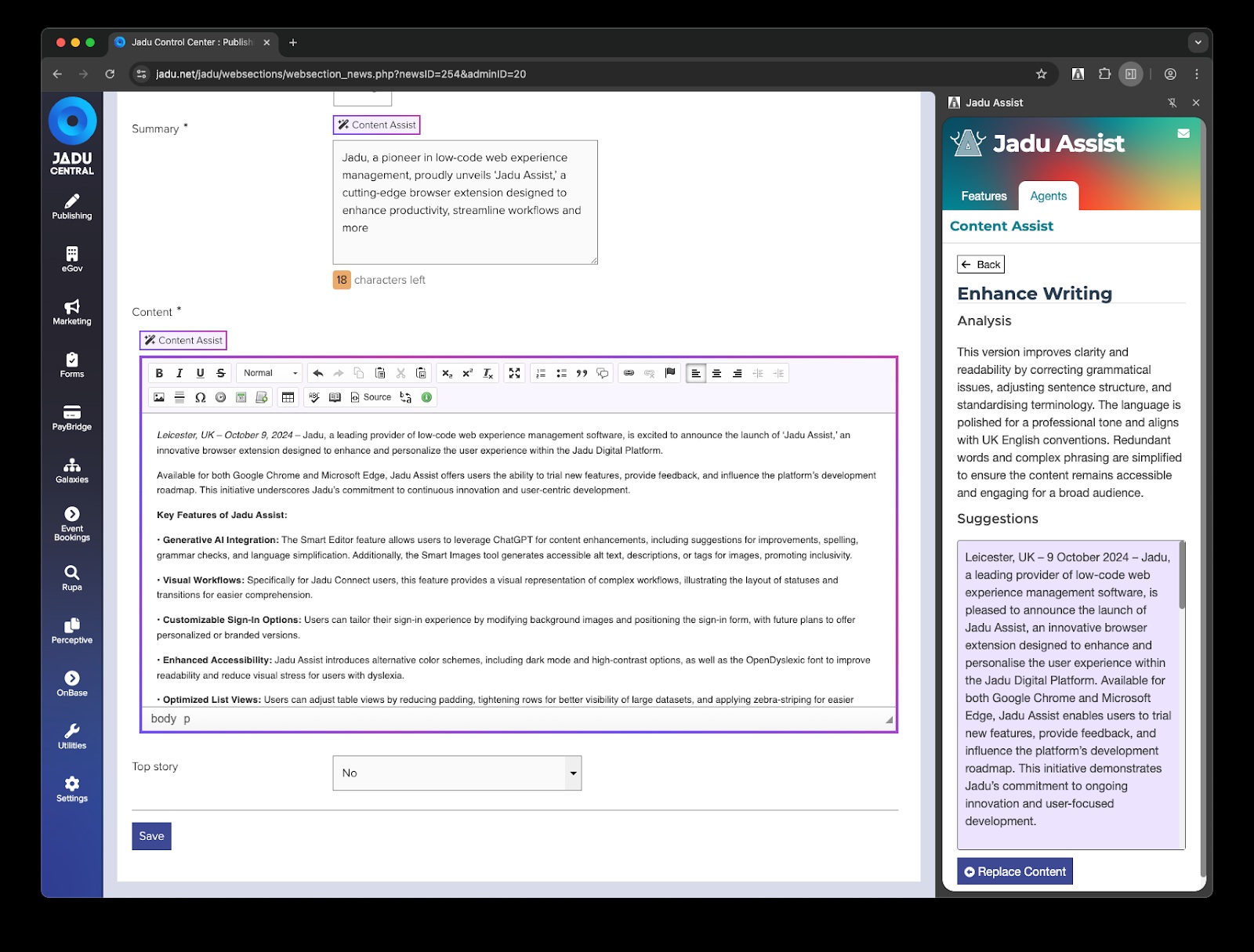
Liverpool’s February 2025 selection of Jadu put these ambitions in a wider service context. The planned connections included Brightly Confirm for highways and NEC for revenues and benefits. The announcement projected roughly £1.8 million in annual recurring savings. That figure was an ambition at selection, with integration and service reform still doing the heavy lifting.
“AI is powerful, but expensive if mis-used.”Suraj Kika · Liverpool announcement, February 2025
The Netcall chapter
Jadu dates its founding to 2001, when Suraj Kika and Andy Perkins started the business. Its naming story invokes Arthur C. Clarke and the Sanskrit word for magic. Two decades later, a more literal simplification followed: in 2022 it combined its CMS and forms products under Central and renamed its CXM product Connect. The names describe the work more plainly than the old acronyms.
Netcall acquired the group in December 2025. The announcement put initial consideration at £15.2 million, with up to £4 million more dependent on performance. It described about 120 customers and over 80 staff. For the year to September 2025, Jadu had £7.4 million in revenue, 76% recurring, and an adjusted EBITDA loss of £0.3 million, based on unaudited figures.
Netcall’s stated rationale was to bring Jadu’s digital-experience capabilities together with its Liberty automation and customer-engagement platform. Existing routes to market include partners such as DataBank IMX and Naviant. Brightly’s Community Central partnership illustrates the technical logic: connect resident-facing services with Confirm asset information so people can see existing issues and avoid duplicate reports.
Borrow the form. Own the handoff.
For a public-service team, the most immediately copyable feature may be Jadu Library. Customers and partners can share forms, case types, widgets, themes and service-design documentation. Reusing an existing pattern offers a starting point for work that another organisation has already attempted. It also leaves more time to investigate what is different locally.
Implementation still needs owners. Jadu’s onboarding documentation calls for live and test environments, identity configuration and payment-integration details. It describes testing forms and workflows before moving them into production. Low-code tools can change who builds a service, but the organisation still has to decide who receives the request, who can see the information and what counts as resolution.
That is also where the proposition has limits. If a team cannot connect its operational systems or maintain its content, a new front end can leave the original delays intact. An organisation needing only a simple publishing site may have little use for the wider case-management stack. The useful test is concrete: submit a request, follow every handoff and see whether the person who asked can find out what happened.