A television transmitter seems an unlikely place to look for a theory of enterprise software. It sends a signal. Someone watches. But Gaian saw another possibility: a broadcaster possessed a delivery network whose usefulness extended beyond the evening schedule. The interesting question was what else could travel through it, and who would pay.
- Mobius connects data, automated workflows, apps and marketplaces.
- Its broadcast work supplies a concrete example of that approach.
- The buying question: does connecting the parts improve a real process?
In 2022, Gaian introduced Mobius Marketplace, including an AI-based spectrum-planning tool for ATSC 3.0, the standard behind NextGen TV. The proposition treated a broadcast channel as divisible capacity. Software could help organize that capacity into services. An infrastructure asset acquired another commercial life.
That is a useful doorway into Mobius by Gaian. The company now talks about enterprise AI, low-code development and digital transformation. Those are roomy categories. The narrower, more revealing idea is that organizations already own useful things which their systems make unnecessarily difficult to combine.
The bottleneck was between the machines
Founder and CEO Chandra Kotaru comes from media and content-delivery engineering. His ATSC conference biography lists work at companies including Microsoft, DirecTV and Hewlett-Packard. It also describes his architecture work on India’s ocean-weather and tsunami alerting platform. Moving information across different channels was part of his professional vocabulary well before today’s enthusiasm for AI agents.
Gaian’s February 2022 account of broadcast commercialization is refreshingly specific about the obstacles. Alongside technical and commercial barriers, it identifies “missing business workflow orchestration capabilities.” Broadcasters needed ways to discover available spectrum, combine it and transact. Better transmission alone would leave the business problem sitting there.
“missing business workflow orchestration capabilities”
Gaian, describing broadcast barriers in 2022
The proposed response linked a low-code television designer, a content-management system and a marketplace. Production staff could assemble applications; data feeds could update them; deployment could reach multiple stations. The product’s logic lay in those connections.
A workshop changes the question
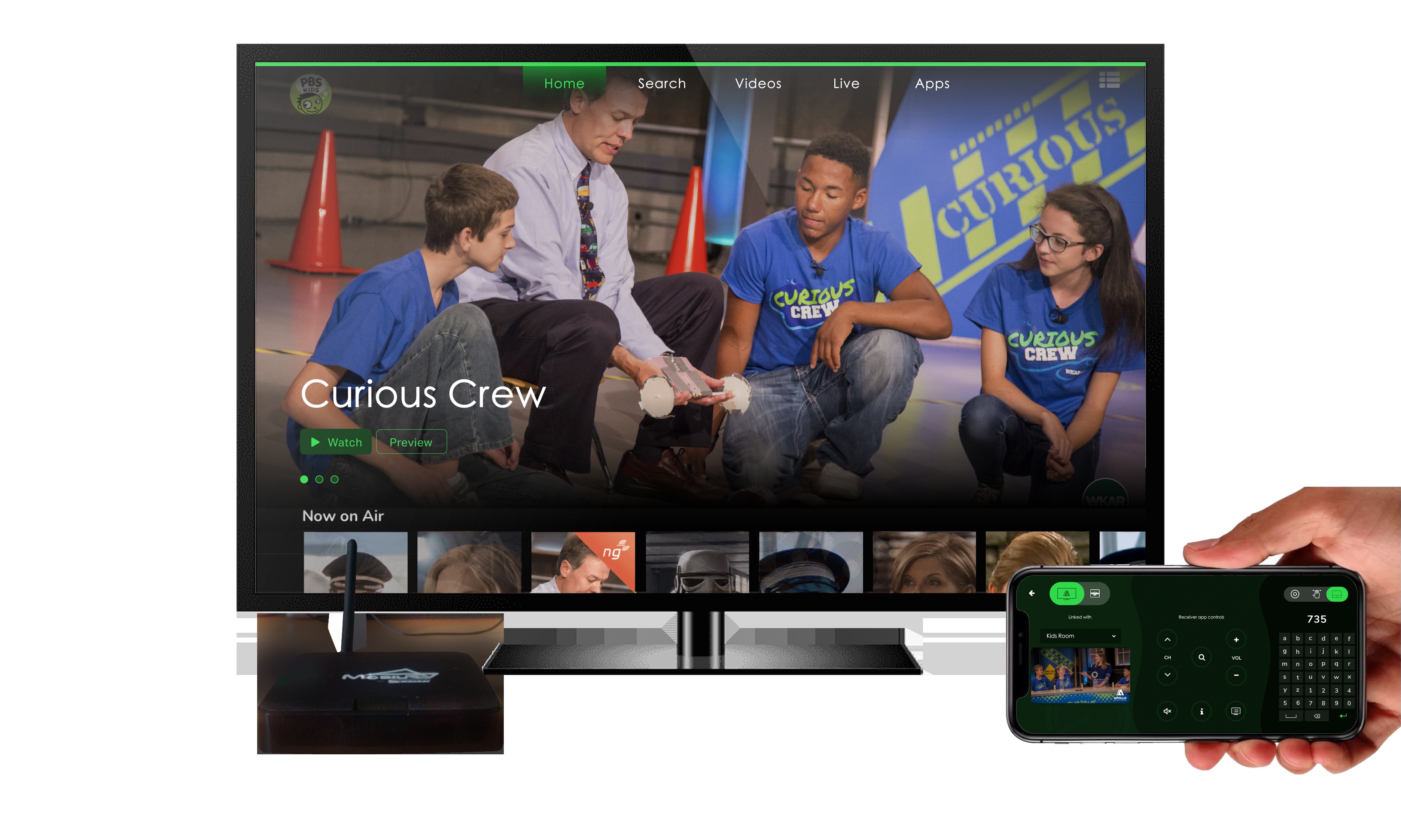
A product consultant’s published account adds a useful wrinkle. Sai Charan describes working on a Mobius on-demand and live-broadcasting service with a six-person team over four months. The early question was commercial: with streaming services already plentiful, where would another offering fit?
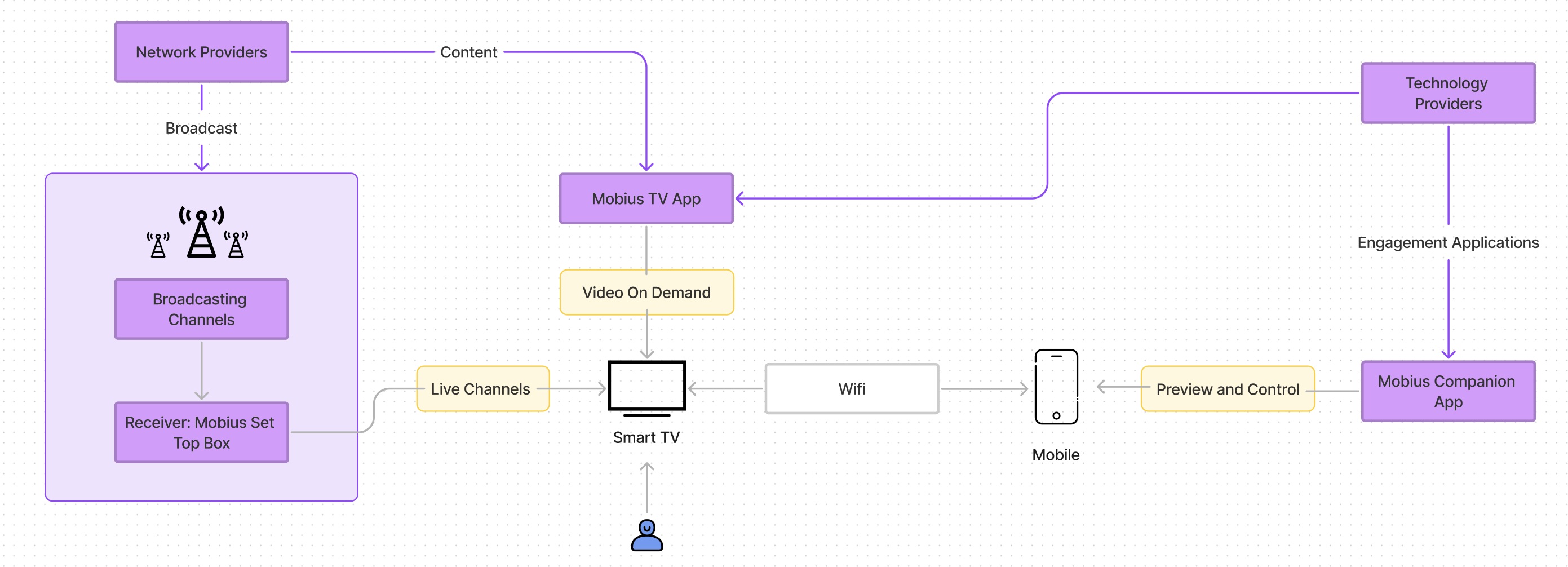
His account says workshops with American beta clients exposed an opening around live engagement. That informed a service connecting television, a receiver and a companion mobile app. The lesson is modest and worth stealing: ask what the participants need from one another before polishing the interface. It is a design account, rather than proof of a company-wide pivot.
The distinction matters because Mobius’s appeal depends on the whole service working. A phone controlling a television is familiar. Connecting broadcast content, applications and shared data into a coordinated experience asks more of the underlying platform.
Pascal gets the data. BoB gets the job.
The enterprise suite divides that work into named tools. Pascal Intelligence handles data and analytics. BoltzmannBot, shortened to BoB, orchestrates workflows. Monet builds applications and experiences. Vinci handles engagement across channels. Marketplace tooling appears under names including HolaVerse and Holacracy in public materials.
The names are memorable; their division of labor is more useful. An organization needs information to move from a source into a decision, then into an action and something a person can use. Mobius positions its tools along that journey. Its business spans software platforms and the implementation work involved in digital transformation.
This puts Mobius at the intersection of several markets: low-code development, automation, data platforms and systems integration. A buyer could assemble separate products for those jobs. Mobius’s proposition is to bring the jobs into a connected environment. The value depends on how well the connections survive actual business requirements.
The factory has a broadcast pedigree
There is outside recognition for parts of this work. Gaian’s spectrum-planning tool received a 2022 NAB Show Product of the Year Award. ATSC’s 2023 list includes five Gaian winning entries: radio delivered over ATSC 3.0, two software-update and automation entries, a monetization framework, and Mobius DTaaS, described as a SaaS Factory.
Gaian entries in ATSC’s list of 2023 NAB Product of the Year winners.Awards across several categories, not a customer or revenue count.
That record explains the company’s unusual range. Its intended users include broadcasters and spectrum owners, enterprise teams and public-sector organizations. The Nexus Connect catalog describes ImpressIO, powered by Mobius DTaaS, as a signage application combining content, communication and data. Again, a physical endpoint becomes part of a wider software service.
The learning requirement is visible too. The Platform Academy advertises separate courses for PI data engineering, BoB workflow modeling and Monet app development. Low-code still involves understanding the job. Someone must decide what the data means and what happens when a process encounters an exception.
Give the intelligence somewhere useful to go
Mobius’s current messaging extends to autonomous agents and governance. Its website now presents a broader intelligence thesis under the Rasa Foundation, emphasizing truth, accountability and foundational commons. These are stated architectural and institutional ambitions; they should be read separately from the broadcast products and award record.
The practical test remains pleasantly concrete. Choose one workflow. Identify its inputs, permissions, owner and exceptions. Include integration, training and ongoing oversight in the buying calculation. A low-code interface cannot resolve conflicting instructions or supply access to a system that remains closed.
For readers building their own services, the transferable idea is to examine the handoff. Who has the asset? Who needs the information? Who is allowed to act? Mobius’s broadcast story makes those questions visible. A useful platform earns its place when the answer travels all the way from the data to the person waiting for it.