The glamour of artificial intelligence lives in the reveal: a prompt, a pause, an answer that seems to have arrived from the near future. Amit Akhelikar has built his career in the long stretch after the applause. His work begins when a prototype meets a customer database, a compliance process, a sales team, a budget, and the mild terror of changing something that already runs. That is a useful place to begin a story about the new CEO of Lynx Analytics. It is also the part of AI that enterprises eventually have to pay for.
Akhelikar took the chief executive role on March 1, 2026, when Lynx Analytics and LynxKite became independent companies. The split put daylight between two businesses that had grown together: a consulting and services operation on one side, and a product company built around knowledge graphs and platform technology on the other. Lynx Analytics would concentrate on life sciences and expand across the United States and Europe. Akhelikar, after nine years inside the firm, would run it.
The appointment rewarded familiarity with the unphotogenic machinery of a business. A colleague announcing the change pointed to Akhelikar’s fingerprints on delivery, customer outcomes, operational strength, and team culture. Akhelikar’s own note was warmer but no less practical. What mattered most, he wrote, was the impact created for customers. The technology would evolve; the value would come from helping leaders make better decisions, move faster, and find new paths to growth.
A career with one stubborn question
The industries changed before the question did. Akhelikar began in the United States at BusinessEdge Solutions, working across telecommunications and financial services. At BT in Britain, he moved into broadband customer experience. A former manager remembered handing him a program that was behind schedule: build a way to track automation across core products and put it into the hands of sales and service teams. Six months later, the system was deployed. The assignment widened to the customer experience of broadband and value-added services.
Then came mobile banking at Barclays, followed by Vodafone, where his digital customer experience brief spanned 21 countries and the My Vodafone app. The scale is worth lingering over. A feature that feels obvious in one country may collide with billing systems, languages, regulation, device habits, and local commercial priorities in another. During his tenure, digital engagement tripled and global customer Net Promoter Score recorded double-digit growth. Those are customer numbers, but they are also evidence of coordination.
The customer-decision route
Seen from 2026, this looks like preparation for enterprise AI. The hardest question was never whether a model could produce something interesting. It was whether a large organization could absorb the change, whether an employee could understand the recommendation, and whether a leader could connect it to a result. Telecom taught Akhelikar about distribution. Banking taught him about trust and commercial responsibility. Consulting made the translation itself the product.
“AI surfaces the signal. Expert review makes it actionable.”Amit Akhelikar
The demo ends. The workflow begins.
Lynx now describes Akhelikar’s task as moving from bespoke analytics toward scalable, capability-led AI solutions. The language can sound abstract until it lands in a day’s work. One recent example dealt with thousands of comments scattered across employee onboarding, engagement, exit surveys, and public review platforms. Manual sampling missed too much; fixed taxonomies aged too quickly. The AI system processed every comment and built themes. Human experts decided what those themes meant and what to do next.
That last handoff is the whole philosophy in miniature. Akhelikar does not present expertise as a decorative human layer added after the machine has spoken. Expert review is what turns a surfaced pattern into an accountable action. In his CEO announcement, he placed the company’s next investment in agentic AI frameworks and decision platforms. At JPMorgan Healthcare Week, he described the promise in terms of workflows: AI moving from insight to action by fitting into the systems people already use.
This pattern has particular weight in life sciences, the industry at the center of Lynx Analytics’ post-separation plan. Akhelikar’s commercial work there includes customer segmentation, omnichannel engagement, and tools intended to sharpen decisions across the market. He chaired the Customer Engagement track at Reuters Pharma USA in March 2026, framing the conversation around smarter targeting, personalization, trusted AI, and measurable engagement. The recurring noun was not novelty. It was value.
A network built for field notes
Akhelikar’s second operating system is a community. He is president of the INSEAD Alumni Association in the United States and a co-founder of the alumni-led INSEAD AI network, alongside Robert Maciejko and Fabio Valle. The group calls itself a builder’s network, a place to exchange playbooks across markets and connect operators with researchers. Its inaugural AI 50 program drew more than 200 nominations and recognized 50 alumni, faculty, and friends for practical and responsible work.
There is an appealing consistency here. Inside a company, Akhelikar connects data people with commercial decisions. Around a school, he connects researchers, founders, operators, and investors with one another. Both require a curator’s instinct: decide which signal deserves the room. Both also demand generosity. The founders made themselves ineligible for the AI 50 honors they were selecting, a small governance choice that made the recognition cleaner.
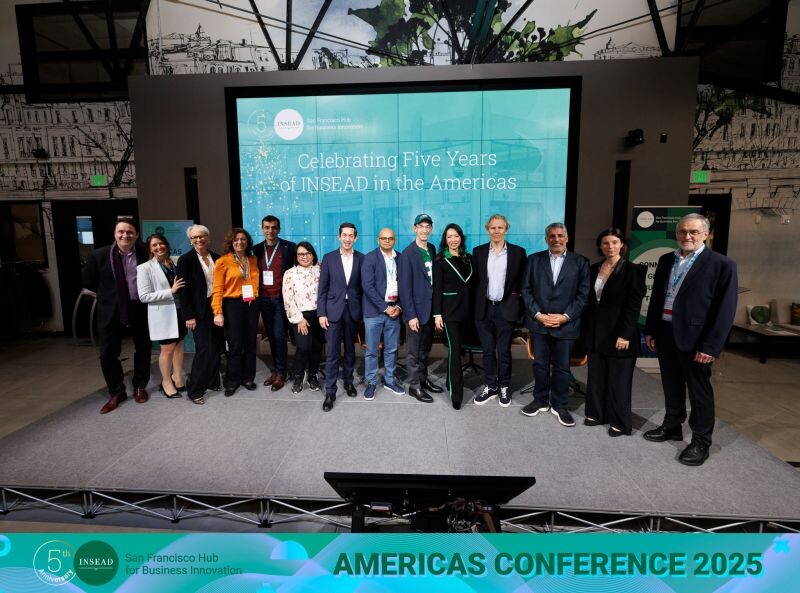
His public enthusiasm for INSEAD is unusually unguarded. He calls the network a lifelong connection and writes about its power to spark ideas and open doors. At the 2025 Americas Conference in San Francisco, attendees moved between conversations on AI and space technology, visits to Genentech and NVIDIA, and the social rituals that make a network more than a directory. Akhelikar’s account kept returning to the people who organized it. The executive voice briefly became the host thanking everyone before the chairs were stacked.
“The technology will continue to evolve - but the real value comes from helping leaders make better decisions.”Amit Akhelikar
The useful middle
Akhelikar’s route is neither the familiar founder myth nor a tidy climb through one corporation. It crosses countries, sectors, and functions. His education does something similar: an undergraduate engineering degree, a master’s in computer science, then an INSEAD MBA. The combination fits a career lived between technical possibility and commercial consequence. Even his lighter public biography keeps a foot in two worlds: Bay Area coffee culture and outdoor adventures.
What can another operator borrow from it? First, choose a durable problem rather than a fashionable tool. Akhelikar’s problem has been customer decision-making; broadband, mobile apps, graph analytics, and agentic AI have rotated around it. Second, treat adoption as design work. A solution that cannot survive twenty-one markets or one cautious enterprise team is still unfinished. Third, make the metric recognizable. Engagement, NPS, speed, and commercial effectiveness give different teams a shared scoreboard.
The Lynx separation adds a fourth lesson: clarity can be an operating advantage. A services firm and a product company may share technology and history while needing different rhythms, capital, and accountability. Giving each a separate mandate was less dramatic than announcing a dazzling model. It was also the kind of structural decision that determines whether dazzling models become durable businesses.
There is a telling modesty in the sequence. Akhelikar did not arrive at Lynx for the CEO announcement. He arrived years earlier and worked through different versions of the company and its market. By the time the businesses separated, he knew the consulting operation from the inside. Continuity became useful precisely because the strategy was changing. The new title altered his authority, but the customer argument behind it had already been rehearsed in delivery rooms, operating reviews, and commercial conversations.
That distinction matters in an AI market where a new vocabulary can make old work appear obsolete overnight. Akhelikar’s record suggests the opposite. Customer experience, data governance, digital engagement, graph analytics, generative AI, and agents are not isolated eras. Each adds a new instrument to the same organizational problem: how to notice something important and act on it with confidence. The executive who understands the connective tissue has an advantage over the tourist collecting shiny nouns.
Akhelikar now has the title that makes every operating choice louder. The agenda includes agentic frameworks, decision platforms, life sciences, and growth across the United States and Europe. Yet the interesting bet beneath those nouns is plain. Intelligence must enter a workflow, meet expert judgment, and leave behind a better decision. The future, in this version, arrives with an owner, a metric, and perhaps a second cup of coffee.