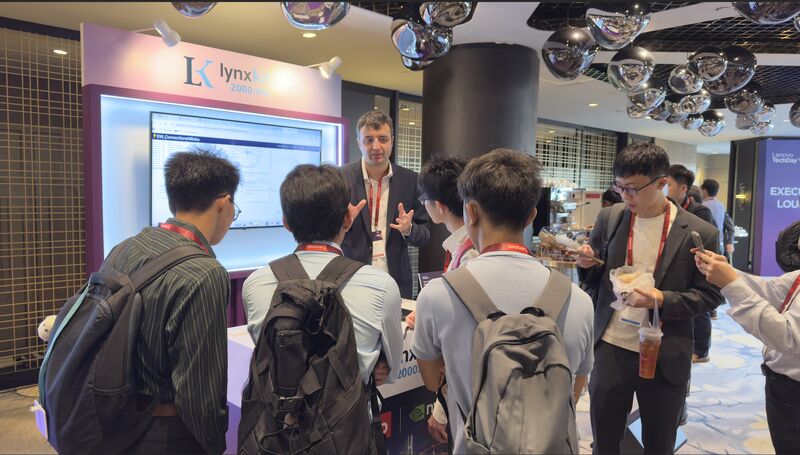
In January 2026, Gyorgy Lajtai stood beside a screen at Lenovo TechDay, explaining LynxKite to a small crowd. There were backpacks, red lanyards, refreshments and a software demonstration. It was a familiar piece of the technology business: someone has built something complicated, and now another human being needs to understand why it matters. For Lajtai, that small transaction has been a recurring occupation.
A few weeks later, the transaction grew considerably larger. On 1 March, Lynx Analytics and LynxKite became independent companies. Lajtai moved into the chief executive role at LynxKite. Amit Akhelikar took over as CEO of Lynx Analytics. After years of building a business that combined consulting with its own technology, the founder had chosen to give the product a company of its own.
That decision provides a useful way into his story. Lajtai’s career has passed through consumer finance, an online environmental ratings venture, a business school’s marketing systems and a Singapore analytics company. Across those changes, the practical question has stayed remarkably consistent: how do you turn information into something another person can use?
The credit card before the graph
Before there was a LynxKite demonstration screen, there were financial products. From September 2002 to February 2008, Lajtai worked at GE Capital Consumer Finance in financial analysis, product management and project management. His assignments included credit cards, unsecured lending and payments linked to mobile services. These were systems with customers, transactions, distribution channels and many opportunities for a detail to go astray.
Consider the ordinary credit card. To its holder, it is a rectangle that makes a purchase possible. Behind that rectangle sit several organizations, rules and records. Lajtai’s work included a T-Mobile credit card connected to mobile payments and value-added services. The assignment put him at a junction between a financial institution and a telecommunications company long before those two industries became early markets for Lynx.
This is the most useful context for his later career: experience with the machinery underneath a consumer’s apparently simple action. A technical system has to survive contact with product requirements and customer expectations. A payment can be elegant on a diagram and troublesome at a till. The diagram has the easier job.
In 2007, he studied for an MBA at INSEAD. He also holds an honours degree in business studies from Oxford Brookes. His education brought him into a setting that would later supply collaborators as well as a credential. The next company in his story would emerge from the overlap between academic work and business problems.
A detour through other people’s opinions
Lajtai’s next venture concerned environmental information. He co-owned GreenerOne, a Silicon Valley company building crowdsourced eco-ratings for consumer products. His business development work took him across Silicon Valley, Britain and France. The job included shaping a proposition using investor feedback and negotiating with online retailers and consumer websites.
A crowdsourced rating asks a deceptively awkward question: whose information should a buyer trust? A shopping page gives a product a tidy place to sit. The opinions surrounding it are much less tidy. They arrive from different people, with different knowledge and different incentives. GreenerOne brought Lajtai into a business where the usefulness of information depended on its relationship to a buying decision.
By February 2009, he was working on customer relationship management and marketing automation at INSEAD. His account of the assignment includes replacing a failed PeopleSoft CRM implementation with Siebel on Demand. He worked on priorities for executive education, linking sales, analytics and marketing across several regions. The title was advisory; the substance involved making a working system out of an institutional ambition.
Look at those assignments together and the career has a recognizable texture. A card has to connect services. A rating has to reach a shopper. A business school has to turn interest into a relationship with a participant or corporate client. Each job places technology inside a chain of human decisions. The connection itself becomes part of the work.
A professor, a student, and a different kind of graph
Lajtai co-founded Lynx Analytics in 2010 with a team from INSEAD. Miklos Sarvary, then the school’s dean of executive education in Singapore, encouraged his former MBA student to help lead the venture. Academic ideas about networks were meeting a familiar commercial frustration: companies could accumulate substantial information and still struggle to decide what to do with it.
The company chose telecommunications, mobile advertising and financial services as early testing grounds. That choice gave its work a demanding setting. Telecom businesses have large data sets and customers whose activities connect them to one another. An analytics product would have to deal with that scale while producing an answer a business could act upon.
“We started Lynx Analytics in 2010 to test out our ideas of applying graph theory to solve business problems.”Gyorgy Lajtai
The word “graph” needs a moment here. In this work, it refers to connected objects and the relationships between them. Imagine people joined by calls, products linked to buyers, or documents connected to their authors. Those links become information that can be examined alongside the objects themselves.
By 2016, Lynx’s interconnected graph solution had received a merit award in Singapore’s National Infocomm Awards. LynxKite was already part of the company’s technology. The product that became independent in 2026 had a history inside the earlier business; its name had appeared in Lajtai’s own writing about the Spark summit in 2015.
Singapore was the base. Hong Kong was a test.
Lajtai is based in Singapore, but the work spread beyond it. Lynx Analytics entered Hong Kong in 2016, responding to demand from corporations in the city and the surrounding region. Its local and international team worked with academia and Hong Kong Telecom. For a business selling ways to understand connections, partnerships were also a practical means of getting work done.
In a 2024 account of the Hong Kong operation, Lajtai emphasized access to macroeconomic and corporate data, improving data infrastructure and the possibilities of sharing information across industries. His reasoning was concrete. A market’s value to an analytics business depends partly on the information available there and partly on the organizations willing to use it.
That places expansion in a different light from the customary map covered in triumphant pins. The significant question is what a team can learn and build in a place. Telecom partnerships, academic relationships and corporate customers supplied different pieces of that opportunity. Geography mattered through the work it made possible.
The founder who helped send a spirit to school
There is an unexpected classroom in Lajtai’s career. In 2020, he co-authored a paper with Daniel Darabos and Andras Nemeth about Tokamak Elementary, a game combining a visual novel with natural language understanding. Its AI character, Toki, is a spirit learning about the human world. The player teaches Toki, then sends the character to school.
The game alternates between conversation and scripted scenes. What Toki learns changes the responses given at school, opening different paths through the story. The paper describes an educational demo involving music theory. Players progress by explaining concepts to their pupil. A magical creature’s school day becomes a test of whether the instruction has worked.
It is an amusing entry in a founder’s record, and an unusually tangible one. An AI system can seem impressive while it talks. Toki has to carry something learned in one setting into another. The consequences become visible in the game. The exercise brings a technical question down to a scale where a player can argue with it.
Lajtai was one of three authors. Darabos would later join the independent LynxKite as CXO and a board member. Their shared work therefore includes both a conversational game and the next organizational chapter of a graph analytics product. The school-going spirit makes an agreeable companion to a corporate timeline.
When language arrived, the connections stayed
As large language models entered enterprise software, Lajtai continued to advocate combining them with knowledge graphs. He shared work by Lynx’s data science director Marton Szel on LynxScribe, a multilingual chatbot. His argument concerned factual answers: generative capabilities could be supplemented by structured connections among the information a company actually held.
The team’s approach linked pieces of text to other useful information and used graph queries to retrieve material for an answer. Its examples included prices and promotions for telecom customer service. A conversation could also supply links between related pieces of information. The aim was to give the answer more context than an isolated passage could provide.
That work connects naturally to Lajtai’s earlier assignments. A marketing system needs the relevant customer record. A payment product needs the right service relationship. A chatbot needs information that belongs to the question. The technology changes, while the demand for usable context keeps returning.
Giving the kite its own string
The March 2026 separation made a distinction that had existed within Lynx explicit. Consulting services and a software product require different operating models and investment paths. Lajtai chose the product business. His announcement described the milestone as personal as well as strategic, and emphasized the combination of graph expertise with accelerated computing.
Consulting and services
CEO: Amit Akhelikar
Product development
CEO: Gyorgy Lajtai
The founder remains on the board of Lynx Analytics. At LynxKite, his stated priorities include product and partnership growth and enabling investment. NVIDIA and Nebius feature in the independent company’s partner strategy. These are business commitments with work ahead of them, rather than completed achievements to hang on a wall.
Seen through that decision, Lajtai’s career is a succession of attempts to make connections useful: between services and payments, information and shopping, a business school and its customers, academic research and enterprise problems. At the demonstration screen, that purpose becomes pleasantly ordinary again. Someone asks a question. He explains the software. A connection earns its keep.