A graph, at first glance, is almost insultingly simple. A few dots. A few lines. The sort of thing one might draw while a meeting decides whether it needs another meeting. Rajeev Shrivastava sees something more useful: the structure of a decision. The dots are customers, accounts, devices, suppliers, events. The lines explain who knows whom, what depends on what, and why an apparently ordinary signal might matter. In an AI industry enchanted by the eloquence of machines, the CEO of TigerGraph keeps pointing back to the evidence.
Shrivastava took the job in August 2024 after six years at Google, where he led an AI-first customer conversation platform. Before that came a run through NICE inContact, Rackspace, and Satmetrix, spanning product management, strategy, marketing, business development, and general management. It is the résumé of someone who has spent a career near the seam between impressive technology and the impatient customer asking what, exactly, it does for them.
His opening agenda at TigerGraph had three pillars: innovation, customer success, and growth. This is respectable CEO furniture. More revealing was the reason he gave for joining. Graph analytics, he said, could uncover deep connections and insights from vast amounts of data. He was drawn to the company’s scale and depth, but also to its capacity to expose relationships. The language has become more urgent as AI systems have moved from producing drafts toward influencing real operations.
A career built at the seams
There is a tidy metaphor hiding in Shrivastava’s education. He earned a bachelor’s degree in civil engineering from Delhi College of Engineering, then an MBA in strategy and finance from Wharton. Civil engineering teaches that a structure is not a pile of excellent beams. Its behavior lives in the joins, loads, dependencies, and failure paths. An MBA turns the same instinct toward markets and organizations. Decades later, Shrivastava runs a company whose product turns entities and relationships into queryable infrastructure.
The path was not a straight march toward databases. At Satmetrix, he worked across product management, marketing, and business development. At Rackspace, his remit included product marketing and marketplace initiatives. At NICE inContact, he served as chief product and strategy officer. At Google, he managed a substantial business and teams working on AI for customer conversations. Each role added a different view of the same commercial machine: how a product is conceived, explained, sold, scaled, and judged by people outside the building.
That breadth matters because enterprise infrastructure has two audiences who often speak past one another. Developers care whether the system is expressive, fast, and manageable. Executives care whether it reduces loss, reveals risk, or improves a decision before the decision becomes expensive. Shrivastava’s public language moves easily between the layers. When TigerGraph expanded hybrid graph and vector search, he talked about putting tools in developers’ hands. When describing the company’s direction, he returned to business outcomes and customer experience.
His board work adds another angle. Shrivastava has been identified as a founding investor and board member at SupplyHub.AI, and previously served on the boards of Talligent and Goombal. Goombal was later acquired by Verizon. A board seat changes the questions a product leader must ask. The feature under discussion sits inside a financing plan, a hiring plan, a distribution strategy, and somebody else’s tolerance for risk. It is another exercise in tracing dependencies before they become surprises.
The move from customer-conversation software to graph infrastructure looks wider than it is. A conversation platform has to assemble intent, history, identity, and the next useful action. A graph platform models entities, histories, and the relationships that shape an action. Both are concerned with context at the moment a person asks for help. Shrivastava did not leave the customer problem behind when he left Google. He moved closer to the data architecture underneath it.
“The engineer in me is excited to put these solutions directly into the hands of developers.”Rajeev Shrivastava
The model knows words. The graph knows context.
Shrivastava’s central argument begins with a frustration familiar to anyone who has searched an organization’s files. Enterprises own abundant information but distribute it across databases, applications, and documents. A language model can summarize what it retrieves. A vector search can find passages that resemble a question. Yet many consequential questions are relational. Which accounts share a device? Which order depends on the delayed component? Which access request diverges from a person’s established pattern? The useful answer sits along a path.
If the system does not preserve those paths, the model has to reconstruct context again and again. That costs tokens, introduces ambiguity, and makes the conclusion harder to inspect. Shrivastava has described a “relationship runtime” as a missing layer in the AI stack: compute the connections where graph systems are designed to compute them, then make the resulting context available to applications and models. The proposal is less glamorous than a talking robot. It is also the sort of plumbing on which talking robots eventually depend.
The same logic becomes more important with AI agents. A research agent discovers a fact. A risk agent evaluates it. An execution agent acts. Without shared context, each begins as a brilliant amnesiac, rummaging through the same cupboards. Shrivastava argues that persistent context graphs can let agents share entities, events, and relationships while recording where the information came from. Autonomy, in his view, increases the need for coordination.
This is also a bet on explainability. A model’s answer can sound confident while concealing a weak retrieval trail. A graph path can show the sequence of relationships behind a conclusion. It does not abolish error, bias, or judgment. It gives the people responsible for a system something concrete to examine. In enterprise software, a visible path is often more valuable than another adjective attached to “intelligence.”
Consider what this changes for a product review. Instead of asking only whether an answer is accurate, a team can ask which entities shaped it, which relationships were traversed, how current those links are, and whether another system can reuse the same context. Those are less theatrical questions than asking a model to perform live. They are also closer to the questions an operator faces after the demo, when the software meets permissions, changing records, and accountability.
The customer is another node
Shrivastava’s management thesis mirrors the architecture he sells. In his first TigerGraph interview, he said customer needs would guide product value and stronger relationships. Innovation, customer success, and growth were not three isolated boxes. Listen closely to customers, direct the team toward a real problem, produce an outcome, and earn the right to expand. The organization itself becomes a graph of feedback rather than a conveyor belt of features.
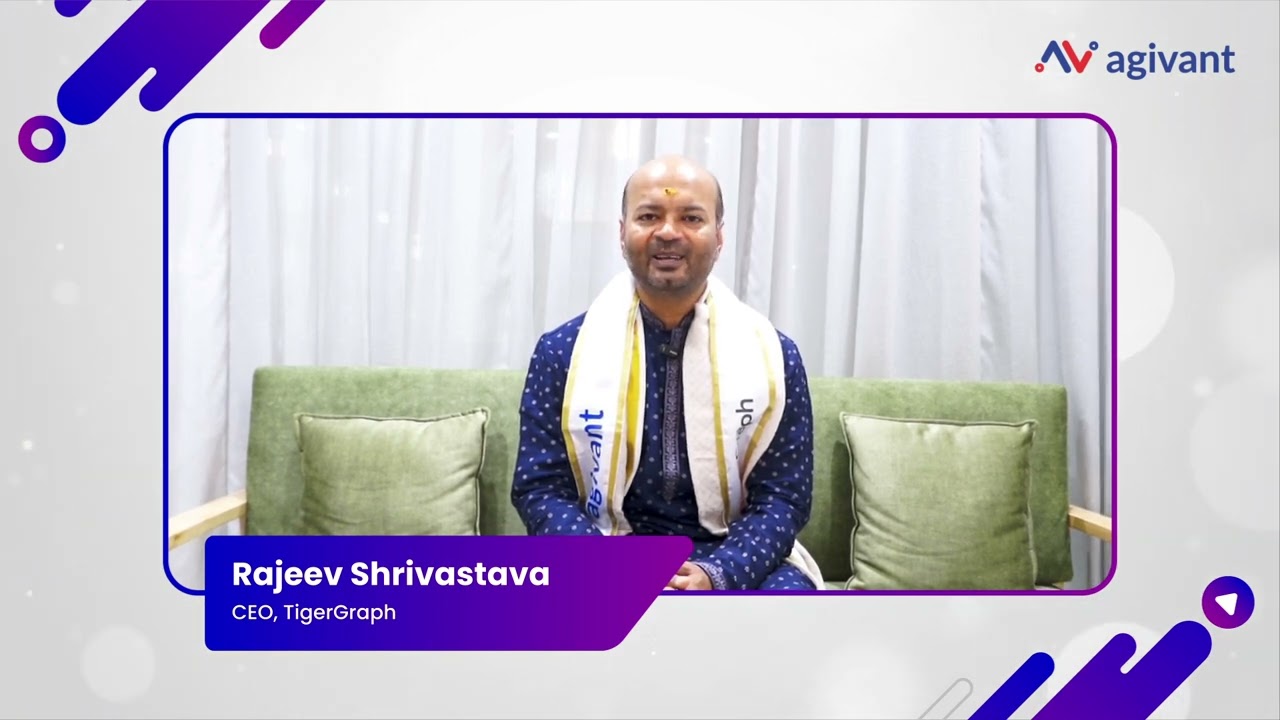
That view showed up in Hyderabad, where Shrivastava appeared as chief guest for the inauguration of the TigerGraph Global Engineering Center and Agivant office. The ceremonial scarf and stage were a long way from a database query, but the event illustrated another part of his agenda: partnerships and distributed teams as practical extensions of product capacity. Software may be weightless. Building it remains a human coordination problem.
Away from work, the available details are modest and revealing. Shrivastava has said he enjoys family time, new technologies, and outdoor activities. For nearly four years in Austin, he volunteered as a youth soccer coach for children ages five through ten. Coaching that age group is applied systems theory with loose shoelaces: establish a few clear rules, notice the whole field, and accept that the ball will occasionally travel in a direction no strategic plan anticipated.
“Agentic AI will increase the need for coordination, not reduce it.”Rajeev Shrivastava
A useful suspicion of easy answers
By 2026, Shrivastava’s writing had settled into a recognizable rhythm. Enterprise AI needs relationships. Agents need shared memory. Retrieval should surface connected context. Decision quality matters more than activity metrics such as token volume. The repetition is deliberate. Product categories are often made by finding one important idea and explaining it until the market stops treating it as optional.
His preferred contrast is not between humans and machines, but between disconnected information and connected understanding. That choice keeps the argument grounded. A business rarely lacks facts. It lacks a reliable view of how facts affect one another across time. Once AI begins taking actions, missing those dependencies stops being an inconvenience and becomes an operating constraint. The graph, in this account, is a way to remember the organization as a living network rather than a filing cabinet.
His August essays pushed from retrieval toward judgment. One argued that the competition in enterprise AI would turn on better decisions, not larger consumption. Another laid out a hands-on context graph for persistent agent memory. The combination is characteristic: a boardroom claim paired with an implementation path. Strategy floats unless somebody can build it.
TigerGraph still has the ordinary burdens of an enterprise software company: earn attention, win deployments, support demanding customers, and turn technical differentiation into durable growth. Shrivastava’s aspiration does not make those tasks easier. It does give them a coherent center. The company is betting that as AI becomes more capable, businesses will care more about where an answer came from, how a decision was reached, and whether context survives from one action to the next.
There is a pleasant contrarianism in choosing the line over the dot. The AI conversation loves singular objects: the model, the agent, the chip, the app. Shrivastava keeps returning to the spaces between them. His career has done much the same, crossing engineering and finance, product and market, developer tools and customer outcomes. The interesting work, he suggests, happens where one thing meets another.
A dot can be impressive. A line can make it useful. And a well-drawn graph can tell you where to go next.