Paweł Wieczyński has a place in Wrocław where an argument can be settled without a presentation. He puts on boxing gloves. Across from him is a sparring partner, sometimes the entrepreneur Piotr Maksymowicz. They know one another. There are rules, an agreed pace and a certain amount of mutual respect. Whatever advantages a chief executive enjoys outside the ring, his title has limited persuasive power here.
Wieczyński likes boxing partly because it demands thought. You read the other person, adjust your approach and discover whether the adjustment works. It is a pleasingly economical arrangement for a person whose working life involves explaining complicated software. At DataWalk, the company he co-founded, feedback takes longer. Institutions have procurement processes. Projects have dependencies. A promising idea must eventually survive somebody else’s working day.
His business is built around connections: the relationship between records, the links an investigator might otherwise miss, the context that makes information useful. Increasingly, his public argument concerns another relationship altogether. How much control should the customer retain once the technology arrives? For Wieczyński, the answer reaches beyond a software contract and into Europe’s ability to build analytical capability of its own.
A founder with something at stake
In January 2019, ahead of DataWalk’s move to the main market of the Warsaw Stock Exchange, Wieczyński described a substantial personal wager. He said he had invested all his money in the company and worked seven days a week for more than half a decade. Whatever the eventual outcome, the commitment was already considerable. The investment had been measured in years before it could be measured on a larger exchange.
His education had taken him through management, logistics and quality management at Wrocław’s technical university, followed by a doctorate in economics at the city’s economics university. His professional background included involvement in aviation, information technology and finance. He came to DataWalk with the experience of an entrepreneur and investor. The technology’s creator, fellow founder Krystian Piecko, brought the data expertise.
That division matters. The story of software often collapses into a single founder’s portrait, as though a database, a sales operation and an international customer base were the work of one pair of hands. Wieczyński’s role sits at the junction: building a business around technology, recruiting people who could help it travel, and finding institutions willing to buy from a comparatively small supplier.
On February 28, 2019, DataWalk began trading on Warsaw’s main market, having previously been listed on NewConnect. It was a visible milestone in a less visible process. A listing could broaden the company’s access to investors. It could also bring more people into the audience for the next set of promises.
The corkboard gets a second life
Wieczyński has an accessible way of explaining the product. Think of the detective’s corkboard, with photographs joined by colored strings. Each picture contains information. The strings reveal relationships. A name by itself tells you one thing; the same name connected to people, places and transactions may tell you considerably more.
The scale is where the analogy starts to strain. An investigator can arrange a wall. Nobody can manually arrange billions of records and keep every relationship in view. DataWalk’s platform brings information from different sources into an analytical environment where users can examine those connections. The familiar visual idea becomes a way to work with much larger collections of data.
An illustrative network. Connections help an analyst ask questions; they still require interpretation.
His examples usually concern work with consequences: financial-crime investigations, public security, the reconstruction of events from scattered records. Those applications give the pitch its urgency. A connection can direct an investigator toward a useful question. It also needs to be understood. A line on a screen is an invitation to examine the relationship, with a person responsible for deciding what it means.
Getting through the American door
For a Wrocław software business, selling into American government investigations required more than a persuasive demonstration. It needed relationships, a local presence and people who understood enterprise customers. DataWalk’s American team included Gabe Gotthard, whose earlier career covered Hewlett-Packard and 3PAR. That experience gave the business a route into conversations that a Polish address alone could hardly arrange.
A specific foothold arrived in June 2020. DataWalk announced that the US Department of Justice’s Money Laundering and Asset Recovery Section, known as MLARS, would use its software, replacing Palantir. Research Innovations Incorporated, or RII, was the prime contractor; DataWalk supplied a component of the broader solution. The scope was a Justice Department section, an important distinction when a small company tells a large story.
- 2019Main-market trading begins in Warsaw.
- 2020DataWalk announces the MLARS selection.
- 2026Continued Justice Department program support through RII.
In February 2026, DataWalk announced continued support for the department’s Money Laundering, Narcotics, and Forfeiture program through a multi-year extension awarded to RII. Its software remained part of the Search and Investigative Flexible Toolkit. For Wieczyński’s business, the value of such work extended beyond getting through the door once. A reference had to become an ongoing relationship with people who depended on the tools.
When the delivery machine jammed
Success brought an awkward operational problem. In an April 2023 interview, discussing the previous year, Wieczyński acknowledged that DataWalk had fallen short on results. Its commercial machinery had struggled under an increasing number of customers and larger, more complicated projects. The company had to rebuild processes before and after the sale.
There is a considerable distance between a product that works and a company that can repeatedly deliver it. Every additional customer brings its own environment, expectations and staff. A demonstration can follow the seller’s script. An implementation follows the buyer’s calendar. The difference is liable to become expensive precisely when a founder thinks the business is beginning to find its stride.
Wieczyński’s public explanation made that middle stretch visible. In an investor discussion later that month, he described revising foundations, people and implementation processes. He reported early progress, including shorter deployment processes, while acknowledging that the work had taken more time and investment than expected. It was the language of rebuilding rather than a victory lap.
The episode gives his later emphasis on autonomy some weight. A platform designed for customers to operate still needs a company capable of helping them get there. The buyer’s independence and the supplier’s delivery discipline have to meet somewhere. Otherwise, the promise remains elegantly worded and inconveniently incomplete.
The other kind of sparring

Outside work, Wieczyński has tried paragliding, capoeira and K-1. Boxing became the activity he stayed with. In his 2024 account, he described training at Puncher Wrocław under Kacper Mielnik and choosing sparring partners he knew and respected. His interest was in the practice, with its adjustments and accumulated experience.
A taller opponent changes the problem. Sometimes he waits for an attack before closing the distance; sometimes he moves in short bursts to control the space. The account is technical and specific, concerned with what another person is doing. It offers a useful glimpse of the founder away from a corporate biography.
There is no need to declare that boxing explains his business career. People are allowed to have hobbies without putting them on a leadership slide. Still, the appeal he describes is revealing: experience counts, observation matters, and the other person deserves respect. A ring also provides a fairly stern editorial service. An attractive theory can be returned for revision almost immediately.
An answer you can examine
As artificial intelligence became a more prominent part of DataWalk’s public conversation, Wieczyński kept returning to context. In a 2024 interview, he described connected data as a foundation for AI systems and a means of making their operations more understandable to people. His concern was the active operator: someone able to examine the information behind an answer.
“You can walk faster if there is light.”
Paweł Wieczyński, on transparency in analytics, 2024
The image is modest for a technology executive. A lantern improves the conditions for a person to act. It leaves the person doing the walking. That fits his repeated emphasis on investigators using the tools, with judgment remaining part of the job. In his telling, software helps people reconstruct connections and reach conclusions; it does not acquire their responsibility for the investigation.
The question becomes especially concrete in institutional work. If a system produces a lead, users need to examine what informed it. A fluent answer may sound finished while the investigation is still beginning. Wieczyński’s case for graphs rests partly on that gap between receiving an output and understanding the context in which it was produced.
Who gets to keep the keys?
By September 2026, his discussion of European technological sovereignty had an unusually practical emphasis. Customers needed their own people and the ability to change their analytical environment. Hosting software locally was one part of the arrangement. The competence to operate and adapt it was another.
His position asks something of the buyer. An institution can purchase a platform, but it still has to recruit, train and retain people who know its work. Wieczyński argues that autonomy depends on that capability. The ambition is easier to announce than to staff. It turns a fashionable geopolitical phrase into a question about who can make a change on an ordinary working morning.
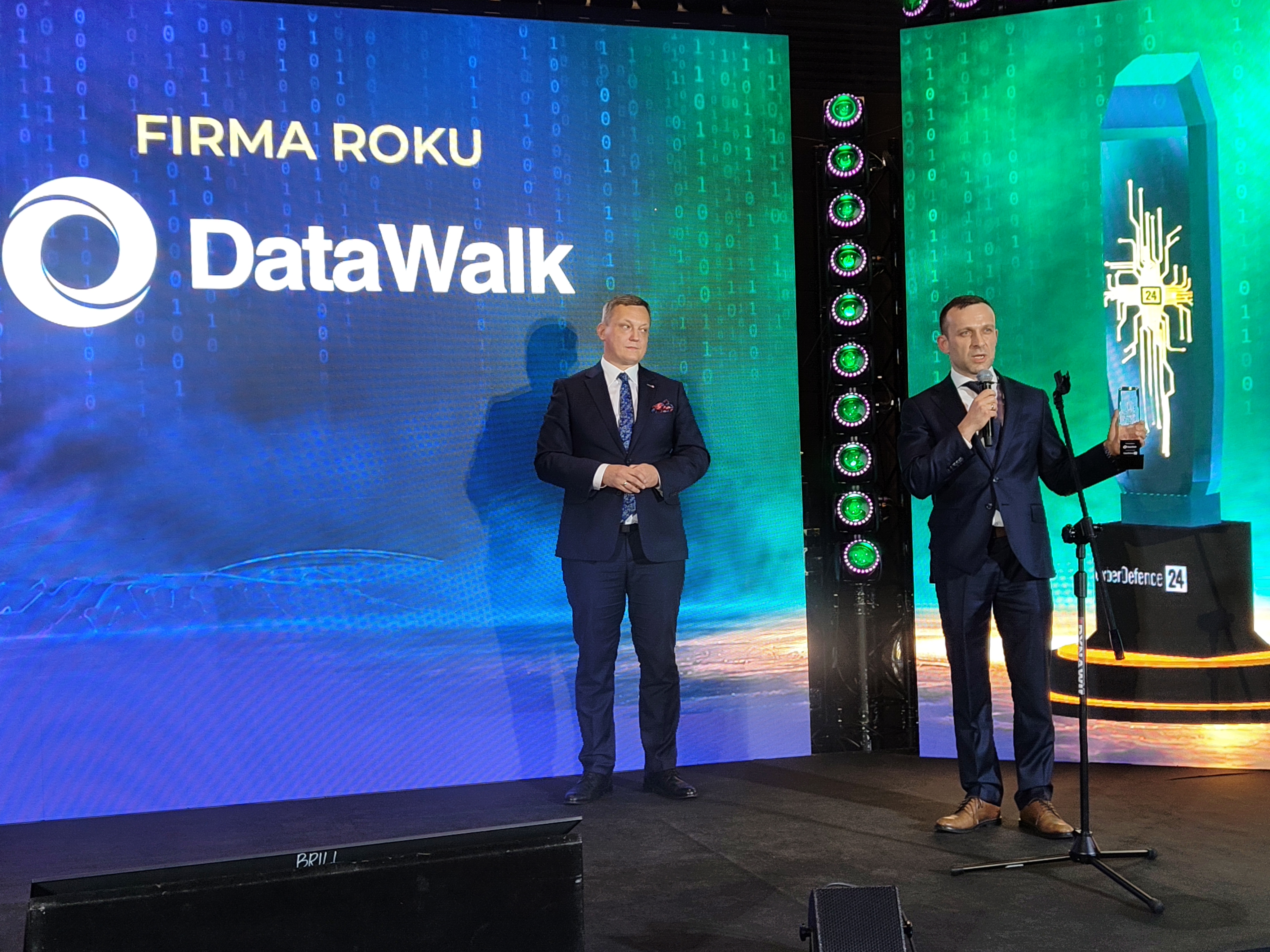
On October 7, he accepted DataWalk’s Company of the Year award at the Cyber24 DAYS gala in Warsaw. Krzysztof Gawkowski, Poland’s deputy prime minister and minister of digital affairs, presented it. The recognition arrived while Wieczyński was making the case for institutions to retain control over their data and analytical work.
The award makes a neat photograph. His underlying proposition is less photogenic and more demanding. A customer should be able to understand the tool, develop its own capabilities and adapt as the work changes. For a founder who has spent years trying to make connections visible, that is a fitting next question: once people can see the relationships, do they have the means to act for themselves?