Consider the word cash. It looks reassuringly uncomplicated. Then someone adds restricted, places an explanation in a footnote, and sends the statement to a lender with its own rules for assessing liquidity. The number may be perfectly readable. Its meaning has become a small negotiation.
This is the territory Cognaize has chosen. The company turns financial documents into structured data, but its more interesting promise concerns what happens between those two states. A figure must arrive in the right category, carry the right context and survive the checks that make it usable. Finance has a talent for making a tidy spreadsheet the final product of very untidy work.
- It reads the paperwork: financial statements, credit agreements, rent rolls and more.
- It applies the buyer’s rules: classifications and adjustments belong to the institution.
- It checks the result: failed checks trigger another attempt or expert review.
The spreadsheet has a secret author
In banking, financial spreading means transferring information from statements into a consistent analytical format. The clerical description undersells it. Somebody must decide which entity a figure belongs to, what a footnote changes and how a line item maps to the lender’s chart of accounts. The analyst is partly a reader and partly the keeper of a private dictionary.
Cognaize’s banking offering captures that dictionary in what it calls a Personalized Analytical Framework. Definitions for cost of goods sold, restricted cash and depreciation treatment become part of the processing instructions. The company’s description of the problem is refreshingly concrete: a template breaks when the filing changes; generic extraction loses context; the troublesome cases return to the analyst.
The failure begins before anyone complains about the speed of the model. A moved footnote or renamed line item can upset a rigid template. Extracting the digits correctly does little good if the system selects a subsidiary’s revenue when the analyst needs the parent’s. Faster copying leaves the expensive interpretation untouched.
“Your classifications, your adjustments, on every document.”Cognaize’s description of its approach
That is a useful way to locate the business in the market. Cognaize sells the preparation of financial data for institutions that already have systems, policies and people making decisions. Its pitch asks those institutions to supply their analytical framework, then promises to carry it through the document pile.
A reader with a checking department
The technical term is neuro-symbolic AI. Neural models handle the untidy material; symbolic models enforce explicit rules. Think of the first as a reader capable of working through varied pages and the second as a checking department with a list of conditions that must be satisfied.
Cognaize describes a pipeline that reads, structures, contextualizes, verifies and delivers the result. Its Semantic Kernel translates business definitions into executable formulas. A workflow engine chooses models and coordinates retries. According to the company, intermediate work can be reused, while harder models are called in when lighter ones fail a check.
This creates an economic argument as well as a reliability argument: avoid using the most expensive model for every page. It also makes exceptions visible. Cognaize says unresolved failures go to expert review. The human contribution begins with the definitions and returns when the document refuses to cooperate.
In its July 2023 funding announcement, founder Vahe Andonians argued that “even better comprehension requires a graphical understanding”. That concern helps explain the company’s attention to relationships across financial information. The structure around a value can matter as much as the words beside it.
A founder who knew the paperwork
Andonians brought experience in the machinery behind financial analysis. His current biography says he founded SCDM, a fixed-income analytics business acquired by Deloitte in 2017. Its work included data management, reporting, cash-flow simulations and valuations. He is also a senior lecturer at the Frankfurt School of Finance & Management.

The background matters because this product requires knowledge of how financial specialists work. An institution’s definition is something to capture and enforce, rather than an irritating deviation from a universal template. Cognaize’s public account of its team includes data scientists, software engineers, data architects and financial specialists.
The business has also attracted investors. In July 2023 it announced an $18 million Series A led by Argonautic Ventures, with Metaplanet and other investors participating. The announcement allocated the money to research, product development and commercial expansion. It reported fourfold annual recurring revenue growth in 2022. These were company disclosures, rather than an invitation to infer today’s revenue.
What happened to the work?
Cognaize’s published client stories are anonymous, which makes the process and the measurements more useful than the glamour of a customer logo. One financial-information project covered corporate, tax and bank reports. The company describes a tailored spreading system with more than 30 templates, multilingual support and integration into existing databases.
It reports validating 500,000 reports across 12 million pages, achieving 99.9% accuracy and reducing manual spreading time by 75%. The stated cost reduction was tenfold. These numbers describe that engagement. A procurement team should treat them as a reason to examine the workflow and its measurement method, rather than as a promise for every filing.
Another published engagement involved an ESG analytics provider. Cognaize reports processing 150,000 documents in six months with 98% accuracy. A fintech case describes handling more than 120,000 documents annually, including loan bank agent notices, with a 65% reduction in processing time. The different accuracy figures are a useful reminder that the document, task and checking regime matter.
For buyers, the practical question is what work disappears after extraction. How much review remains? How many exceptions return? Can the team reproduce the classification and trace the checks? A spectacularly quick first pass has limited charm if an analyst spends the afternoon repairing it.
The same nuisance, three different desks
The current product positioning concentrates on banks, private credit and commercial real estate. For private-credit teams, the documents include agreements, amendments and compliance certificates. A changed definition or side letter can alter the interpretation of a covenant. Monitoring requires the relevant relationships to survive extraction.
Property finance presents a different paper problem. Rent rolls, operating statements, leases and appraisals arrive from independent parties in differing formats. Cognaize offers to map and reconcile those documents to the buyer’s standards. Its role sits before the analysis: turn the deal file into data that lenders, investors, managers and servicers can use.
This is a competitive market. Ocrolus, for example, markets lending analytics and document understanding focused on bank statements, pay stubs and tax forms. Enterprise document platforms such as ABBYY are also alternatives. Cognaize’s distinctive emphasis is the institution’s own analytical rules and the verification surrounding the extracted answer. Buyers still need to compare products on their actual document set.
Bring the difficult file
Cognaize follows an enterprise sales model: request a demonstration and work through the institution’s documents and requirements. Deployment can be hosted or run inside the customer’s cloud or on-premise environment. The company states that customer data is isolated from training for other clients and that it maintains SOC 2 Type II compliance.
The approach asks something of the buyer. A bank must make its definitions explicit; a team must decide how exceptions will be handled. It is less useful when the institution cannot agree on the rules it wants enforced. The sensible evaluation is a representative batch that includes the awkward cases, with review effort counted alongside processing speed.
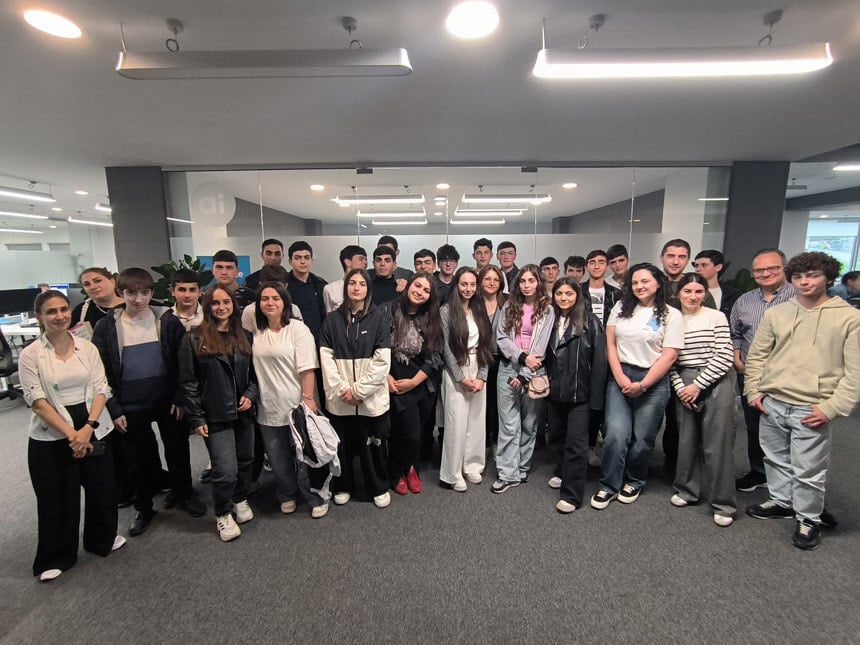
There is a wider human thread in the company’s activities. In 2024, Cognaize described equipping a school AI lab and hosting more than 20 students through Armenia’s Generation AI programme. Its Data Science and HR teams helped guide the visit. In May 2026 it joined FinTech Armenia Association as a founding member.
The lesson a reader can borrow is wonderfully unglamorous: write down what a correct answer must satisfy before asking a machine to produce it. In finance, the final number owes an explanation to the person who will use it. Cognaize has built a business around making that obligation part of the workflow.