The awkward thing about artificial intelligence is that a business still has to do something with it. A model can be a research achievement, a compelling demonstration and a conversation starter. Then someone asks how it will handle the documents already sitting in the office. The applause has barely subsided; the paperwork has arrived.
Huanbo Luan has spent much of his career around that gap. He is the Singapore-based co-founder and CEO of 6Estates, a company with roots in the National University of Singapore and Tsinghua University. His earlier work dealt with language, multimedia and information retrieval. Today, the company he leads builds enterprise AI applications and customised model services. The recurring subject is information that exists, but needs work before it becomes useful.
The customer has a different question
In a 2024 interview, Luan described a customer preference that should give an AI researcher pause: businesses in his region wanted applications ready for their work, rather than fundamental models as the purchase itself. The distinction puts a demanding audience into the room. The buyer wants a task completed. The builder may have spent years learning why the underlying technique is interesting.
For Luan, the move into enterprise work brought research into contact with that audience. His academic training included a Bachelor of Engineering from Shandong University in 2003 and a PhD from the Institute of Computing Technology, Chinese Academy of Sciences, in 2008. He later worked at NUS and helped lead the NUS-Tsinghua NExT research centre. Those are substantial preparations for understanding a technical problem. Running a company adds the question of who needs the answer.
His public ambition is practical. In a 2025 conversation, he described a desire to make AI adoption accessible and effective, emphasising enterprise customisation and customer control over data. There is no need to invent a dramatic conversion from academic to entrepreneur. His record offers a quieter story: the same difficult material, encountered in settings with different demands.
Before the boardroom, the noisy sentence
One of those difficulties is that text can mislead a machine without being especially misleading to a person. A sentence may contain the names of two organisations or people without explaining the relationship a system is looking for. Collect enough sentences, label them automatically, and the errors can become part of the training material. More data can bring more confusion along for the ride.
Luan co-authored Neural Relation Extraction with Selective Attention over Instances, published at ACL in 2016, with Yankai Lin, Shiqi Shen, Zhiyuan Liu and Maosong Sun. The work addressed noisy labels by giving different sentence instances different weights. In ordinary language, the system was being taught to pay closer attention to the evidence that mattered. It is a fitting problem for anyone who hopes to extract a dependable answer from an untidy collection of words.
Another 2016 paper, published at AAAI, explored knowledge graphs using descriptions of entities alongside their recorded relationships. Ruobing Xie, Zhiyuan Liu, Jia Jia, Luan and Maosong Sun investigated how those descriptions could help represent entities, including ones without an established set of connections. A description could contribute information that the structure of the graph alone did not provide.
Then came 2017 research on bilingual lexicon induction, co-authored with Meng Zhang, Yang Liu and Maosong Sun. The team explored connecting word representations across languages without the usual bilingual supervision. These papers concern different techniques, but read together they reveal a sustained research interest in getting meaning out of material that resists a straightforward lookup. That is an editorial reading of the work, rather than a claim about a single master plan.
A reading of three co-authored papers. These are research themes, not a product architecture.
A company with two universities in its family tree
The company’s early history had a different vocabulary from its current website. Founded in 2014, 6Estates initially offered real-time market and consumer intelligence in English and Chinese. The idea was to help businesses make sense of online information about brands, consumers and industry trends. Its university connection was concrete: technology came out of NExT, the joint research centre established by NUS and Tsinghua.
In the early leadership arrangement, Luan was CTO. Gary Chin was CEO, Chua Tat-Seng was chairman, and Roger Yuen was chief strategist. Luan also held the role of Deputy Executive Director at NExT. The founder group combined research and commercial experience. It is a useful correction to the familiar startup portrait in which one person appears to have invented the company, the technology and the coffee machine.
The current leadership includes Luan as CEO, Chao Wang as CTO, Chua as chairman and Yuen as chief strategist. Across the years, the business has moved from the language of consumer intelligence into enterprise applications, models and infrastructure. Those dated descriptions show an evolving offering. They also keep the research connection visible, even as the work and Luan’s responsibilities have changed.
The ribbon and the machinery behind it
On 22 September 2023, Luan stood at a launch ceremony with colleagues and partners, scissors in hand. The ribbon offered the usual ceremonial obstacle: everyone had to cut together while maintaining a respectable expression. Behind the group, the backdrop announced the deployment of NVIDIA DGX BasePOD infrastructure with DGX H100 systems. For an enterprise AI company, the machinery was the consequential part of the occasion.
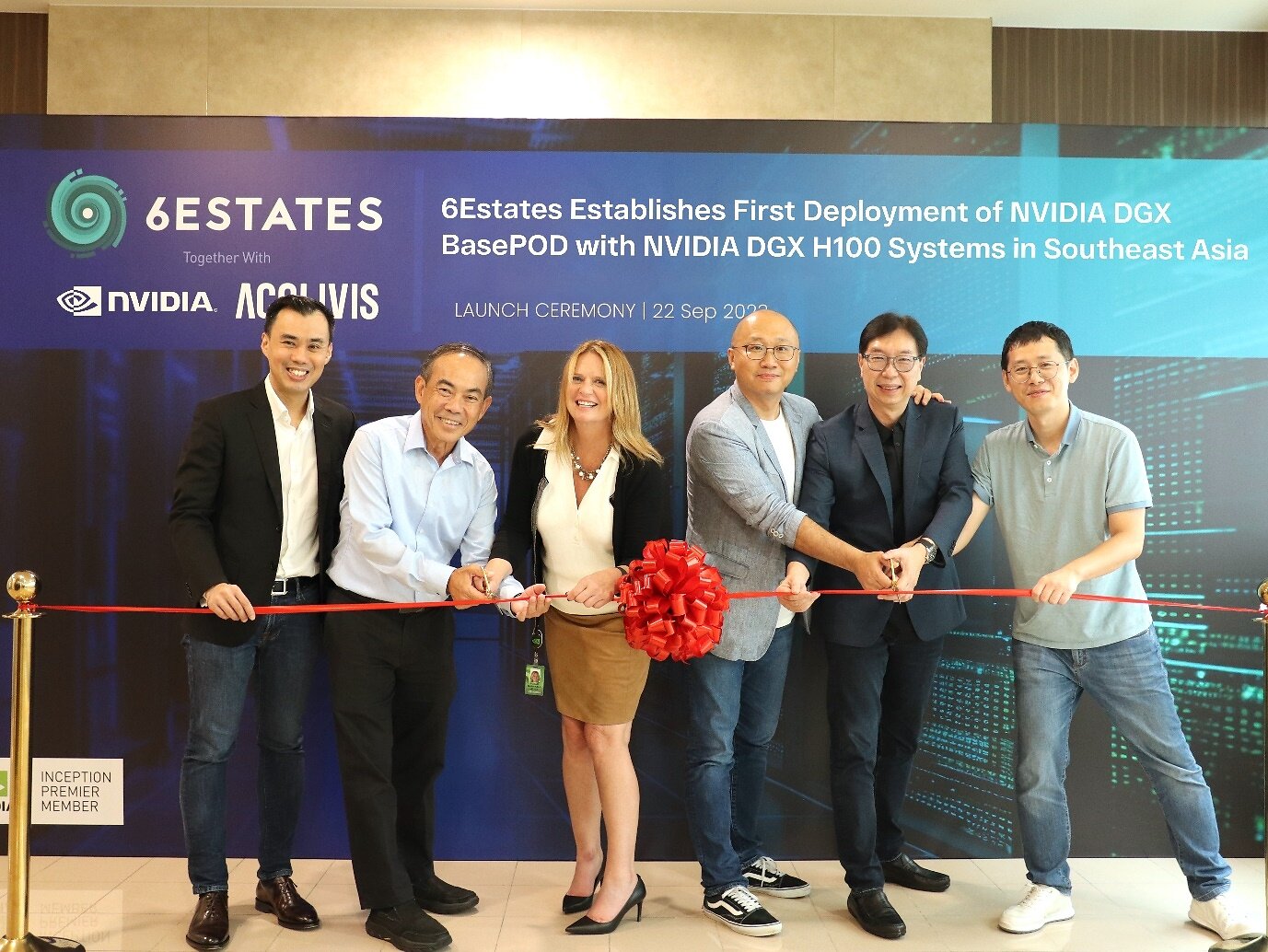
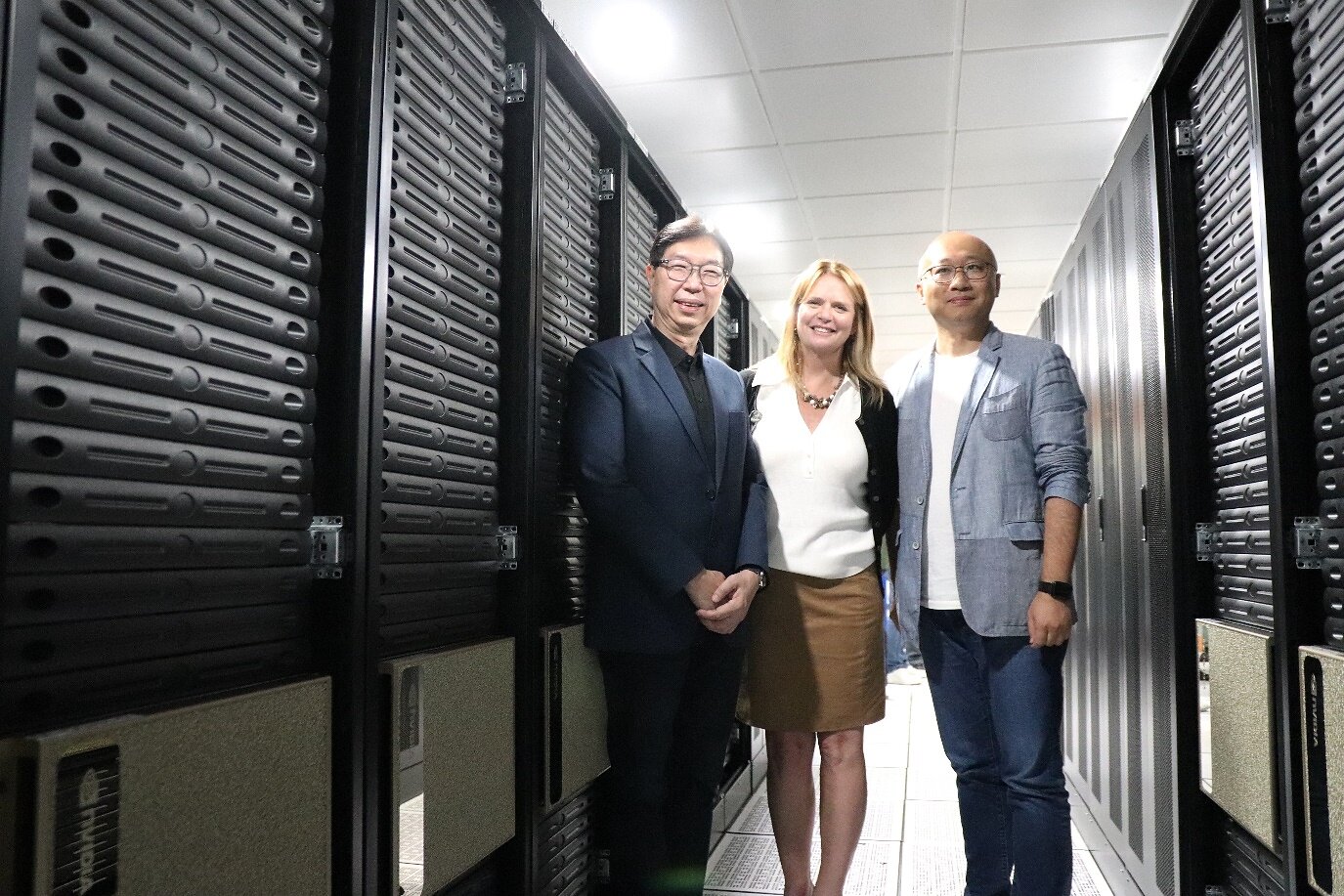
The company’s announcement connected the computing deployment to customised, domain-specific large language models and enterprise applications. It described plans to shorten model training time and support on-premise deployments. Luan’s explanation focused on the resources required to process substantial customer data. This was infrastructure with an intended business use, rather than a machine bought simply to look formidable in a photograph.
The launch also shows how many kinds of work sit behind the phrase enterprise AI. Computing, model development, implementation and the application all have to meet. None of those layers is especially impressed by a slogan. A customer still needs the system to fit a task, and the team still has to make the pieces work together. The ceremony is a clean moment in a much less tidy process.
The skill that does not fit on a chip
Ask Luan about AI talent and his answer extends beyond computing. In 2024, he discussed the mismatch between changing industry requirements and workforce skills, as well as competition for talent from larger ecosystems. His advice included keeping up with research and commercial applications. It also included interpersonal skills: AI projects bring academia, industry and government into conversations where their priorities may differ.
That point is easy to underestimate. Technical skill can tell a team how to build something. Understanding another person’s work helps establish what should be built and how it might be adopted. Luan’s own career has crossed those institutional boundaries. His advice treats practical experience and a professional network as part of the preparation, rather than decorative additions to it.
“Seek internships, projects, and real-world applications to build hands-on experience.”
Huanbo Luan, 2024
There is a pleasantly unglamorous quality to the recommendation. Attend events. Meet people. Work on a project. Learn what happens when a promising idea meets an actual requirement. It is advice that gives aspiring AI professionals something to do on Monday morning. The next paper matters; so does the ability to explain why someone else should care about it.
Putting financial AI through an examination
By 2025, Luan’s continuing research involvement included a workshop on financial information retrieval at SIGIR. Its agenda brought together retrieval techniques, evaluation, financial systems and questions of trust, privacy and security. The workshop paper names organisers from universities and businesses, including 6Estates and Bloomberg. The public record keeps placing Luan in rooms where commercial work and research share a table.
He also served in sponsorship leadership at ACM ICAIF 2025 in Singapore. In January 2026, he appeared among the co-authors of a technical report on the Financial Deep Document Research competition. The report, posted as a preprint, describes a challenge built around analysing annual reports and generating structured financial research. Its dataset covers more than 100 listed companies across eight global markets.
Dataset scope described in the January 2026 competition report.
The question has become more demanding than whether a system can locate a fact. Can it work through a long document, connect the relevant material and offer an analysis that can be assessed? The competition report describes a framework for testing that work. A benchmark does not answer every question about using AI in an enterprise. It does make evaluation part of the conversation, before fluent output is mistaken for a finished job.
Luan’s career offers a continuity worth noticing. The early research asked machines to handle noisy sentences, descriptions and languages. The company put information tools in front of customers. The recent evaluation work asks how to judge the resulting analysis. Read in sequence, these activities form a practical argument for staying close to the material, the task and the person who needs an answer.
The customer’s question survives each change of technology. What can I use? Luan’s work keeps returning to it, from a research centre to a company launch to an examination of financial documents. A ribbon can be cut in seconds. Making information useful takes rather longer.
Follow the work
Company, conversations and papers from the story.