A government website that actually works
Somewhere in Maryland this morning, a family booked a state-park day pass in about the time it takes to send a text. No printed form. No fax machine wheezing in a back office. No seven-mile line of idling cars at the gate. That quiet non-event is the whole pitch. The company behind it is Kaizen, a New York civic-technology firm that has spent roughly three years doing the least glamorous work in software: making the public sector usable.
Kaizen calls itself the operating system for America's public services. In practice it builds the screens residents actually touch - permitting, parks and recreation, licensing, payments, transit - and the configurable platform underneath them. As of late 2025, that work runs across 50-plus agencies in 17 states, reaching jurisdictions home to more than 30 million residents. Most of those residents have no idea who Kaizen is. That is arguably the point.
"American citizens have been worn down into accepting second-class solutions when it comes to public service technology."
The software that time forgot
Government software has a reputation, and it earned every bit of it. The systems that issue your dog license or take your water bill were, in many cases, built before the smartphone existed and have aged with all the grace of a fax cover sheet. They are slow, ugly, and weirdly proud of it. For decades the prevailing wisdom held that this was simply the natural state of things - that "good enough for government work" was a ceiling, not an insult.
Kaizen's founders disagreed, loudly. Their argument is almost suspiciously simple: when the campsite reservation site crashes, or the permit portal demands a password you set in 2014, people don't just get annoyed. They quietly conclude their government cannot do anything right. Bad software, in this telling, is not a UX problem. It is a trust problem wearing a UX costume.
The legacy incumbents, briefly
For years, agencies bought from a short list of established govtech vendors - the kind of contracts that renew because switching is terrifying, not because anyone is delighted. Kaizen's bet is that "nobody ever got fired for buying the old thing" stops working the moment residents have something better to compare it to.
FILED UNDER: things that should not still require a PDF you print, sign, scan, and email.
An ex-defense engineer and a finance operator walk into city hall
Kaizen was founded around 2022 by Nikhil Reddy and KJ Shah. Reddy, the CEO, came from the defense-technology company Anduril and is a UC Berkeley graduate by way of the Accel Scholars program. Shah arrived from the startup world, having run finance and operations as chief of staff at Flockjay after an earlier stint in M&A at William Blair. Neither is the obvious profile of a person who wakes up excited about parking enforcement. That is roughly the point.
Their wager was that the talent and design standards of consumer technology could be pointed at the least sexy corner of the economy - and that doing so was not charity but a large, underserved market. They staffed accordingly, pulling early hires from Palantir, OpenGov, Granicus, Gusto, Anduril, X and Stytch. The strategy started narrow, with parks and recreation departments, then expanded sideways into the higher-volume transactions agencies run all day: licenses, permits, utility payments.
"Our agencies need and deserve a platform built natively and designed to grow with them."
One platform, configured a hundred ways
The technically interesting part is that Kaizen did not build a hundred separate products. It built one AI-native, highly reusable platform and made it hyper-configurable - a single codebase that can be shaped into a state DMV licensing flow, a national-park reservation system, a city permit portal, or a parks booking app. For agencies used to buying a different vendor for every function, a system that grows with them is a genuine novelty.
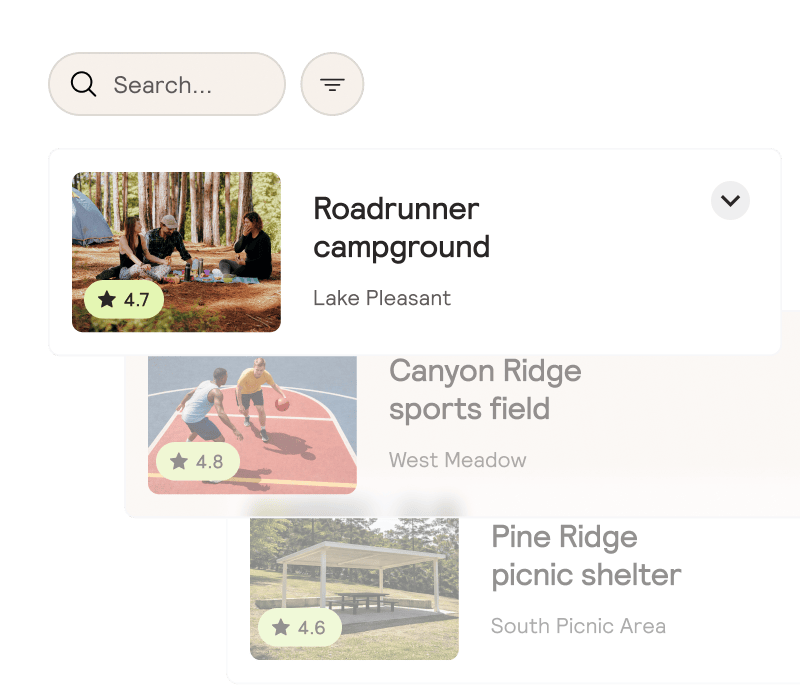
What residents get is the boring-sounding stuff done well: reserve a facility, register for a program, apply for and renew a permit, pay a bill or a fine, verify an identity, ask an AI resident chatbot where to go next. What administrators get is the back office - multi-department workflows, custom permit rules, point-of-sale, integrated payments, and analytics that turn civic activity into something they can actually read. The interfaces are mobile-friendly by default, which in govtech still counts as a feature.
What you can actually do with it
Book a campsite or a basketball court. Pull a building permit. Renew a license without a trip downtown. Pay a utility bill from your phone. Register the kids for summer rec. Ask a chatbot a question at 11pm and get a real answer. None of it is futuristic. All of it was, until recently, inexplicably hard.
CAPTION: the most radical idea in this entire profile is "the button works."
The short, fast history
Founded
Nikhil Reddy and KJ Shah start Kaizen, beginning with parks and recreation software.
$11M seed
Co-led by Accel and Andreessen Horowitz's American Dynamism practice. Expansion beyond rec into permitting and licensing.
10x growth
Customer base grows tenfold; ARR climbs 9x year-over-year. First state contract: Maryland's park system.
$21M Series A
Led by NEA with 776, Accel, a16z and Carpenter Capital. 50+ agencies, 17 states, 30M+ residents - and an eye on federal contracts.
Scaling the team
Headcount expanding from ~30 toward 50 as it pushes the platform across more government segments.
Numbers that grew up fast
Skepticism is the correct posture toward any startup promising to fix government, an arena where ambitious software goes to die. So here is the evidence, such as it is. Kaizen has raised $35 million total - an $11 million seed in 2023 and a $21 million Series A in October 2025, the latter led by NEA with participation from Alexis Ohanian's Seven Seven Six, Accel, Andreessen Horowitz and Carpenter Capital. Its customer roster reads like a cross-section of the country: Maricopa County in Arizona, San Bernardino County in California, Suffolk County in New York, Pinellas County in Florida, the Cherokee Nation, and the State of Maryland.
Kaizen by the numbers
Source: company statements and 2025 funding announcements. Figures are approximate and self-reported.
The Maryland project is the one people repeat, because it is legible. The state needed a day-pass reservation system for its parks. Kaizen launched it in under 60 days. The visible result was the disappearance of the multi-mile traffic jams that used to form at popular park entrances, and a measurable bump in visitor satisfaction. It is a small story that does a lot of work: it shows the software shipping fast, and it shows a citizen's day getting better in a way they can feel.
"Kaizen is focused on the most fundamental American services - exactly what the American Dynamism movement stands for."
Rebuilding the digital front door - and the trust behind it
Kaizen's stated mission is to restore public faith in government by giving residents experiences that are, in their words, beautiful, effective and ever-improving. The name is the tell: kaizen is the Japanese term for continuous improvement, which is either a tidy bit of branding or an actual operating philosophy, depending on how cynical you are feeling. The company's longer-term vision is to become the "technology prime" for civic institutions - the default vendor agencies reach for when they want something built right.
There is a worldview underneath the product roadmap. The founders argue that every clunky form and broken portal is a small withdrawal from the public's confidence in its institutions, and that every interaction that simply works is a small deposit. Fix enough of the screens, the theory goes, and you start to repair something larger than software.
"Kaizen" is Japanese for ongoing, incremental improvement - a fitting name for software built to never stop iterating.
CEO Nikhil Reddy worked at defense-tech firm Anduril before turning his attention to permit offices and park gates.
Replacing 7-mile park traffic jams with a two-tap day pass is the kind of victory most residents never trace back to a vendor.
The next government screen you don't notice
With fresh capital and federal spending opening up, Kaizen's ambition is widening from city halls and county offices toward state and federal systems - the DMV-scale, national-park-scale workloads where legacy software is most entrenched and most painful. It is a bigger fight, against incumbents with deep relationships and longer contracts. Whether a three-year-old company can win it is an open question, and a fair one.
But return to that family in Maryland, the one that booked a day pass without a second thought and then went and enjoyed the park. They will never write a Kaizen review. They got their afternoon back, and someone, somewhere, made that boring and easy on purpose. If the company is right that good software quietly rebuilds trust, the measure of its success will be exactly this: more moments no one bothers to remember.