Consider the paper timesheet. It is a modest object with an expensive social life. Someone fills it in, someone approves it, someone carries its contents into another system. Each handoff offers a fresh opportunity to lose time, transpose a number or ask a colleague where the latest version went. For a town hall, this is ordinary work. For BS&A, it is a business opportunity.
- BS&A connects the administrative work of US local governments.
- Its pitch combines municipal software with conversion, training and support.
- Customers’ experiences reveal why integration matters more than a long feature list.
- Cloud subscriptions bring convenience, but buyers still need to count the full bill.
The paper timesheet problem
In Lowell, Arkansas, Finance and HR Director Darcy Richard wanted better HR tools and more joined-up operations. The city already used BS&A’s desktop software. Familiarity alone had not solved everything: employees were still recording time on paper. After a colleague’s recommendation, Richard explored BS&A Cloud, including employee access to timesheets, paychecks and benefits.
The company’s Lowell account reports connected applications across eight departments and a 40% saving in time spent on month-end reporting. Treat that as a customer result reported by the vendor, rather than a forecast for every municipality. The detail worth stealing is the sequence: identify the troublesome work, then judge the software by what happens to that work.
A municipal ERP - enterprise resource planning system - is supposed to make these repeated exchanges less laborious. That sounds dry until you remember who waits at the other end: a resident paying a bill, an employee expecting a paycheck, a contractor hoping to begin work. Administrative delay has a public address.
A water bill has several lives
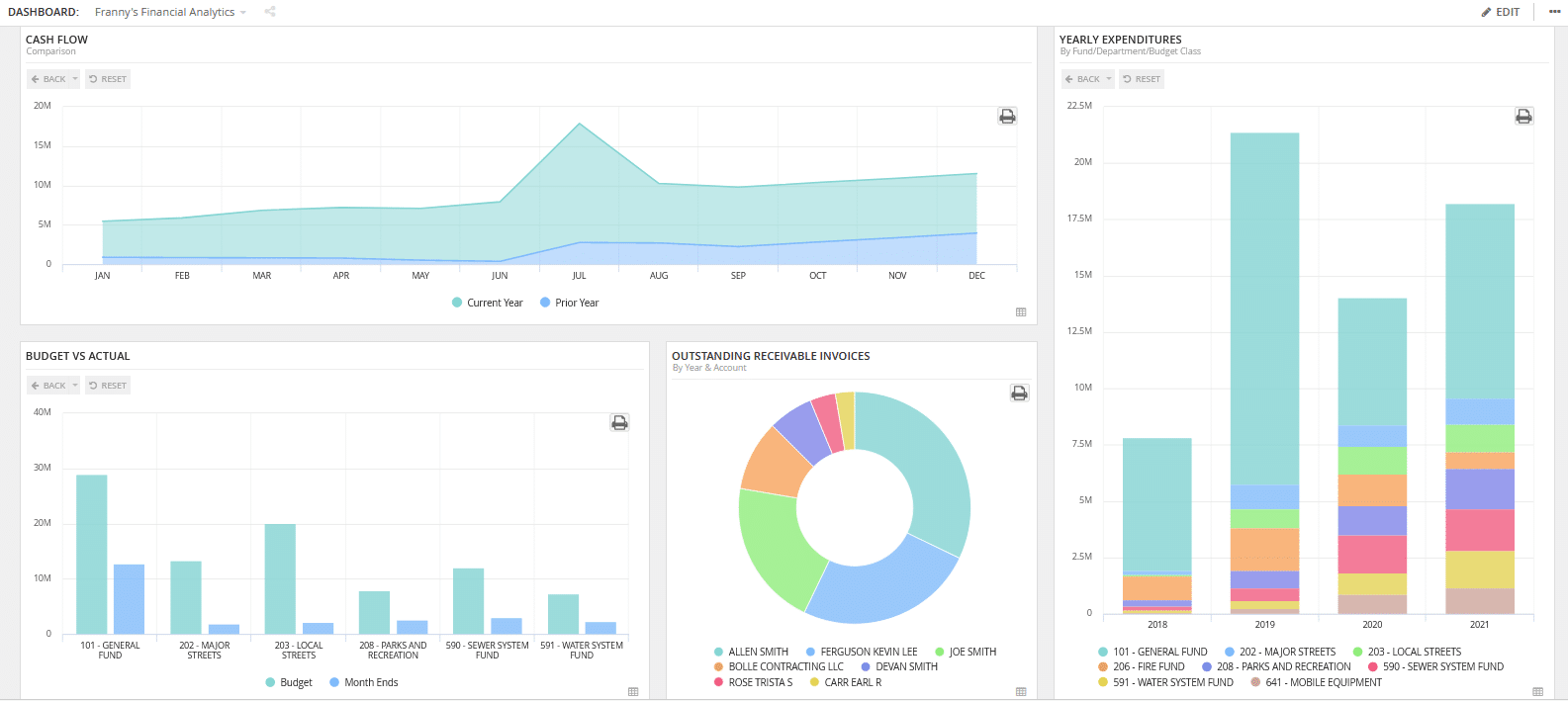
BS&A sells software for the financial and operational machinery of local government. Its financial suite covers the general ledger, budgeting, accounts payable and receivable, purchasing, bank reconciliation, grants and fixed assets. The attraction is shared data across modules: fewer occasions to type the same information twice, and a clearer route from a summary to the underlying transaction.
A water bill is also an account record and, sometimes, a reason to dispatch a worker. BS&A’s utilities tools handle billing and account management alongside work orders that staff can access in the field. The useful unit of analysis is the whole journey, from a request to the person acting on it.
Permits have similarly sociable lives. The Community Development suite covers planning, zoning, inspections, licensing and code enforcement, with GIS integration and online services. It also handles invoices, payments and bond deposits. A building department’s work has financial consequences; connecting the two is the point.
Applies online
Reviews permit
Records the fee
Pays online
Connected work, rather than four separate islands. Exact configuration varies by municipality.
HR tools add payroll, employee records, hiring and self-service. BS&A Online gives residents and contractors routes to records, payments, permits and inspections. Native BS&A Payments extends electronic collection into reconciliation and reporting. These are different doors into an administrative system, with different users on each side.
Property assessment and tax are particularly revealing specialties. BS&A says its assessing and tax products support nearly 1,600 Michigan municipalities. State-specific knowledge is less portable than a generic spreadsheet, but much more useful to the person maintaining a tax roll. Here, knowing the local rules is part of the product.
The person who remembers the last conversion
Software purchases are often described as contests between features. Easley, South Carolina, offers a more human explanation. Its finance director, Joni Smith, had worked with BS&A at St. Joseph County in Michigan. When Easley sought to replace aging software, she remembered the earlier implementation and support.
In BS&A’s historical Easley case study, the city compared BS&A with Tyler Encode over five years. The account attributes the choice to lower costs and service reputation. It also describes frustration with the previous system: capabilities existed that staff had never used. A feature that nobody can bear to reach is a peculiar sort of asset.
Woodstock, Georgia, tested seven providers, including Tyler Munis, New World and Springbrook. Its requirements included integrated data, overtime handling, utility billing and GIS. The published account says BS&A demonstrated complete functionality to departments and disclosed support costs. Conversion still occupied the finance staff for a year. The sensible lesson is to require a demonstration of your actual work, and leave room in the calendar for changing it.
Ask the vendor to follow one transaction all the way through town hall.A procurement lesson from the customer accounts
Those examples place BS&A among specialist municipal ERP suppliers. They establish particular reasons particular buyers chose it. They do not prove that it is always cheaper, or that today’s rival products behave exactly as they did in those older evaluations.
The cloud comes with a bill
BS&A describes its cloud platform as software rebuilt for Microsoft Azure. Municipalities share a software version and infrastructure, while each has a separate SQL database. Browser access and vendor-managed updates change who looks after the machinery. They also change how a government buys it.
A December 2024 New Brighton, Minnesota proposal makes that business model unusually visible. It listed $104,140 in annual module fees, $25,850 for project planning, $59,400 for implementation and training, and $39,720 in travel: $229,110 altogether. Annual module fees included unlimited support. Service days were estimates, billed on actual use.
The same paperwork specifies an internet connection and allows separately proposed custom work. This is a useful antidote to the word “cloud,” which sometimes makes a purchasing decision sound suspiciously weightless. Migration needs staff attention, data checking and training. Subscription fees return next year.
For a buyer, the calculation must include the server and maintenance work that might disappear, as well as the recurring fees that arrive. A municipality without reliable connectivity, enough training time or a suitable module for an essential process has more homework to do. A browser cannot negotiate those constraints.
A support department with a memory
BS&A’s service pitch includes taking responsibility for extraction, mapping and conversion, while customers verify reports. It says its own representatives implement the software. The company also reports retention above 99%. That is a company claim, with no period or calculation method stated on its homepage. Happy users and costly switching can coexist; retention alone cannot untangle them.
The careers page offers a more concrete glimpse of how expertise accumulates. Sheri Trotter describes joining as a front-office receptionist, moving into application support, managing teams and later working in talent development. BS&A also describes a Product and Customer Experts team that handles difficult issues and coaches support and implementation colleagues.

That progression suggests a practical advantage: the people teaching a new employee may remember what confused the last customer. Published values stress humility, integrity and looking after colleagues. Values are easy to print. Building routes for knowledge to move between teams is the more interesting organizational choice.
In January 2026, BS&A publicly announced its AI Assistant, following a conference unveiling the previous October. It answers from curated BS&A documentation, FAQs and support materials. The announcement says it neither searches the open internet nor accesses a municipality’s internal data. This is a help tool with a deliberately narrow remit, rather than a claim that software will now run the town.
An Indiana detour, then a bigger assignment
Founded in 1987, BS&A spent decades building its municipal business. A May 2023 growth investment from Serent Capital gave the company backing for geographic expansion and cloud adoption. Co-founder Tom Szur’s explanation emphasized finding a partner aligned with the company’s customer relationships and culture.
In February 2025, BS&A acquired Boyce Systems, strengthening its Indiana presence and adding school-focused operations. Boyce dates to 1899, when public-sector administration meant forms, printing and bookbinding. The instruments changed; the business of helping institutions keep their records did not vanish. Neither deal disclosed its price.
BS&A’s 2026 announcements describe more than 3,500 municipalities served. In April it named former Boyce CEO Jason Harrington as chief executive, with Chad Harryman remaining on the board. September brought Chief Product Officer Rajitha Chaparala and Senior Vice President Gabe Graham, responsible for marketing and go-to-market work. Expansion now has people explicitly assigned to it.
The test is easy to state and hard to schedule. Can a growing supplier keep demonstrating the whole workflow, moving the records and helping the employee who has just inherited payroll? A town hall does not buy software to admire it. It buys software so that, next Friday, the paychecks go out and the paper stops making the rounds.
Open the software drawer
Explore BS&A’s website, company updates, the blog and customer accounts.
Watch the Financial Management video, browse product demonstrations or visit the training library. Follow BS&A on LinkedIn, X and Facebook.