- GovOS sold cloud software for records, forms, licensing, tax compliance, identity checks and payments.
- Its roots run through SeamlessDocs, founded in 2011; the GovOS suite launched from Kofile in 2021.
- More than 700 U.S. agencies used the company before it merged into Neumo in August 2025.
- Public contracts reveal a wide price range - and a failed $1.26 million records migration reveals the risk.
The least glamorous object in public life may be the government PDF. It arrives already hostile: tiny boxes, baffling instructions, a signature line designed for ink, and the quiet expectation that someone owns a printer. For a resident, it is an afternoon lost. For the clerk on the other side, it is data entry, routing, storage, phone calls, reconciliation and, eventually, a cardboard box. GovOS built its company around a simple observation: the form is never merely a form. It is the visible edge of a government process.
That insight came from SeamlessDocs, the company Jonathon Ende and Chachi Camejo started in 2011 after an earlier small-business incarnation called Bizodo. The product could turn a static PDF into a mobile-friendly form, accept attachments and legal electronic signatures, then organize the result. In 2015, the company raised a $5 million Series A led by Govtech Fund. The pitch was charmingly specific: make paperless government possible without forcing every municipality to become a software company.
Kofile acquired SeamlessDocs in 2020. A year later, Kofile arranged its software under a new GovOS banner with six initial lines: Records, Access, Licenses, Studio, Community and Workforce. This is why GovOS can truthfully look both young and old. The named company arrived in 2021; the product lineage and the commonly cited founding year reach back to 2011.
A permit looks like a page. To a city, it is a miniature operating system.
The form was only the opening move
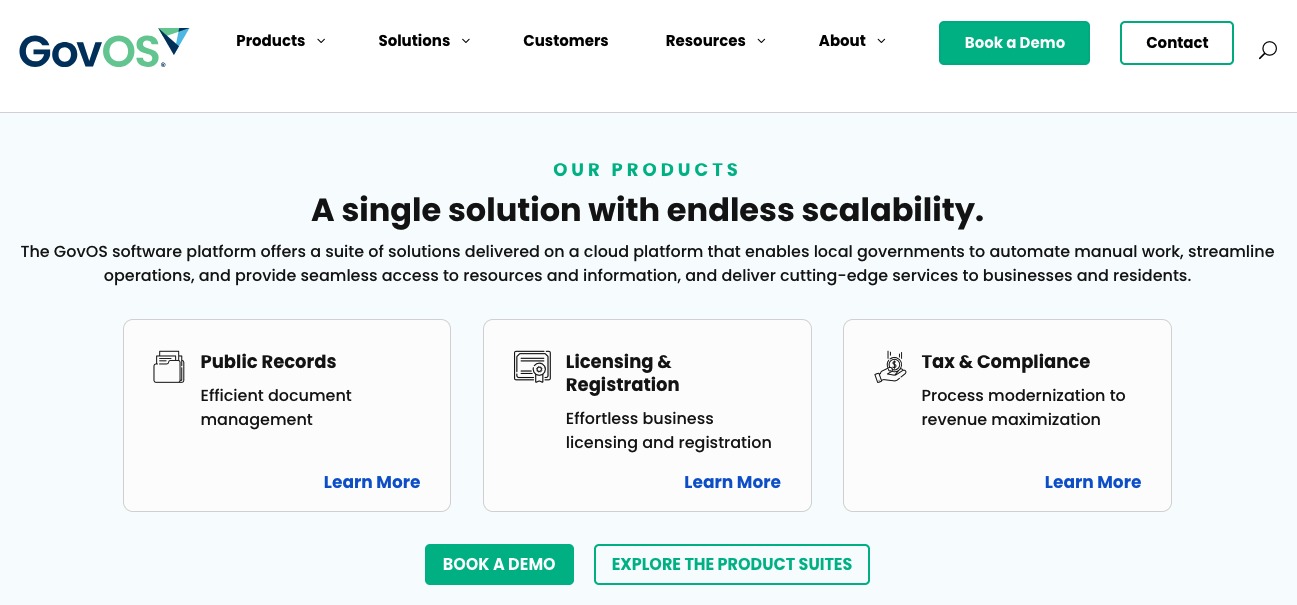
GovOS widened from digital forms into the transactions that make local government feel either competent or antique. Public Records handled land and vital records, eRecording, certified copies, public search and property-fraud alerts. Licensing & Registration covered applications, renewals and compliance for businesses, professionals and short-term rentals. Tax & Compliance dealt with filings, collections and reporting. GovOS Pay put cards and e-checks inside those flows. ID Verify added document checks, facial matching and liveness detection to remote requests.
The customer was the agency, but the user could be anyone trying to get married remotely, register a rental, renew a business license, pay lodging tax or retrieve a deed. That two-sided design mattered. Officials wanted control, reporting and compliance. Constituents wanted the transaction to finish without a counter visit. GovOS was different from a generic form builder because it came with government vocabulary and workflows; different from a single departmental system because it stretched across multiple transaction types.
What changed their minds was the work itself
Luna County, New Mexico offers the useful version of the story. Its three-person IT team was receiving photocopies that had to be retyped in Word and converted to fillable PDFs. A maintenance director asked that forms automatically reach specific people. That request changed the frame: instead of purchasing a separate ticketing system, the county used GovOS Studio. It built more than 100 forms, covering records requests, work orders and employee onboarding. In one reported year, the system took more than 1,700 submissions. The database preserved notes, technicians, status and timestamps.
Bloomington, Illinois supplied the larger shove. During 2020, the pandemic made counter service and wet signatures impractical. The city converted more than 70 paper forms, including permits, grant applications and license renewals. It also created electronic-signature and electronic-seal processes. What changed the city's mind was not a futurist memo. It was the sudden impossibility of doing the old work in the old room.
The lesson is copyable because it is modest: begin with an ugly, frequent workflow. Count the submissions. Map who touches it. Preserve the approvals and audit trail. Only then widen the platform. A three-person department can prove value with one maintenance request long before anyone says “digital transformation” at a podium.
There was no single GovOS price
GovOS sold business-to-government software through negotiated subscriptions, implementations, conversions, support and transaction fees. Public procurement records give the shape of the bill. DeKalb County, Georgia approved a four-year form-builder subscription at $41,250 annually. A 2025 Hays County public-records proposal totaled about $869,383 across five years. Dallas extended licenses, training, maintenance and support for a short-term-rental and hotel-tax system by $118,800 for a year. A Baldwin County project to load roughly 53,744 historical images was priced at a flat $7,000, with an agreed $500 fee for each re-load caused by source-file problems.
Public price sightings
Selected examples with different scopes and terms - useful scale, not a rate card.
This variability is not a trick peculiar to GovOS. A form builder for one department is not the same object as a county records system with conversion, search, security and years of support. The useful buyer question is not “What does GovOS cost?” It is “Which pieces of the old process are included, who owns the migration, and what happens when the source files are wrong?”
The $1.26 million reality check
In January 2025, Tarrant County, Texas supplied the uncomfortable answer. The county moved to terminate its GovOS Cloud Records migration after the effort was unsuccessful. Full configuration and implementation had been estimated at $1,264,500; $120,000 had been paid. The clerk planned to keep using the on-premise CountyFusion system until a replacement could be procured.
What failed first was not the idea that records should be online. It was the migration from an existing system to the cloud. That distinction matters. A polished application cannot compensate for unknown data quality, incomplete inventories, brittle integrations or an agency that lacks people to make decisions quickly. GovOS's own project documents say successful implementation requires close customer collaboration, defined scope and commitment to milestones. In other words, software can be configurable without the project being easy.
Inventory before demo. Count file types, indexes, integrations and exceptions before judging the new interface.
Pilot the migration. Move a representative slice, reconcile it and test retrieval before committing the whole archive.
Name an agency owner. The model works poorly when no empowered official can resolve policy and data questions.
Keep an exit path. Know the export format, transition support and fallback system before go-live.
The GovOS approach is most convincing where a government has a repeated transaction, an engaged process owner, exportable data and a real appetite to change staff routines. It is less likely to work as a cosmetic layer over a poorly understood archive, or where procurement assumes “cloud” means the vendor can discover decades of local exceptions by magic. Small agencies also need to test whether the breadth of a government-specific suite justifies the cost over a lighter form tool.
The roll-up becomes the product
GovOS itself became a workflow of acquisitions. Audax acquired Kofile in 2020, launched GovOS, then spun it out as a standalone company in 2023. Audax says it installed dedicated management, built an enterprise sales organization, completed three add-on acquisitions and grew annual recurring revenue about fourfold during its ownership. In August 2025, Arlington Capital Partners acquired GovOS and combined it with Avenu Insights & Analytics and Intellectual Technology to form Neumo. Terms were not disclosed. The combined company reached beyond local forms into public administration, DMV systems, revenue compliance, justice and payments.
That ending is fitting. GovOS began with the realization that a form is connected to a process. Neumo represents the next claim: all those processes are connected to one another. The attraction is obvious - one broader platform, more integrated transactions, more ways to cross-sell into the same government customer. The danger is obvious too. When a system touches records, revenue, licenses and identity, a difficult migration is no longer a departmental inconvenience.
Still, the original observation survives the corporate names. People do not experience government as an org chart. They experience it as the moment a tax clears, a license arrives, a certified record can be found, or a form finally submits. GovOS made those moments its business. The paper form refused to die; the company learned to build an operating system around it.