A pothole complaint in Rochester, Minnesota, a property appraisal in Louisa County, Virginia, and a probation file in Lake County, Illinois, do not look like the same software problem. To CATALIS, they are three doors into the same building: the slow, regulated and stubbornly local machinery of government. The Alpharetta, Georgia, company sells the systems behind those doors, plus the payment rails that move money through them.
CATALIS is not the familiar startup fable about two founders and a prototype. Greater Sum Ventures formed Government Brands in late 2017 by acquiring eGovernment Solutions. It then kept shopping. During the investor's hold, the platform acquired more than 28 public-sector software businesses. CATALIS now describes the total as more than 30, spread across the United States and Canada.
That distinction matters. The company did not persuade every assessor, clerk and court administrator to abandon a specialist vendor. It bought many of the specialists, their customers and the accumulated knowledge embedded in their code. In 2021, PSG and TPG recapitalized the business at a valuation above $1 billion. Government Brands became CATALIS in 2022, a name meant to sound less like a holding pen and more like a catalyst.
The roll-up is the product
The portfolio looks less like one app than a map of city hall. Payments covers taxes, courts, utilities, child support and vehicle transactions. Tax and CAMA software bills, collects and values property. Courts and Land Records handles case management, e-filing, juries, probation, dispute resolution and official documents. Public Works and Citizen Engagement takes in 311 requests, tracks assets, publishes meetings, sends alerts and runs municipal websites. Regulatory products reach unemployment insurance and financial-services oversight.
The business model follows the map. Agencies buy subscriptions, implementation, integrations, training and support; CATALIS also processes transactions. That last piece is important. A software vendor that helps a county calculate a tax can also help collect it. Payments can stand alone or connect natively to the company's court, tax and utility products. The workflow makes the software useful. The transaction makes the relationship wider.
Its customers are public employees, but its users include almost everyone. A resident opening a phone to report a broken streetlight, a lawyer filing a document, a student spending from a 529 account and an assessor sketching a parcel can all touch the portfolio. CATALIS says it powers more than 7,000 state, provincial, county and municipal agencies. The company also administers services for 14 state-sponsored 529 education and ABLE disability savings programs.
The first crack was “likeability”
Roll-ups create breadth quickly. They also inherit different codebases, interfaces and habits. CATALIS said the quiet part plainly in a March 2026 review of the previous year's product work: customer feedback and usage data showed that backend usability and overall “likeability” of admin tools were contributing to churn. For enterprise software, “likeability” is a startlingly human diagnosis. A system can pass procurement, satisfy a requirement sheet and still annoy the people sentenced to use it every day.
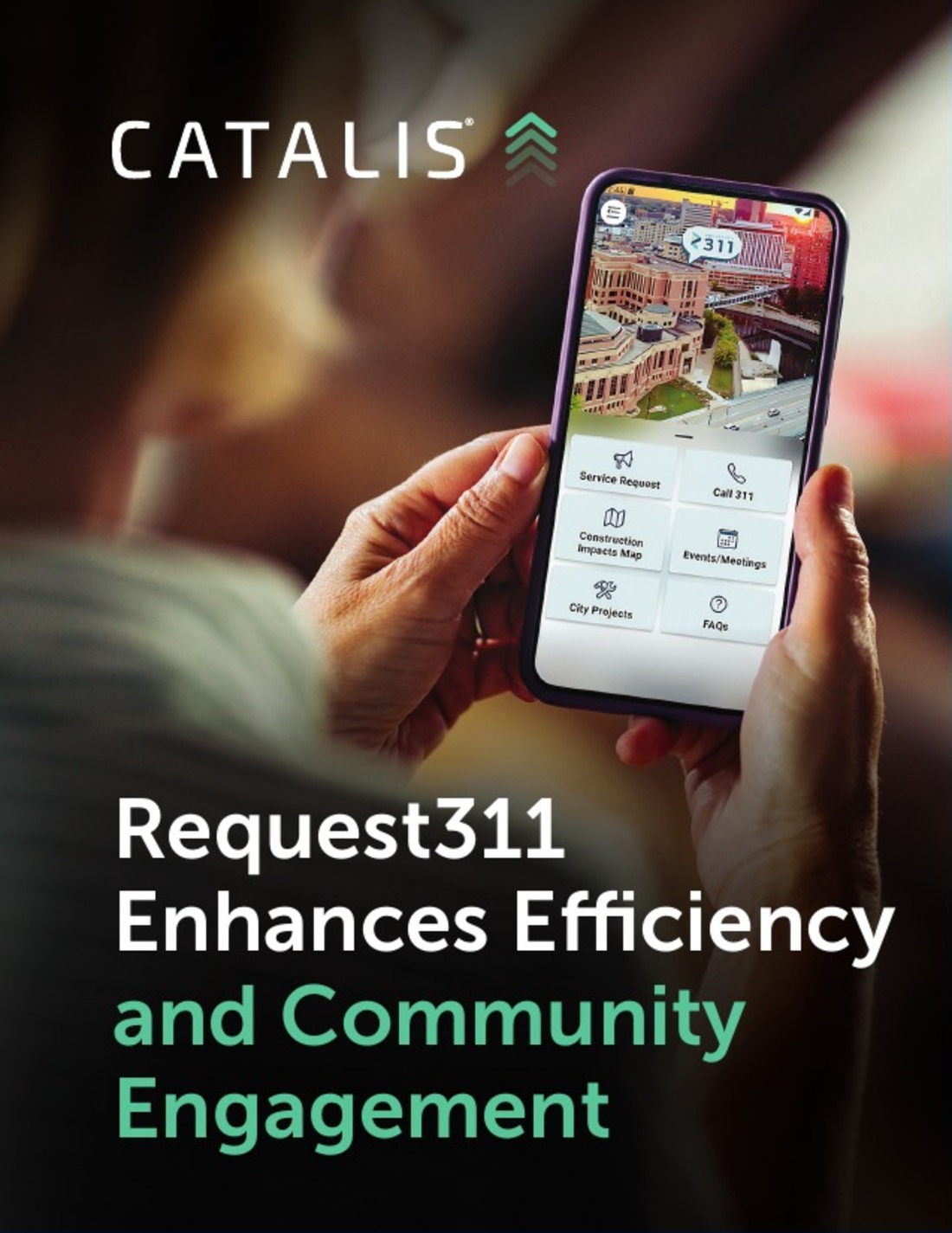
That was what failed first: not the grand strategy, but the small friction. GIS Webmap users wanted faster performance and more control over their own data. Municipal teams needed workflows flexible enough for last-minute meeting changes, confidential sessions and accessibility rules. Request311 customers found gaps in the branded app experience. The tools technically worked; accumulated irritation made them less competitive.
“Our philosophy for AI remains the same as everything else: practical, embedded, and purpose-built.”CATALIS, reviewing its 2025 product work
What changed the company's mind was evidence from customers, not a consultant's slogan. CATALIS invested in faster maps, self-service theming, full spatial exports and better APIs. It improved contrast, page structure and skip links. Request311 gained integrations with Lucity, Cityworks, Cartegraph, NexGen, Esri and Catalis Tax. A branded resident app was rebuilt in React Native.
Even its AI project is deliberately tucked inside a task. Catalis Assistant guides a resident toward the correct request type, pre-populates fields and uses the municipality's own knowledge base. It was still being validated with a small beta group when the company described it. A separate Sacramento case study reported that a CATALIS AI assistant managed 46 percent of calls. The believable pitch is not artificial general city hall. It is fewer misrouted questions and less rework for staff.
What government software costs
CATALIS does not publish a neat monthly menu because a court implementation and a 311 portal are not interchangeable seats. Public procurement records offer a better view. In 2024, Lake County approved $73,212.74 a year for Caseload Explorer probation software, with five percent annual increases. Rochester approved $177,350 through 2026 for implementation, setup, integration and maintenance of its 311 system. San Bernardino County approved $505,114 for one year of Caseload Explorer maintenance, support and county-specific programming.
Those numbers are examples, not a rate card. They show why government SaaS is durable. Switching is not a weekend export. Data must be converted, laws encoded, staff trained, integrations retested and public service kept running. Lake County had used the underlying AutoMon product since 2010 and cited the value of that long relationship when it renewed. The strongest competitor is often inertia.
Where the platform earns its keep
The cleanest case for CATALIS appears when several government jobs must connect. Rochester wanted one system to accept questions, track a ticket from intake to resolution and analyze service demand across departments. Louisa County replaced an aging AS/400 appraisal system with a browser-based CAMA platform combining parcel management, valuation modeling, GIS and field collection. San Ramon chose Request311 to replace GovQA through a competitive RFP, citing configurable workflows, Esri integration and fit for a mid-sized city.
Its differentiation is not that nobody else sells government software. Tyler Technologies offers a formidable broad suite. CivicPlus, CentralSquare, Granicus, Accela, OpenGov, Harris brands and specialists compete in individual corridors. CATALIS's argument is the combination of acquired domain depth, North American scale, integrated payments and an expanding set of connections between products.
The approach works less well when an agency wants a tiny, isolated tool with no need for payments, shared data or long-term support. A small office may find implementation and migration heavier than the problem. A government committed to best-of-breed vendors may dislike deeper suite dependence. Heavy customization can also make future change expensive. And no vendor can rescue a rollout when an agency lacks clean data, an accountable owner or time to redesign the process around the software.
What builders can copy
- Enter through a regulated workflow whose language outsiders underestimate.
- Preserve specialist knowledge, then connect products where data and money already move.
- Watch usage and support signals for irritation that feature checklists miss.
- Use AI inside a narrow task with a trusted local knowledge base.
- Fix performance, accessibility and exports before announcing another novelty.
A platform still becoming one
CATALIS's latest moves show both sides of the strategy. It launched Official Records with cloud access, e-recording, payments and machine-learning-assisted indexing and redaction. It brought ERP Cloud to Canadian municipalities. It connected appraisal software to EagleView imagery and CAI Technologies' AxisGIS. In 2026, it expanded tax payments across nine Wisconsin counties and 240 municipalities, added Request311 deployments, and partnered with Creative Planning on Mississippi's 529 plan.
The company was born from the idea that government technology was too fragmented. Thirty acquisitions proved that the market was fragmented enough to assemble. They did not prove that assembly equals integration. CATALIS's more interesting phase begins after the billion-dollar headline: making a tax collector, a probation officer and a resident feel the pieces belong to the same system, while respecting the peculiar rules that made each specialist valuable in the first place.
Government software rarely wins by looking futuristic. It wins when Tuesday's work takes fewer clicks and nobody misses a statutory deadline.
That is a less glamorous promise than disruption, and probably the right one. City hall cannot close for a rewrite. CATALIS has to modernize the machinery while it is running.