The first version of OpenGov could make a city budget look less like something found in the copier tray after a long weekend. It took rows of accounting data and turned them into navigable charts. A resident could start with the big picture, then drill into an agency’s chart of accounts. In 2012, this felt almost impolite: government finance was supposed to arrive as a thick PDF, not respond to a click.
But a clean chart is not an operating system. OpenGov’s early team learned that distinction the expensive way. The company then known as Delphi Solutions had a prototype, no revenue, a changing founding team and no settled roadmap. Co-founder Zac Bookman, newly back from advising an anti-corruption task force in Afghanistan, wondered whether the founders should return investors’ money.
They did not. Bookman cut the problem down to a sequence: hire one engineer, sign one customer, build one feature. He spent a holiday reading a three-inch government-finance reference book. The team interviewed public officials and studied the systems underneath the budget. One notorious example stuck: Palo Alto had paid more than $10 million for an ERP system with green screens, delivered on 20 disks.
“Hire one engineer, sign one customer, build one feature.”Zac Bookman’s early-company reset
01 / The turnTransparency was the wedge, not the company
OpenGov’s founders came to the problem through California Common Sense, a nonprofit created after the financial crisis exposed how brittle municipal finances could be. Vallejo, Stockton and San Bernardino went bankrupt. The young company’s instinct was to make the numbers visible. Its customers taught it that the uglier opportunity sat upstream: budgets were hard to explain because they were hard to build, reconcile and manage.
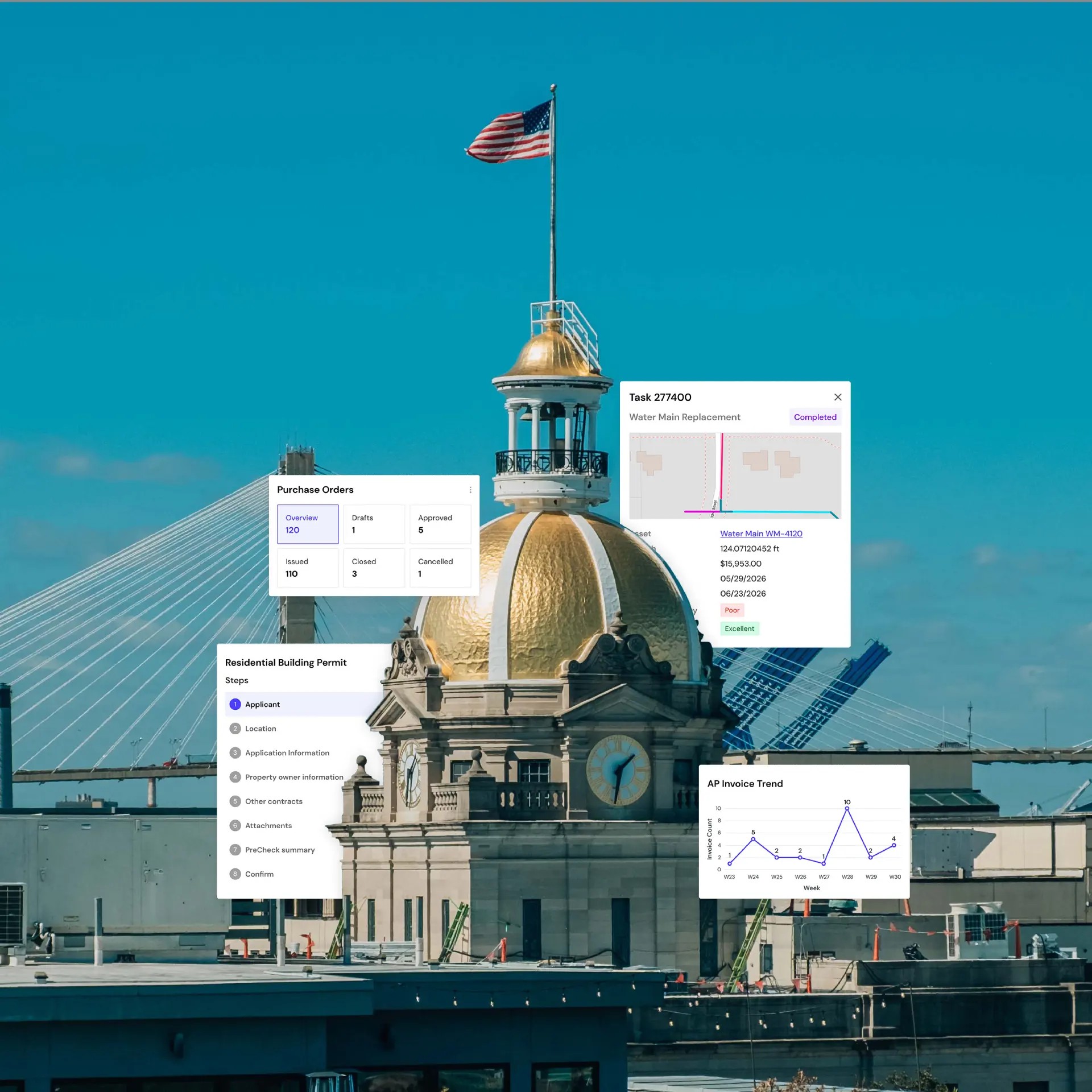
In 2015, the executive team committed to building budgeting software. That decision moved OpenGov from observation to action. A dashboard shows what happened. A budget workflow decides what may happen next. Procurement authorizes spending. Financial management records it. Permitting turns policy into approvals. Asset management tells a public-works crew which pipe, road or pump needs attention. Each adjacent workflow added a reason for another department to use the platform.
That is what OpenGov does today: it sells recurring cloud subscriptions and implementation services to public agencies. More than 2,000 cities, counties, state departments, school systems and special districts use at least part of the suite. Finance directors, buyers, inspectors, planners, utility clerks and field crews work inside it. Vendors submit bids. Residents apply for permits, pay bills or explore public data through its portals.
02 / The roll-upTen acquisitions, one data model
Some of this breadth was built; much of it was bought. OpenGov acquired open-data developer Ontodia in 2016. ViewPoint Cloud added permitting and licensing in 2019. Cartegraph brought public-works operations and infrastructure assets in 2022. Ignatius, acquisition number ten in 2025, added low-code forms, configurable government apps and AI-assisted workflows.
The strategy resembles a vertical-software roll-up, with an important catch: a suite only becomes a platform when the records connect. A permit may create a fee. A procurement request must check a budget. A work order touches an asset, labor and inventory. OpenGov’s stated advantage over a collection of point tools is a shared foundation designed for those links. Its rivals include Tyler Technologies and CentralSquare at the full-ERP level, plus Accela, Euna, Granicus, CivicPlus and many specialists around the edges.
Cox Enterprises supplied patient capital for that expansion, first as an investor and then by supporting the Cartegraph deal. In February 2024, Cox took majority ownership in a transaction valuing OpenGov at $1.8 billion. The price bought a foothold in a fragmented market with difficult procurement, specialized accounting rules and customers that do not casually replace mission-critical systems.
03 / The proofThe software works when the institution moves too
Richmond, Virginia offers a useful anti-demo. The city wanted to run a reverse auction for ferric chloride, a water-treatment chemical bought by the millions of pounds. Before anyone clicked a button, the procurement team spent nearly two years changing city code, writing policy and designing a procedure. It chose a controlled first purchase and kept the existing contract as a fallback.
Then OpenGov handled the auction. Three suppliers competed. The price fell from 27 cents to 17 cents per pound, the cycle shrank from 30 days to 18, and Richmond projected $6 million in cost avoidance over ten years. The product did not repeal a rule or persuade the council. It made the new rule operational, visible and repeatable.
Other reported outcomes rhyme. Delaware County, Indiana moved 34 departments out of a 70-tab workbook and cut budget preparation time by 60 percent. Ashland, Oregon said it avoided a financial-analyst hire, saved $110,000 annually and reduced manual rework from 15 percent to zero. These are customer case-study figures, not a promise that every deployment prints money. They show what becomes possible when data, authority and staff behavior line up.
04 / The next actAI with a permission slip
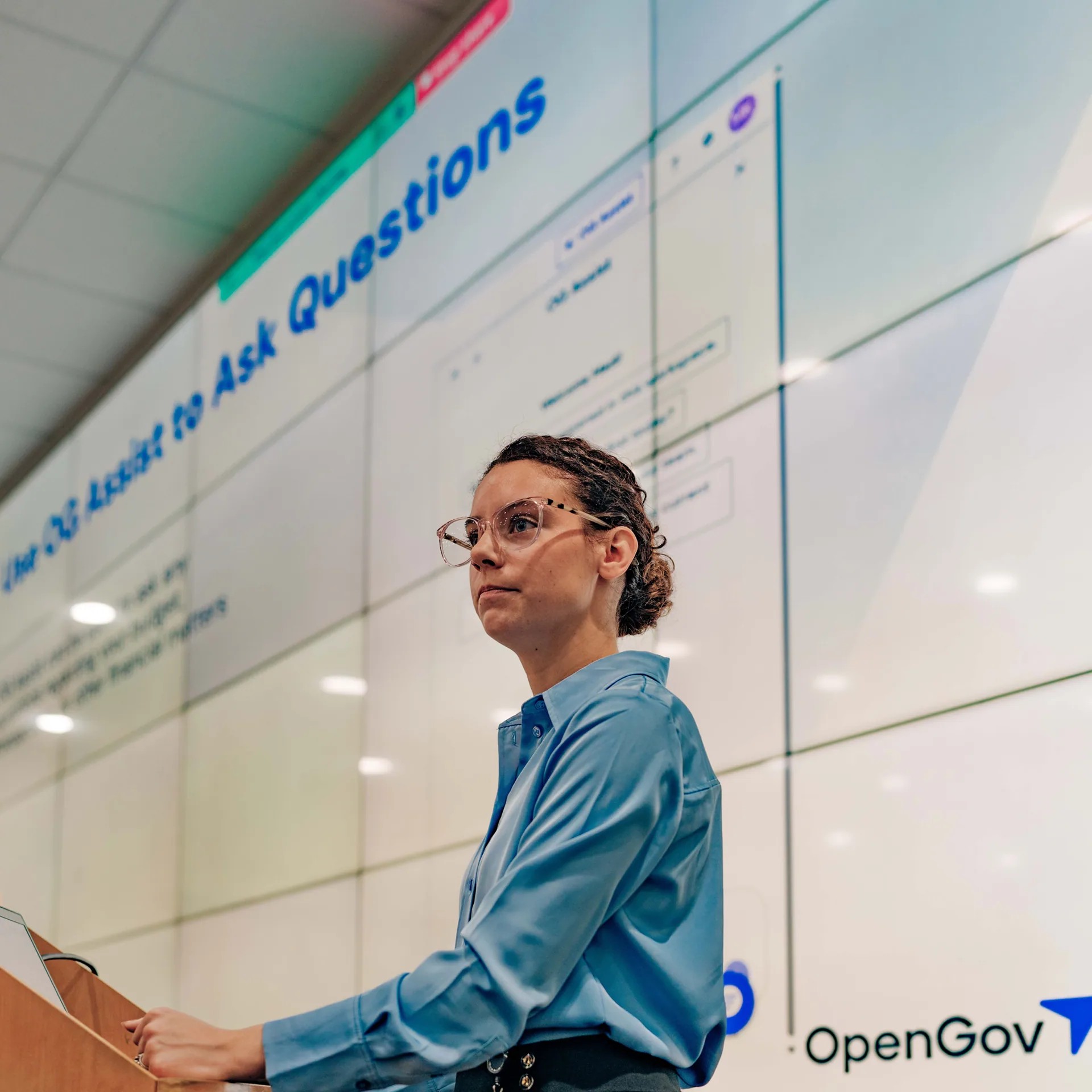
In April 2026, Thiago Sá Freire replaced Bookman as CEO, while Bookman became Chairman Emeritus. The handoff arrived with a new description of the product: an AI-native Public Service Platform. OpenGov introduced OG Assist across the suite, expanded ERP into human-capital management and payroll, and demonstrated AI-assisted permit review.
The practical idea is more interesting than the label. OG Assist can draft a solicitation, explain a record, answer a question about an agency’s data or prepare a workflow action. It operates in the context of the user’s page, permissions and customer environment, and a person reviews the result before it advances. For government, the winning AI feature may be less “magic” than “show your work.” OpenGov says customer data is not shared across agency environments or used to train public models without permission.
The company has early usage evidence. Its AI Scope Builder creates a structured procurement draft from a blank page, while leaving publication to the buyer. From late July through November 2025, customers logged nearly 700 cumulative hours saved. That number is modest enough to be believable and specific enough to matter: hundreds of hours returned to procurement teams that rarely have spare hands.
05 / What to stealThe OpenGov playbook, without the government ERP
OpenGov occupies a peculiar and durable corner of enterprise software. It is not consumer civic tech, though residents touch it. It is not merely fintech, though public money runs through it. It is vertical SaaS for the machinery of local government, sold to institutions that move slowly because the consequences are public.
The company’s original transparency instinct still matters. Yet its real discovery was that accountability is produced before it is displayed - in the budget request, the bid evaluation, the permit review and the maintenance log. OpenGov built its business by following those records backward into the work. The result is less romantic than “fix democracy with an app.” It is also more useful.