John Thomson did not set out to make municipal finance interesting. In 2013, he wanted a sticker. A postcard told him to renew his vehicle registration online; the website failed to find him; the errand ended where American errands go to lose an afternoon - the DMV line. The frustration became PayIt, a Kansas City software company built around a tidy proposition: renewing a plate should feel closer to checking out online than applying for a small moon landing.
Thirteen years later, PayIt says the agencies on its platform collectively serve more than 150 million residents across North America. The menu has grown well beyond motor vehicles. A city, county, state or province can use it for property taxes, utility bills, court fines, permits, tolls, hunting licenses and the assorted official chores that arrive with a due date and a warning printed in stern type.
Calling it a payment app undersells the machinery. PayIt gives residents one profile, transaction history, saved payment methods, reminders, eBills, AutoPay, payment plans and a cart that can hold obligations from different departments. On the agency side, it handles payment processing, fraud, disputes, settlement, disbursement, refunds, reconciliation and reporting. The product is SaaS, but the company is also a registered payment facilitator. Software and money movement live in the same box.
The old basement stays
PayIt's sharpest product decision is architectural and almost humble: do not insist that government replace every old database before a resident gets a decent screen. Its service layer sits in front of systems of record and connects by API or flat file. The agency can modernize the experience while the mainframe, tax system or court software continues humming in the basement.
profile
workflow
reconciliation
of record
That separation matters because public IT projects have a habit of turning into archaeology. PayIt sells configuration instead of bespoke development: encode the agency's rules, connect the records, brand the experience, launch one service and add more. Built-in payments keep the agency from stitching together a gateway, processor, fraud vendor and reporting portal. AWS GovCloud hosting and certifications including PCI Level 1 and SOC 2 Type 2 are part of the procurement argument, not decorative badges.
The customer is the agency, but the user is the person trying to pay before bedtime. That two-sided audience explains PayIt's market position. Tyler Technologies and Catalis offer broad government suites; Paymentus and ACI bring large-scale payments; Accela, OpenGov and Salesforce attack adjacent workflows. PayIt wedges itself between the resident experience and the ledger, then promises to make both sides less annoyed.
A business model that waits at the register
PayIt advertises zero upfront implementation, integration, consulting or maintenance fees. In its common model, the company earns a small fee on each transaction only after money starts moving. An agency can instead choose a software subscription, or share transaction charges with residents. Hardware for point-of-sale terminals is an exception. Exact rates live in individual contracts.
It is a deft answer to the public-sector budget problem: lower the cost of saying yes, then grow with usage. It also creates the central tension in the story. Somebody pays. If a resident sees a convenience fee beside a free bank-payment option, convenience has to win by enough. If the agency absorbs the fee, adoption becomes easier but the cost moves onto its books. The price is part of the product experience.
Grand Rapids read the whole recipe
Grand Rapids launched GR PayIt in 2017 and did several things that sound mundane enough to skip. The city tested with more than 1,600 community members. It absorbed card-processing fees. It marketed the new service. It consolidated property tax, water, refuse and parking payments into one profile, then added the habits that make software sticky: eBilling, alerts, AutoPay, scheduled payments and saved methods.
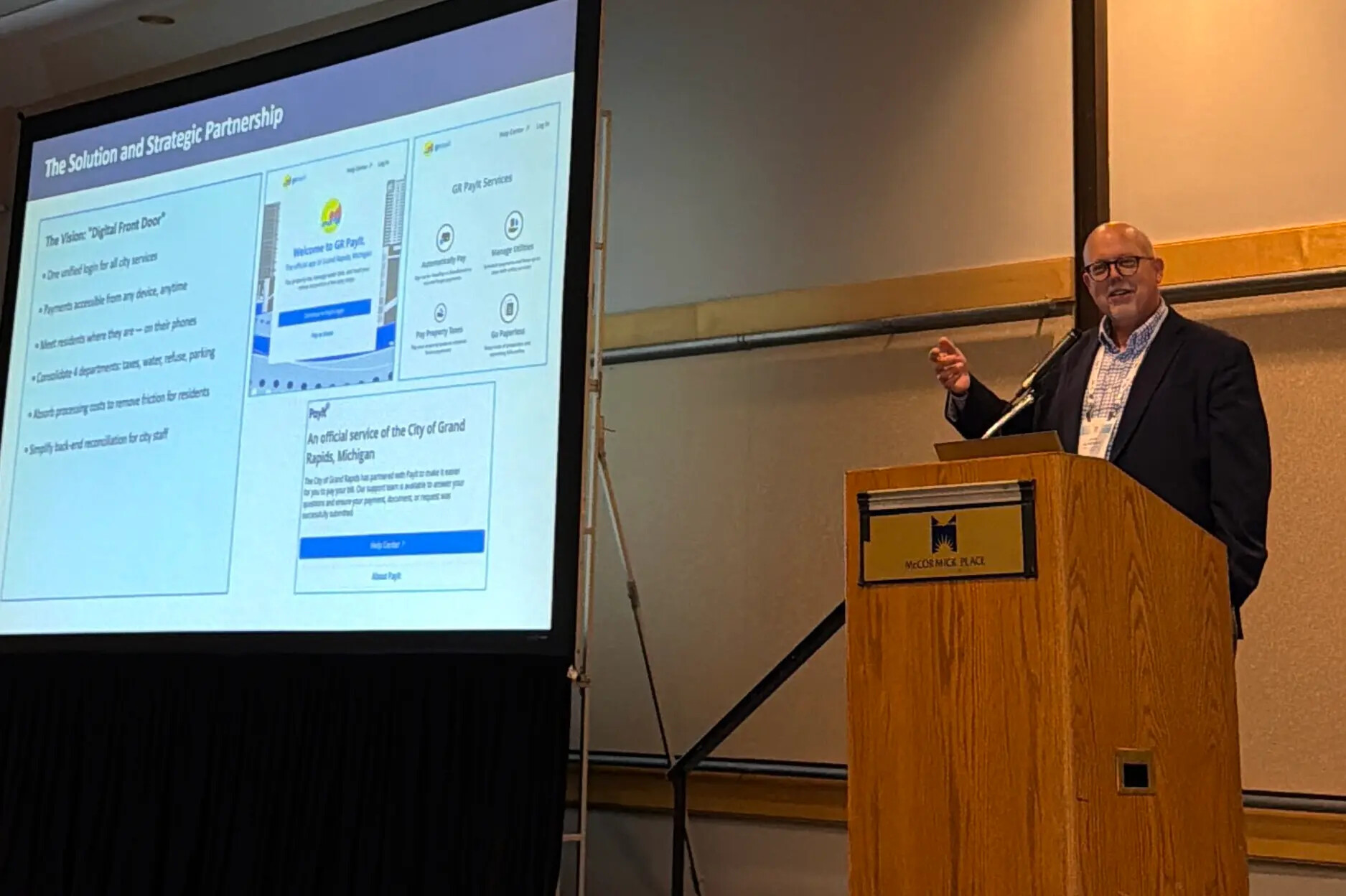
By 2025, annual online collections had climbed from $29.6 million to $175.2 million, a 491 percent increase. The platform had processed more than $1 billion since launch. City Hall walk-in traffic fell 65 percent, while 85 percent of water, refuse, parking-ticket and property-tax transactions were happening online. The result earned Grand Rapids a 2025 Government Finance Officers Association award.
North Carolina offers the statewide version. myNCDMV launched in late 2018 after the department decided its basic renewal page could do more. By early 2025, more than 7.6 million users had completed over 25 million transactions. The common move is visible in both cases: start with a high-frequency irritation, make the digital route genuinely easier, and use the resulting account to support more services.
Toronto skipped a few ingredients
Then there is MyToronto Pay, the example every balanced PayIt profile needs. Toronto introduced the platform for property tax, utility bills and parking tickets. By July 2024, the city and customers had paid an estimated $8.4 million in transaction and processing fees. Adoption was 6.4 percent for property taxes, 5.3 percent for utilities and 31 percent for parking tickets.
The city's auditor general found that anticipated benefits fell short, departmental buy-in was insufficient and savings assumptions were not realistically achievable on the proposed timetable. The procurement history was also troubled: staff initially moved toward a noncompetitive deal despite rules requiring a challenge process, and records supporting key decisions were not properly retained. The audit emphasized that PayIt generally followed city staff's lead. Toronto still chose to let the contract end and decommissioned the platform in June 2025.
What failed first? The surrounding operating model. A clean interface could not compensate for low organizational alignment, questionable procurement and a weak reason for residents to change habits. The Toronto episode does not erase the Grand Rapids numbers. It explains them. Buying the same software is not the same as running the same playbook.
AI arrives wearing sensible shoes
PayIt's 2026 expansion is called Smart Works. The names are cheerful; the use cases are clerical. Smart Reconcile matches payment, bank and remittance data and sends exceptions to a human. Smart Workflows prepopulates fields and supports automatic approval. Ask Max lets staff query financial data in plain language. Identity and document verification target services that stayed offline because they required a face, a credential or a pile of PDFs. Smart Guide helps residents locate a service without guessing which department owns it.
This is a credible place to apply AI because the desired output is measurable: fewer unmatched payments, shorter review queues, more completed transactions and fewer calls. It is also a hazardous place to get clever. Government decisions require explanations, appeal paths, accessibility, data controls and humans who can catch a confident mistake. PayIt's own research found security and payment compliance to be the largest collection challenge for 45 percent of surveyed public-sector leaders. The company will be judged on saved minutes and controlled errors, not the number of features carrying the word “smart.”
The part worth stealing
For a civic technology buyer, the transferable idea is a sequence rather than a shopping list. Pick a transaction residents already hate. Modernize the front end without waiting for a perfect back end. Connect payment and reconciliation from the start. Price the service so the preferred behavior is also the economical one. Test with actual residents. Promote the launch. Measure digital share, completion, support, reconciliation time and total fees against a baseline everyone accepts.
- Begin with frequency. Vehicle renewals, tax bills and utilities create repeated chances to earn trust.
- Make one owner accountable. A cross-agency portal needs authority that crosses agency lines.
- Treat fees as interface copy. The number beside “Pay now” can undo months of UX work.
- Market the behavior change. A launch announcement does not move a check writer online.
- Publish the scoreboard. Adoption, completion, cost per transaction and staff time should decide expansion.
The model will struggle where records are unreliable, integrations cannot be maintained, procurement lacks daylight, departments do not share goals, residents lack digital access, or convenience fees make the old route rational. Cash, IVR, point of sale and accessible support still matter. Digital-first cannot quietly become digital-only.
PayIt occupies a valuable, unromantic layer of the economy: the moment a public obligation becomes a completed transaction. Its best deployments make government feel briefly absent. Its weakest one demonstrates that technology never operates alone. The company built the checkout button. The agency still has to give people a reason to press it.