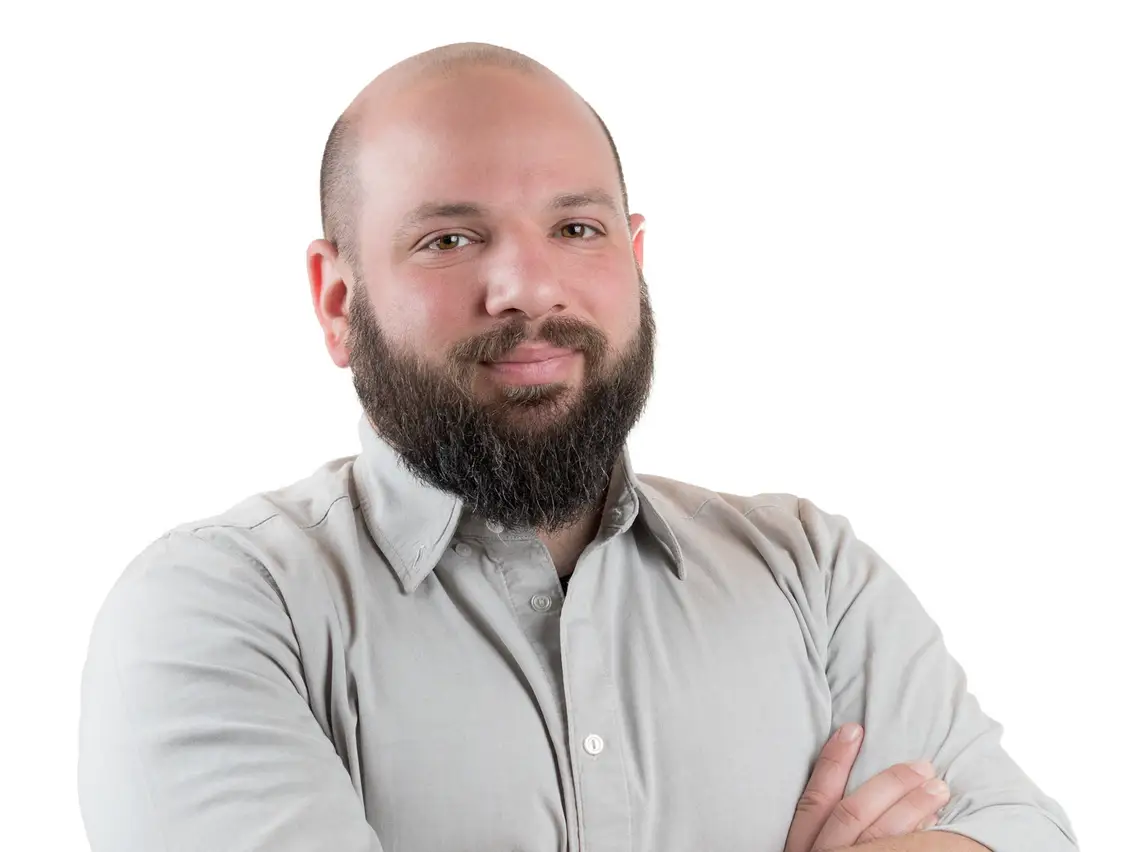
A finger on the pulse of the city
Eyal Feder-Levy spends his days thinking about a question most people never ask: how does a city know if it is doing a good job? As co-founder and CEO of Zencity, he has turned that question into a company. Zencity collects millions of public data points - social posts, service requests, survey responses, calls to city hall - and uses machine learning to hand local governments a readable picture of what their residents actually need. Today the platform works across six countries and serves hundreds of government agencies that together touch more than 200 million residents.
The pitch is deceptively plain. Feder-Levy argues that data science quietly became "a private sector thing," a set of tools that reshaped how companies understand their customers while the governments closest to everyday life were left reading the room by hand. Zencity's job, as he frames it, is to close that gap. "We empower city leadership with organic, resident feedback data," he has said, "data that is extracted from millions of online interactions."
He did not arrive at software the usual way. Before Zencity, Feder-Levy served in the Israel Defense Forces' elite 8200 intelligence unit, the same signals-and-data corps that has seeded a generation of Israeli startups. But instead of heading straight into tech, he spent three years running The Garden Library, a nonprofit in South Tel Aviv focused on education and arts access for underserved communities. From there he moved into urban planning proper, working with Israeli cities and teaching urbanism at Tel Aviv University. He was, for a time, the youngest board member of the Israeli Planning Association.
That route left a mark on the company. Feder-Levy talks about cities the way some people talk about art. "Cities are the most amazing achievement of human society to date," he says, and he means it as a design brief, not a slogan. Zencity is less a data company that stumbled into government than an urbanist's attempt to scale the thing he already loved: the messy, high-stakes work of making a place function for the people who live in it.
In 2015 he co-founded Zencity with Ido Ivri, a former IDF colleague who serves as CTO. Ivri built the technical spine; Feder-Levy carried the mission and the market. Selling software into city hall is famously slow - procurement cycles measured in seasons, budgets scrutinized line by line - but the company kept expanding, from a handful of pilot cities to a network spanning the United States and beyond. Along the way it raised roughly $93 million in total, including a Series C round reported in 2024.
That line has become something of a thesis for him. Feder-Levy is drawn to local government precisely because it sits underneath the national shouting match. Potholes, permits, park maintenance, response times - these are the things that define whether a resident trusts the institution nearest to them, and they rarely split cleanly along party lines. Zencity leans into that framing by positioning itself around "community trust," treating trust not as a soft sentiment but as something a city can measure and improve.
He is unusually candid about his own position in that equation. In a 2021 interview conducted over Zoom from his Tel Aviv apartment, he described himself as "a privileged white man, Jewish in Israel," and reflected on how his voice had historically been overrepresented at local meetings simply because he was the kind of person who showed up. The observation is not incidental. A tool that surfaces feedback from residents who never make it to a 7 p.m. council meeting is, in part, an answer to that imbalance - a way of hearing the people who are usually too busy, too tired, or too unheard to attend.
For all the seriousness of the mission, colleagues describe an optimist. Feder-Levy resists the cynical read of public servants that comes easily to tech founders. "Most of these people get up and go to work everyday because they believe they want to serve," he says of the government workers Zencity sells to. It is a bet on good faith inside institutions that the wider culture loves to mock, and it shapes the product: Zencity is built to give those workers better information, not to replace their judgment.
The company he leads reflects his priorities in its makeup. In its earlier years Zencity's team ran more than half women, stocked with people from public-policy and data-science backgrounds rather than pure engineering - a deliberate blend of the civic and the technical. That mix mirrors the founder himself, who came to computer science late enough to earn his degree from Tel Aviv University in 2016, after he had already started the company.
He carries a lighter reputation too. His profile on X reduces his obsessions to three words - cities, people, and data - and he cheerfully calls himself an "Urban Innovation Geek." He is also, by his own admission, an e-scooter enthusiast, undeterred even after breaking his arm in a scooter accident; he showed up to that 2021 interview with his arm still in a cast and his enthusiasm intact. It is a small thing, but a telling one: a man who studies how cities move, insisting on moving through them himself.
Feder-Levy now splits Zencity's story between Tel Aviv, where it began, and the United States, where much of its growth has happened. He has served on the World Economic Forum's Future of Cities advisory board, lending his argument - that trust is the real infrastructure of local government - to a wider stage. The aspiration has stayed remarkably consistent since the beginning: to give every city an accurate, routine finger on the pulse of its community, and in doing so to rebuild a little of the trust that has eroded between residents and the governments meant to serve them.
Whether AI can genuinely restore public confidence is an open question, and Feder-Levy tends to answer it with characteristic modesty - not by promising that software fixes trust, but by insisting that you cannot fix what you cannot measure. That is the quiet wager at the center of his work. Give city leaders a clearer read on their residents, the thinking goes, and better decisions, and a little more trust, might follow.