Howard Lerman needed a reference. Jon Brod had worked with the person he was considering, so Lerman sent an email. Brod preferred to talk. Then came six days of phone tag. Two executives, one fairly ordinary question, and nearly a week spent trying to have a conversation: the modern office had arranged an elaborate obstacle course around a telephone.
The delay became the origin story of Confide, the disappearing-message app they helped create. It also offers a useful introduction to Lerman. In his career, an irritating piece of everyday business can become a software company. A missed conversation attracts his attention. The habits that make it difficult begin to look negotiable.
Today, as founder and CEO of Roam, he is working on a larger version of that problem. He wants colleagues scattered across cities to feel close enough to interrupt one another, finish a quick exchange, and carry on. Having helped put businesses on the internet with Yext, he is trying to put an office inside a computer. The hallway, apparently, deserves its own software budget.
A joke with an unusually good exit
Before the public company and the virtual offices came JustATip.com. Lerman launched it in 2000 with Tom Dixon and Sean MacIsaac, friends from Thomas Jefferson High School for Science and Technology in northern Virginia. He was studying at Duke; they were at Princeton. Their service let people send friends anonymous tips about their annoying habits. It was the sort of internet business whose product demonstration could also end a friendship.
Jon Stewart used the site on The Daily Show, sending traffic up. Lerman has recalled the strangeness of watching television from a college dorm and unexpectedly seeing his own creation appear. In 2001, the founders sold it to online marketer Traffix for $150,000. An undergraduate joke had become a transaction with a publicly traded company.
Lerman graduated from Duke in 2002 with a bachelor's degree in history. His next venture, Intwine, began that year, with Lerman as cofounder and chief operating officer, and was sold in 2005. The early projects established something that would outlast any individual product: a working relationship. Dixon and MacIsaac would remain recurring figures in his business life.
That continuity matters. The familiar account of entrepreneurship follows a solitary founder from insight to exit. Lerman's career also has the shape of a group that keeps getting back together, bringing its accumulated experience to a different problem.
The business of getting the details right
Yext, cofounded in 2006, gave that group a much longer assignment. It worked in pay-per-call advertising before developing the business listings and information products that became central to its identity. The problem was wonderfully unromantic: a business could have different details scattered across search engines, directories, and maps. Someone had to keep them consistent.
In a 2011 interview, Lerman described that work as plumbing. Businesses needed a single place from which to update information distributed across other services. His point was that the apparent simplicity of changing a listing concealed a complicated network of integrations. A correct address on a screen had a considerable amount of machinery behind it.
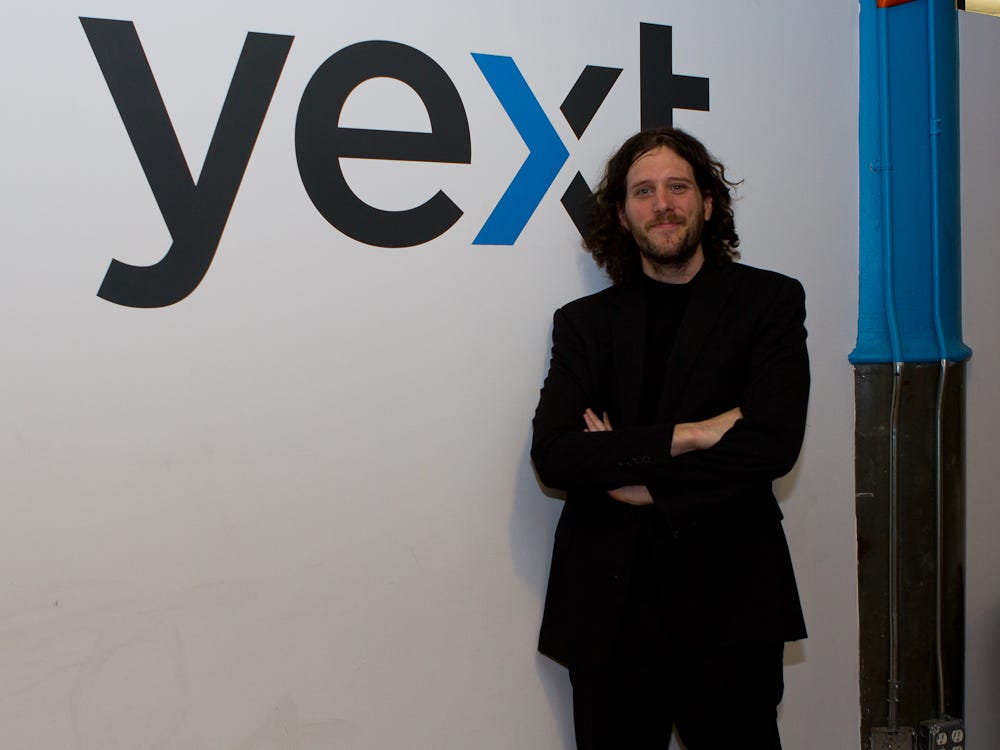
Yext listed on the New York Stock Exchange in April 2017. When the company announced his departure as CEO in March 2022, it reported $391 million in fiscal 2022 revenue and more than 2,700 customers worldwide. Those are company figures, rather than a measure of any one person's contribution, but they show the scale of the operation he had helped build.
His departure took effect on March 25, 2022, with Michael Walrath taking over as CEO. Lerman moved into an advisory role. A career that had spent almost sixteen years expanding one organization returned to the more intimate business of making another.
- 2000JustATip.com launches
- 2006Yext is founded
- 2014Confide reaches the public
- 2017Yext goes public
- 2022Roam emerges from stealth
Six days is a product specification
Confide had arrived while Lerman was still running Yext. Released publicly in January 2014, it was built for professional conversations people hesitated to commit to a permanent digital record. The reference check with Brod had exposed the inconvenience: candor meant arranging a call, and arranging a call could become its own project.
The original app revealed words as a reader moved a finger over them, then made the message disappear. Its interface tried to give a written exchange some of the temporary quality of speech. Lerman and his collaborators were paying attention to a social behavior as much as a technical feature: people communicate differently when they expect their words to remain available forever.
There is a connection between that project and Roam. Both begin with something an ordinary conversation does easily, then ask why the digital version has become so cumbersome. In one case, the missing quality was discretion. In the other, it was proximity.
A hallway, with fewer real estate complications
Lerman's own account of Roam begins with an old ambition: a big office building in New York. He got it. He subsequently decided that the building had failed to deliver everything he wanted from it. His revised ambition is to recreate its useful social machinery for a distributed company.

In a conversation about Calendar Zero, he remembered the early Yext team having fast discussions without scheduling internal meetings. With scale came a calendar full of half-hour and hour-long video calls. Even arriving at headquarters could mean spending the day speaking through a screen to someone elsewhere in the building.
Roam gives people a visual workplace, showing colleagues and rooms so they can see who is available and start a conversation. Private offices, meeting rooms, a theater, and a lobby translate familiar office arrangements into software. The ambition is quite literal. He is rebuilding the places where work happens, room by room.
When Roam emerged from stealth in November 2022, IVP led its $30 million Series A. The investor had also backed Yext. Its announcement named a team that included Dixon, MacIsaac, Brod, Grace Sutherland, Jeff Grossman, and Kevin Caffrey. The next venture carried a substantial amount of shared history.
Editorial illustration of the idea behind Roam.
The calendar is open to negotiation
Lerman's impatience with scheduled one-to-ones predates Roam. He argues that recurring appointments fill a leader's calendar and encourage colleagues to save up questions that could have been resolved earlier. His preference is frequent access and short conversations. Canceling the appointment, in his telling, should make speaking easier.
There is an entertaining exception to this hostility toward meetings: he has described holding executive calls on Sunday evenings to prepare for the week. The distinction reveals his actual concern. He wants a meeting to earn its place through the work it advances. A repeating calendar entry is a rather thin argument for spending everyone's evening, or Tuesday afternoon.
“Over your dead body should you delegate product market fit.”
Howard Lerman, on the founder's job
His advice to founders has the same hands-on quality. Legal work and other functions can be delegated as the business develops, but understanding the fit between a product and its customers remains the founder's responsibility. At Roam, he has also favored introductions through experienced advisers and direct conversations with company leaders. The sales approach resembles the product: reach the person who can move the question forward.
Even the turtleneck has instructions
All this attention to systems extends to the wardrobe. In February 2026, Lerman published a RoboHoward Wardrobe Protocol. He described using a largely fixed uniform to reduce decisions: black turtleneck, black trousers. He explained the categories, replacement cycles, and practical preferences with the seriousness other executives reserve for their quarterly forecasts.
He also allows for theater. A purple tuxedo bought for a Roam presentation belongs to what he calls his show pieces. The clothes are intended to help summon different versions of himself for different situations. The working uniform removes deliberation; the occasional costume helps him perform. It is a fairly elaborate system for someone trying to spend less time thinking about clothes.
His changing approach to planning offers another glimpse of the person behind the product. In a public reflection, he described abandoning the detailed grand plans of his younger years in favor of the best small action available immediately. He compared building a company to laying one brick, then another. Read alongside the wardrobe protocol, it suggests a founder who wants routine decisions settled so the uncertain ones can receive his attention.
An office that leaves room for the rest of life
By August 2026, Lerman was explaining Roam in more personal terms. Fatherhood had changed what he wanted from the working day. He wrote about moving to Florida to be around his family while continuing to build a company. The hours once spent polishing presentation colors looked different when school pickup was an alternative use of them.
He did not describe a retreat from ambition. His argument for other parents was that proximity to children and substantial professional commitments could coexist. Remote work made room for being there when children left for school or came home. Work could resume later. The office he was building was also an attempt to arrange his own life.
The next occupants may be less concerned with the school run. In June 2026, Lerman argued that AI agents need shared visibility: colleagues should know which agents are working, what they are doing, and when they need human input. His virtual office would give teams a way to understand that activity together. It remains a proposition about how companies should work, rather than proof that every company will choose it.
His October essay, Cash Machines, added another possibility: software businesses using AI could produce meaningful cash flow with smaller teams, offering founders a route beyond depending entirely on a future sale or flotation. After taking Yext public, he was considering other definitions of a worthwhile outcome.
Across these ventures, Lerman keeps returning to the things that happen between people: a candid reference, an impromptu question, a useful introduction, a moment at home. Software is where he tries to rearrange the conditions around them. He once wanted the building. Now he wants to preserve the conversation and get on with the day.