Trey Tepichin had a complaint about being a lawyer that sounds, at first, like an employer's dream. He liked getting things finished quickly. A motion completed in fewer hours ought to have been good news. Under the billable-hour model, however, finishing early left more hours to find elsewhere. The clock had its own opinion about productivity.
He enjoyed commercial litigation. He liked the courtroom and the argument. The objection was to the accounting. A profession could reward the time a task consumed without giving the same reward to the person who shortened it. For someone interested in business, that was an invitation to keep looking.
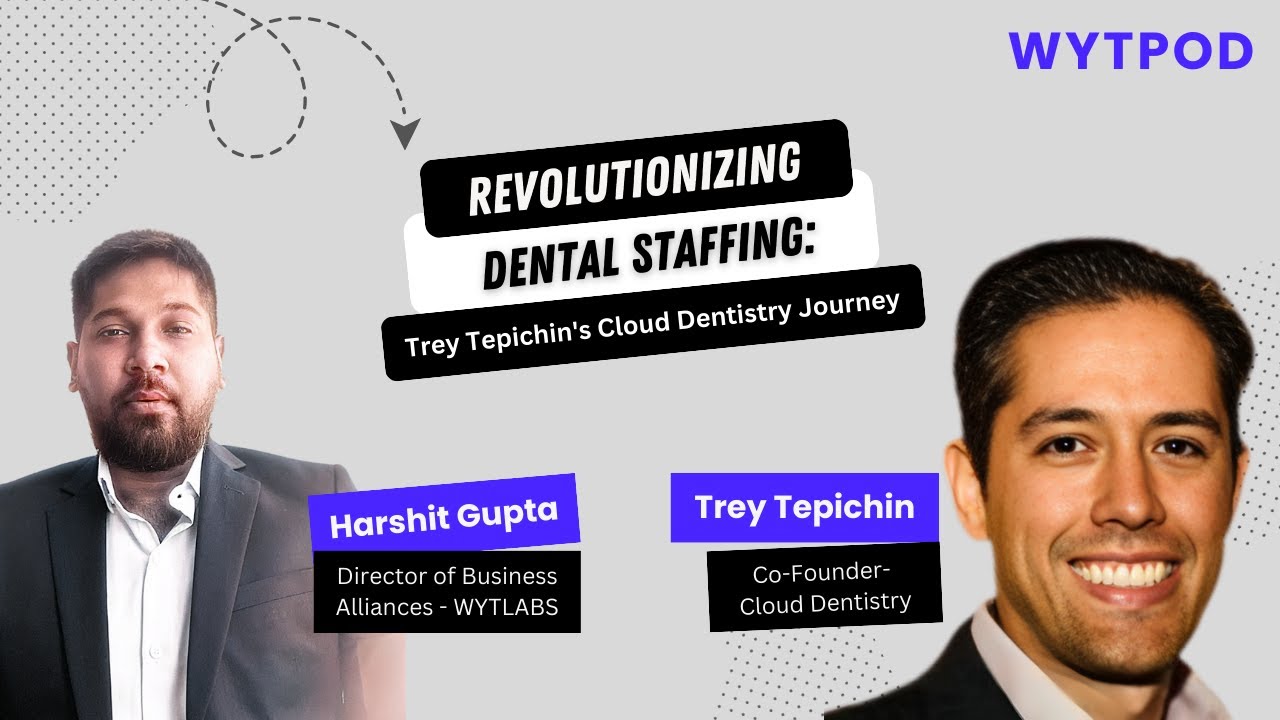
Today, Tepichin is co-founder and CEO of Cloud Dentistry, a marketplace connecting dental offices with people looking for temporary and permanent work. The distance between drafting a court motion and arranging a work assignment looks considerable. Follow the incentives, though, and his career becomes easier to read. Again and again, he comes back to who controls the relationship, who spends the time, and who gets paid.
A reunion with an unexpected agenda
The origin involved Reza Sanjar, a friend from high school who had become a dentist. They reconnected over dinner after years apart and began comparing the difficulties of their professions. Reunions often end with promises to keep in touch. This one produced a company.
Sanjar described the practical difficulty of finding staff while also running an office. Existing options included job boards and placement agencies. Tepichin, approaching the problem from outside the profession, recognized the shape of a marketplace. People needed work; offices needed people; finding each other remained unnecessarily cumbersome.
There is something useful about that particular pairing of friends. One could describe the daily problem in detail. The other could ask why the arrangement had to work that way. Neither perspective alone amounts to a business, but together they supplied a question worth testing.
Cloud Dentistry's own account credits Tepichin and Sanjar with combining their business and industry experience. Its premise is direct contact: offices can inspect profiles and communicate with professionals themselves. The design gives both sides more of the information that a traditional intermediary would otherwise hold.
The route north, and the detour into steel
Tepichin's early life began in Mexico City. He moved to the United States at 14 and finished high school in Houston. College took him to Duke, where he studied economics and biology, followed by Harvard Law School. While at Harvard, he also taught undergraduate economics.
His professional record includes associate roles at Ropes & Gray and Murphy & King in Boston. The progression has the recognizable outlines of a legal career: university, law school, established firms, commercial disputes. Yet his next chapter would involve manufacturing before it involved a staffing platform.
He led RAN Steel Fabricators from 2013 to 2015. A published professional biography describes the business as designing and building pressure vessels for the oil and gas industry. Steel fabrication is an unusually tangible interlude in the résumé of a software founder. It also makes the familiar shorthand of a lawyer simply becoming a technology executive rather incomplete.
Economics, litigation, manufacturing, staffing: the subjects change more dramatically than the underlying questions. What does something cost to arrange? Where does work stall? How should a business charge for removing that delay? Those questions provide a way to understand the career without pretending he followed a plan drawn up at graduation.
- DukeEconomics + biology
- HarvardLaw + economics teaching
- BostonCommercial litigation
- RAN SteelManufacturing
- Cloud DentistryA staffing marketplace
The software needed a person behind it
The public record catches the company in its less polished beginnings. On December 6, 2015, Tepichin published a LinkedIn article announcing that the beta was going live. The following January, he was promoting its presence at Houston's Star of the South convention. These were invitations to try something new, written before there was much history to point to.
He places the product launch in 2016. He has also been frank about its quality at the time. An initial release is a useful antidote to the tidy company biography, in which a good idea appears to become a working product almost as a matter of grammar.
“The alpha version of the product that we launched with was horrendous.”
Trey Tepichin
In a later conversation about the company's early days, he discussed what the hosts called “manual automation.” It is a nicely uncomfortable phrase. A system promises that something happens by itself; meanwhile, a founder supplies the missing machinery. Before the product can consistently coordinate people, somebody has to do the coordinating.
The distinction matters in a marketplace. A booking is a promise about a future action. Showing a profile is relatively easy. Getting two people to agree, remember, respond, and arrive requires the product to survive contact with an actual working day. A pleasing interface cannot attend an assignment on anybody's behalf.
A successful match should be allowed to leave
The business model offers a particularly clear view of Tepichin's thinking. Cloud Dentistry charges offices for access rather than adding an hourly markup to the professional's rate. It also does not charge a buyout fee when an office hires someone permanently. The relationship can outlast the temporary assignment without producing another placement bill.
That choice changes the founder's job. Charging to release a relationship would give the business a reason to guard the exit. Charging for access means the service has to remain useful enough for customers to return. A good match becomes evidence that the product works, even when the people involved decide to keep working together elsewhere.
The approach also leaves room for a working relationship to develop through experience. A résumé describes what someone has done. A day together reveals how people communicate, organize their work, and fit into a team. The possibility of moving from temporary work to a permanent role gives that experience a practical consequence.
His conversations about the platform repeatedly return to control for the professional as well as convenience for the office. In his writing on flexible staff, he describes workers placing value on having a say over their time and income. Flexibility is more specific when someone can choose an assignment than when it appears as a pleasant word in a recruitment advertisement.
Other people enter the picture
One early connection was Darius Somekhian, the co-founder of Pair Dental. Somekhian recalled first encountering an image of Tepichin and Sanjar on a park bench, promoting their idea for changing how professionals and offices connected. It is an appealingly modest setting for a business proposal: two founders, a bench, and a proposition still needing proof.
Somekhian became an adviser and later joined the business. In his account, Cloud Dentistry also acquired Pair Dental as a subsidiary. The connection brought someone with experience organizing work in the same industry into Tepichin's orbit. A marketplace may operate through software, but its history still travels through introductions.
By July 2025, Tepichin was reporting roughly 15,000 placements per month. The figure was his account of the business at that point. Beside the early convention announcement, it gives a sense of how far the daily task had grown: from persuading people to try the platform to supporting repeated use.
A number like that is easy to turn into the whole story. It is more revealing alongside the earlier awkwardness. The company had to work at the level of individual decisions before it could produce an aggregate worth discussing. Each assignment still depends on somebody choosing to accept it.
The next assignment is inside the office
In June 2026, Cloud Dentistry announced an ADSO Innovation Award. Tepichin's public response thanked colleagues by name, including Elizabeth Malazzo, Adriana Pustizzi, and Madeline Methven. Recognition supplied an occasion to make the team visible in a story often told through its founders.
That July, the company introduced Cloud Coaching, an on-demand training offering available through its existing dashboard. Its focus includes onboarding and staff development. Once a business helps people find one another, helping them work together is a plausible next assignment. Recruitment ends at a different point from a team's learning.
In August, Tepichin published an argument for starting office AI with a narrowly defined administrative task. He recommended limited permissions, correction, and gradual expansion of responsibility. His proposed starting points included scheduling and after-hours calls. The emphasis was on putting a tool to work within a defined job.
There is a recognizable continuity with his earlier career complaint. Time spent moving information or arranging routine work deserves scrutiny. The newer technology changes what might be automated; the interest in removing unnecessary effort remains familiar. His prescription also acknowledges that software needs instruction before it deserves trust.
There are still dishes in the sink
For all the attention to efficiency, Tepichin admits that social media can consume minutes he meant to spend elsewhere. He enjoys science fiction and the possibilities of space travel. Asked about an unwanted chore, he chose washing dishes, then began considering whether a neighborhood service could make the economics work.
It is a small, funny glimpse of the same habit that brought him into staffing. An irritation becomes a question about coordination. How many people need this done? Could they be gathered close enough together? Would the arrangement justify someone's time? Even the sink can become a business discussion.
The appeal of his story lies in that recurring habit, rather than in the neatness of his route. A lawyer notices the clock. A friend describes a staffing problem. A rough product requires patient work. The dishes remain an unresolved opportunity. Tepichin keeps finding practical reasons to ask whether people could arrange things a little better.