Paul J. Sarvadi learned something about people while carrying their golf clubs. His first job was caddying, with his brother as caddy master. The family arrangement supplied a lesson of its own. Watching golfers supplied another: put someone on a course, give them a difficult shot, and their personality becomes rather less theoretical. Service meant paying attention to the person as well as the task.
The caddy eventually became a company founder, a public-company chief executive and an author. But attention to people remained the subject. In 1986, Sarvadi co-founded the business now called Insperity in Kingwood, Texas. The first office measured 600 square feet. There was scarcely room for an empire, though apparently enough room for an idea about how other people might build one.
His route was untidy in the ordinary entrepreneurial way. He attended Rice University and the University of Houston, then left without finishing college. Small businesses became his practical education. The experience matters to the story because his eventual customers were dealing with problems he had encountered himself: making a business function while its owner was expected to know rather a lot about everything.
Born in Aurora, Ohio, and based professionally in the Houston area, Sarvadi built his career around those owners. Their ambitions gave him a market. Their lack of spare time gave him a problem worth solving. A new business can have a promising product and still be undone by the accumulated work of employing people. Someone has to recruit, process payroll, keep records and make the machinery run.
The fifth item on the list
Sarvadi’s explanation of the idea begins with five parts of a business: finance, sales, operations, technology and people. The first four depend on the fifth. A sales strategy needs somebody to sell. A financial plan needs somebody to execute it. Technology needs people who understand what to do with it. The observation is simple enough to sound obvious, which is a useful disguise for a business opportunity.
For a small employer, every appointment carries weight. One capable hire can change the range of things the company can attempt. One vacancy can leave the owner doing two jobs while hoping the original job will politely wait. Sarvadi’s proposition was to make human resources support available to employers whose size left them without the departments and specialist knowledge of a larger corporation.
Insperity’s work includes payroll processing, HR administration, hiring and retention support, and aligning people strategy with the business’s goals. The professional employer organization model also involves co-employment. It creates a continuing relationship with a client’s workforce, with responsibilities allocated between the provider and the client. That is a more involved undertaking than dropping off software and wishing the owner luck.
Explaining the arrangement was part of building the business. So was creating a regulatory setting in which it could operate. Texas’s Staff Leasing Act took effect in 1993. Administaff, the company’s original name, went public on the New York Stock Exchange in 1997. In 2017, Insperity received certified professional employer organization status from the IRS. A business built around employment administration acquired plenty of administrative homework of its own.
- 1986Founded in Kingwood
- 1997New York Stock Exchange listing
- 2011Administaff becomes Insperity
- 2026Forty years in business
A name that needed more space
By 2011, Administaff had reached its twenty-fifth anniversary and was becoming Insperity. The new name joined inspiration and prosperity. A name can sound like a minor concern beside contracts and customers, but the old one suggested temporary staffing to people who did not know the company. It also made the expanding service offering harder to explain.
The change had a suitably public coming-out party at Houston’s Minute Maid Park, with Steve Forbes speaking and Jim Nantz serving as emcee. A baseball stadium is an ambitious place to announce an HR rebrand. Yet the underlying issue was practical: Sarvadi wanted a business that could help customers at different stages rather than wait for each to fit one comprehensive service.
That makes the rebranding a revealing episode in his career. Success can trap a founder in the description of the business that first worked. The familiar name has loyal customers, a history and advertising behind it. Giving it up means asking employees to carry their confidence across to something less familiar. A company can outgrow its own explanation before it outgrows its offices.
The pattern continues in Sarvadi’s partnerships. He has described wanting Insperity to be the kind of customer its vendors most enjoy serving. The logic is reciprocal: when difficulties arrive, the quality of a working relationship matters. There is a distinctly service-minded view of scale here. Growing means learning how to work with more people, inside and outside the company, whose judgment cannot simply be replaced by the founder’s.
“Challenges excite and energize me; they improve my whole focus.”
Paul J. Sarvadi
Putting the people argument on paper
In January 2019, Sarvadi published Take Care of Your People: The Enlightened CEO’s Guide to Business Success through Forbes Books. The title gives away the argument without requiring the reader to attend a retreat. Its subject is the relationship between a company’s values, its human capital strategy and its results. By then, the founder had several decades of operating experience to put behind the advice.
Recognition had arrived along the way: the national Ernst & Young Entrepreneur of the Year award for service industries in 2001, the Conn Family Distinguished New Venture Leader Award in 2004 and induction into the Texas Business Hall of Fame in 2007. These are milestones in a career whose main occupation has remained unusually consistent. The company he co-founded in 1986 is still the company he chairs and leads in 2026.
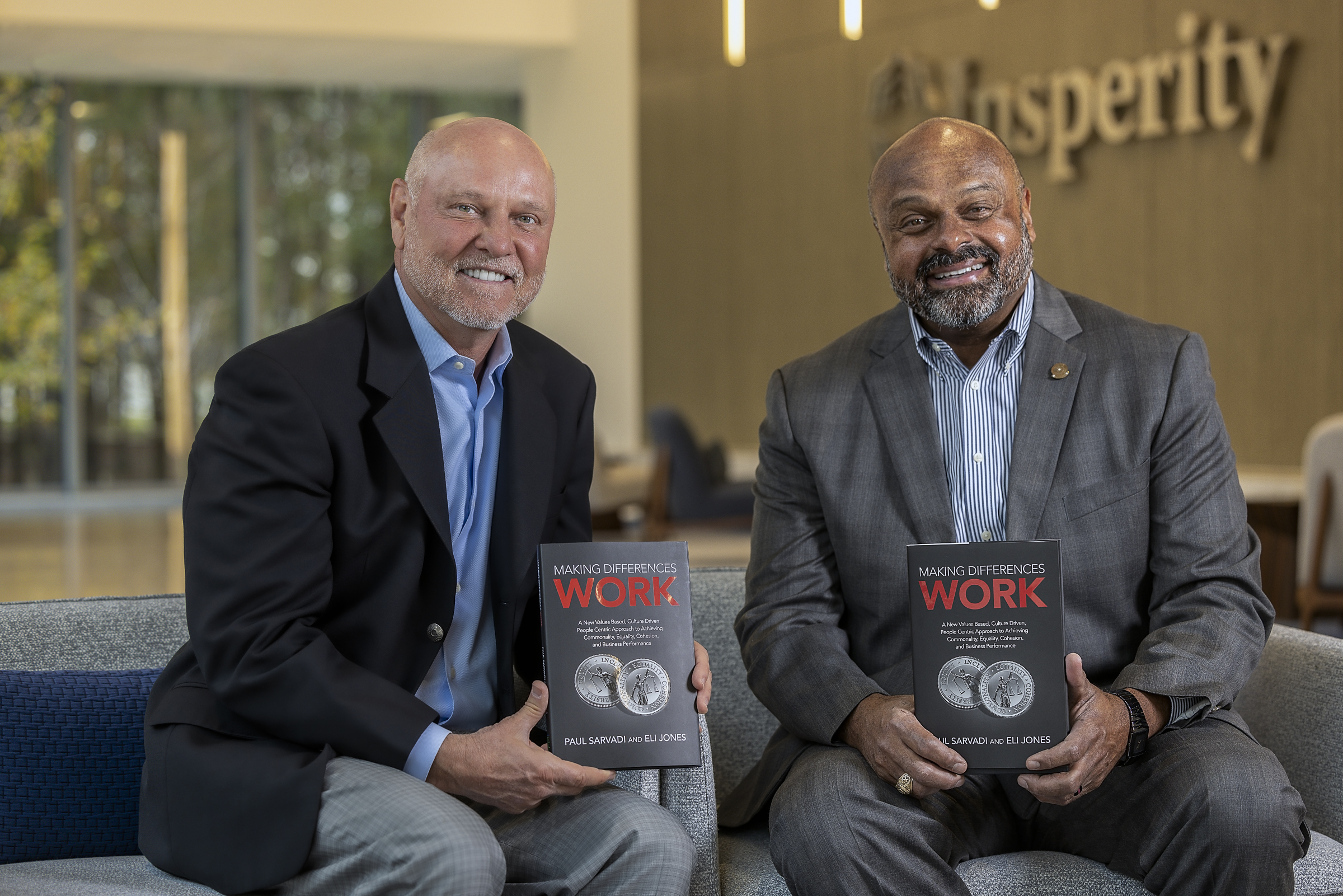
His later collaboration with Eli Jones took the people argument into workplace belonging. Jones is a Texas A&M marketing professor and an Insperity board member. Their book, Making Differences Work, brought an operating executive’s perspective together with an academic’s. The question was how a workforce of different people could develop shared purpose and use its differences productively.
Their framework uses three terms: commonality, equality and cohesion. Commonality asks what employees share. Equality concerns opportunities and rewards. Cohesion asks what helps people work together. Sarvadi and Jones present this as a way to build on the unifying aims of diversity, equity and inclusion. For them, assembling a varied group begins the work; everyday relationships determine what that group can accomplish.
Belonging, with a report card
Sarvadi has tried to put measurement alongside the vocabulary. In a July 2024 account of his work with Jones, he described focus groups followed by a survey of 1,999 Insperity employees. They examined four outcomes: team creativity, collaborative culture, alignment of values and individual discretionary effort. He reported positive relationships between their framework, belonging and those outcomes.
The setting matters. This was research involving his own company, described by its chief executive. It gives the reader a concrete account of what he wanted to examine, while leaving a distinction between his reported findings and a universal rule for every workplace. The revealing point about Sarvadi is his interest in whether employees experience the culture he believes he has built.
His August 2024 practical guidance follows that concern into ordinary operations. Culture should appear throughout the employee journey. Leaders should measure where they are succeeding and where work remains. Responsibility should be shared across the organization. In that view, belonging cannot depend entirely on a chief executive’s speeches. It has to survive the next conversation, promotion decision and meeting.
There is a particular challenge here for the modern employer. Sarvadi has written that much of Insperity’s workforce operates in hybrid, outside-sales or fully remote roles. A shared office no longer supplies all the incidental contact. If people are to understand each other, the company must give attention to how they work together across distance. The old question about making room has acquired a digital address.
Commonality
What do we share?
Equality
How do opportunities and rewards reach everyone?
Cohesion
What helps us work together?
Forty years, and still unfinished
The anniversary does not freeze the business in a commemorative photograph. In July 2026, Insperity reported average monthly paid worksite employees of 305,764 for the second quarter, down 1 percent from a year earlier. Quarterly revenue was approximately $1.7 billion, up 2 percent. Sarvadi identified margin recovery as the year’s leading priority and pointed to sales changes, HRScale and AI initiatives as areas intended to support renewed growth.
Those figures measure different things. Worksite employees are people at client businesses served through the arrangement, rather than Insperity’s own corporate headcount. Revenue describes the scale of the business, rather than its profitability. For a founder who talks about the importance of people, the distinction is worth keeping clear. A large number tells a story only when the reader knows what is being counted.
In September 2026, the company reported continued progress for HRScale, which combines Workday technology with Insperity’s professional employer organization service. In October, Insperity was a presenting sponsor of the Inc. 5000 Conference in Dallas, with sessions exploring AI’s role in HR. The tools have changed substantially since the small Kingwood office. Helping a growing employer use them remains familiar work.
Sarvadi describes himself as focused and has spoken of caring as the characteristic that matters most to his leadership. His unfinished ambition is to institutionalize the company’s culture so it continues beyond him. That is a different assignment from starting a business. A founder can supply an idea, sign a contract and make a decision. A lasting culture requires other people to understand the reasons and carry the work forward.
The caddy’s education offers a fitting way to read that ambition. Good service requires noticing somebody else’s situation. Building a company around service requires making that attention repeatable. Sarvadi began with owners who needed more time and employees whose contribution deserved more thought. Forty years later, the task is to leave enough understanding behind that neither group has to depend on his being in the room.