Farid Virani went to the New Year's Eve party in his waiter’s uniform. He had finished closing at the Marriott near Rice University and arrived still dressed for work. It was 1988. At the party he met Asha, then a Rice student. Several decades later, a building at her university would carry both their names. Even an ambitious young waiter would have needed considerable nerve to put that on the evening’s itinerary.
The distance between those two moments contains a wireless retailer, a family and a particular understanding of Houston. Virani arrived in the United States from Pakistan at 19. Houston became home through the welcome he received, the opportunities people offered and the life he built with Asha. He describes the arrival as partly chance. The retrospective business plan, with its suspiciously straight arrows, can wait outside.
Today he is founder and executive chairman of Prime Communications, which began with one Baybrook Mall store in 1999. His interests include retail, real estate and emerging industries. Yet the geography of his story keeps circling back to the same city, and to a university across the street from an early job. There is something pleasingly local about an enterprise that has grown across borders while its founder keeps finding reasons to invest close to home.
A mall counter, then a much bigger transaction
Prime’s first store opened in May 1999. Phones were the business; Baybrook Mall was the address. Before Prime, Virani had tried other entrepreneurial ventures. The company that endured began with a manageable physical proposition: one location, customers walking past and a product that needed explaining. A shop counter gives ambition a useful inconvenience. Somebody has to serve the next customer.
The scale changed substantially in January 2019, when Prime completed its acquisition of GameStop’s Spring Mobile business. The deal, announced the previous November, covered a chain of 1,289 AT&T wireless stores. Its agreed purchase price was $700 million before adjustments. Two numbers capture the jump: the original single store and a transaction involving more than a thousand locations. Between them sits nearly twenty years of building a retail organization.
1999
Completed January 2019
$700 million agreed purchase price, before adjustments. These are milestones, not a continuous growth series.
Buying a chain makes a dramatic entry in a corporate history. Running it makes a less photogenic entry every morning. More locations mean more employees, more managers and more occasions when a customer expects a simple answer to a complicated question. Prime operates as an authorized retailer. Customers encounter the AT&T brand; the retail organization behind the transaction has its own work to do.
Virani’s account of growth gives considerable room to partnerships, colleagues and family. He credits circumstances as well as decisions, and luck as well as effort. The explanation has fewer theatrical possibilities than a solitary founder conquering the world. It also leaves room for the people who opened stores, developed teams and kept the enterprise functioning after the acquisition announcement had stopped being news.
Three words that have to survive success
His recurring advice is compact enough to remember without a conference tote bag: humility, hunger and resourcefulness. The familiar shorthand is “humble, hungry and scrappy.” Each word has a practical meaning in his telling. Humility allows other people’s knowledge into the room. Hunger keeps a person curious. Resourcefulness asks how much can be accomplished with the people and tools available.
“humble, hungry and scrappy”
Farid Virani’s guiding principles
The first of those can be difficult to retain once success starts offering a person a microphone. Virani connects humility to listening, including the possibility that someone else understands a problem better. That gives the principle a purpose beyond good manners. A leader who can accept another person’s answer has access to more answers.
His version of hunger concerns learning. It is an appetite for questions and unfamiliar possibilities, rather than a particular number on a balance sheet. Being scrappy, meanwhile, includes using contemporary technology to accomplish more with limited resources. The advice carries the habits of a small business into a larger one. An expanding store network does not automatically make waste a virtue.
He is attentive to the speed of technological change, including artificial intelligence. His prescription for future business leaders combines fundamentals, capable teams and willingness to use new tools. There is no promise that an old formula will remain sufficient forever. The challenge is to keep learning while continuing to make sound decisions about people, products and customers.
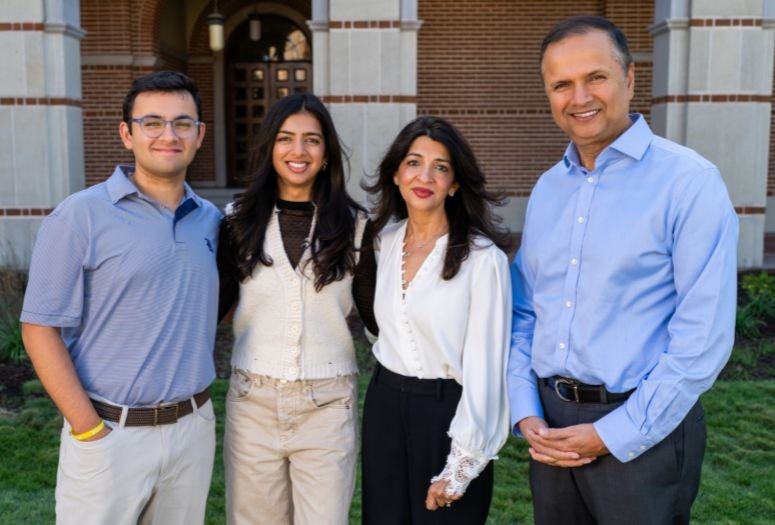
The Rice conversation became a family decision
Asha graduated from Rice in 1989. Their son Faraz followed in 2021, earning a degree in sport management with minors in business and entrepreneurship. That same year Rice launched its undergraduate business major. The timing placed a new academic program alongside a family already thinking about what the university offered, and what future students might need.
A friend brought Virani an opportunity to support Rice. Conversations with then-dean Peter Rodriguez drew in the family, and the discussions developed over roughly a year. Faraz took an active part. Asha’s connection to the university was longstanding, and nieces, nephews and other relatives had Rice connections too. The eventual gift emerged from a household conversation with plenty of campus experience around the table.
On October 29, 2024, Rice announced the gift establishing the Virani Undergraduate School of Business. The contribution supported curriculum, opportunities outside class, an associate dean position and preparation for students’ careers. Those are specific academic commitments: what is taught, how a program is led and how students move from learning into work.
Farid sees education as part of Houston’s ability to remain competitive, with consequences for Texas and the country. Asha has described a desire for students to remain curious, compassionate and ethically grounded. Their hopes give the gift a demanding standard. A graduate’s eventual success has to coexist with the judgment to consider what that success means for other people.
Leadership begins before the university gates
The family’s educational work also reaches school principals. Asha and Farid founded the Virani Distinguished School Leader Award to recognize leadership in Greater Houston schools. Virani is a board member and former chair of Teach For America Houston. Supporting a university program and recognizing a principal sit at different points in a student’s education, but both put attention on the people responsible for helping others learn.
The 2026 award carries a $15,000 grant for its winners. Among the recipients is Adrienne Brown of YES Prep Hobby Secondary. Her recognition brings the family’s educational commitments into the daily world of a school campus: teachers, students, families and a principal whose work has to hold them together. An award is a brief public moment. The job it recognizes resumes the next school day.
That focus on leadership helps explain why Virani talks about education beyond the acquisition of business skills. Accounting, finance and strategy matter. So does the person making the decision after the spreadsheet is complete. His hopes for Rice graduates include service in business, public life and other fields. The return he describes reaches beyond an employer’s recruiting list.
In September 2026, the doors opened
The next Rice milestone had walls. Asha and Farid Virani Hall opened with a ribbon-cutting on September 10, 2026. The 112,000-square-foot building sits alongside McNair Hall and serves undergraduate and graduate business education. The family’s support had moved from naming a school to helping provide additional space for its community.
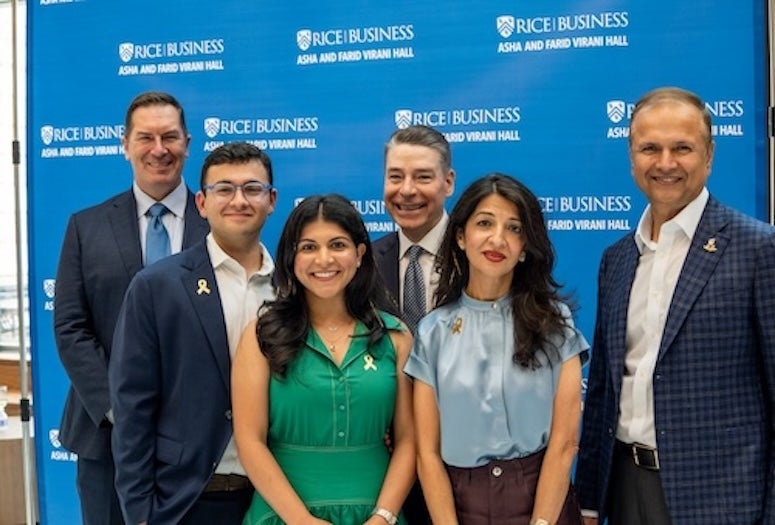
The demand is visible in the students. By fall 2025, more than 360 Rice undergraduates had declared business majors and more than 1,200 were enrolled in business courses. At the new building’s opening a year later, business majors accounted for more than a tenth of the undergraduate population. A family name on a building is conspicuous; the students needing room inside it give the building its practical argument.
The rooms include classrooms, spaces for team projects, faculty offices and doctoral research space. There are also places to eat and linger. In his remarks at the opening, Virani emphasized the people who would use the building and the relationships they would form. His family wanted a place that welcomed the wider university community. That makes the café and common areas part of the idea, rather than conveniences added at the end.
Still room for another question
There is an appealing continuity between the waiter arriving at a party after closing and the founder helping open a university building decades later. Both moments depend on being present where other people are. His recollections repeatedly return to those people: the city that welcomed him, his wife, his son, his colleagues and the partners who helped the business grow.
The story’s next chapter remains open in his own account. Asked in 2025 what might come next, he described a family interested in work with greater impact and a readiness to consider new opportunities. He ended with an economical reminder: “Remember, I’m hungry.” The word still had room in it for another business, another question or another reason to return to Rice.