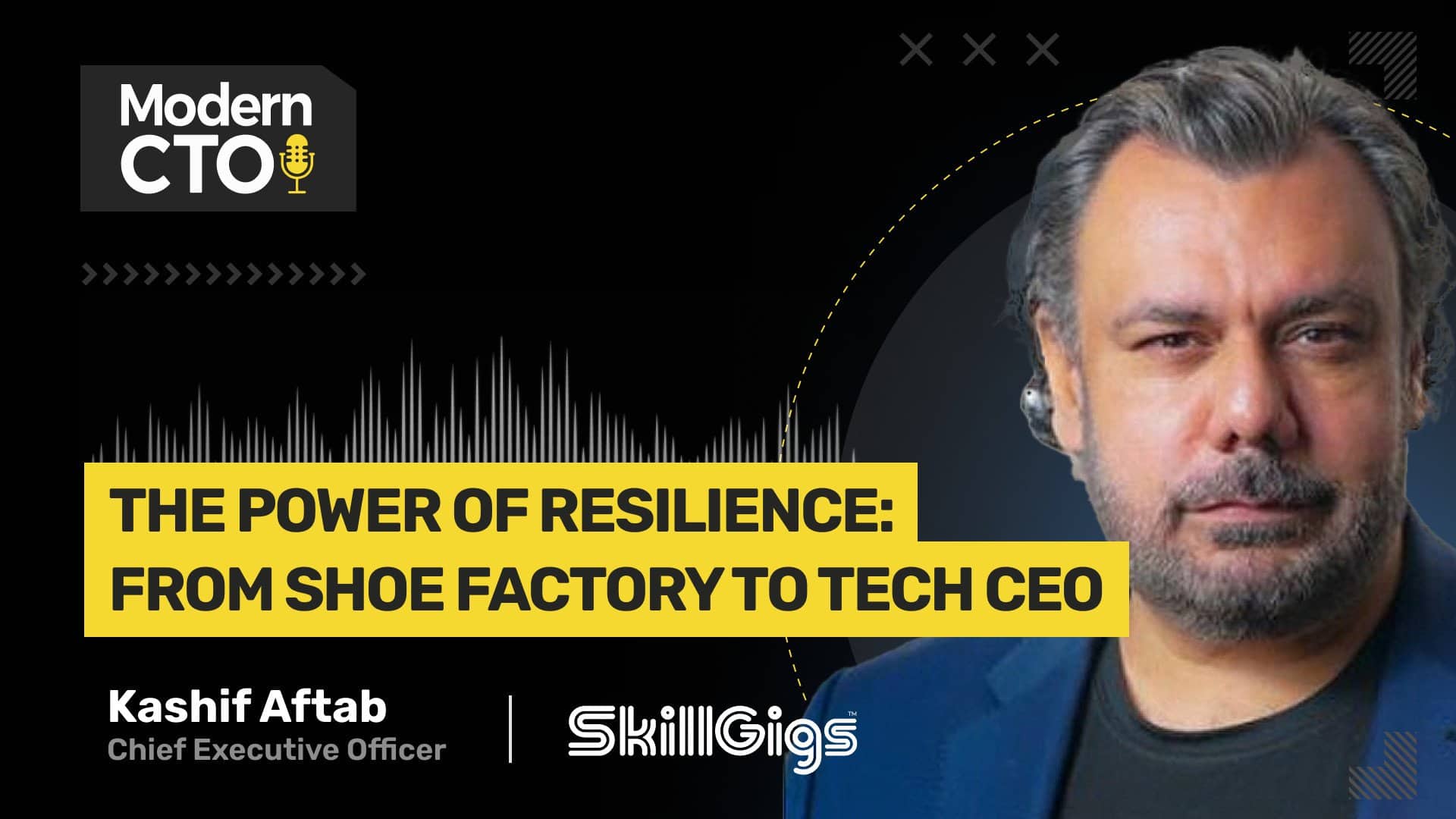
Kashif Aftab found a recruiting idea while looking at eBay. After years in staffing, he could see something familiar in an online auction: two parties trying to agree on value. Buying and selling had acquired a remarkably direct interface. Hiring still involved a procession of introductions. He wondered what would happen if the people doing the work and the people paying for it could meet with the price already on the table.
It was an awkward question for someone whose career had been built inside the industry. Aftab had operated staffing businesses himself. He understood the calls, the candidate searches and the handoffs. His answer became SkillGigs, where he serves as founder and CEO. The interesting part of his story is how often he has looked at a familiar arrangement and asked whether its steps belonged in that order.
A summer education in shoes
Long before the software, there was a factory. His grandfather had established the family’s shoe business; his uncles ran it. During summer visits, young Kashif watched production, warehousing, distribution and selling. He did not make the shoes. He watched how a business connected its parts. His father’s contribution was to send him there and let the machinery of commerce provide the entertainment.
There is a useful distinction between seeing a finished product and seeing the arrangements that make it possible. A shoe has an obvious purpose. A factory introduces the less obvious questions: who supplies what, which operation comes next, and how the finished thing reaches someone willing to pay. It is a fitting opening chapter for an entrepreneur whose later work would concern the route between a skill and a buyer.
His public biography places his interest in entrepreneurship at ten and his first programming at eleven. At twenty-five, he started an IT consulting company and brought it to profitability within its first year. Those are two different appetites, joined early: the wish to understand how something works and the wish to find someone who needs it.
The waiter and the founder
Before the executive titles, Aftab waited tables at a busy Denny’s in Ocean City, Maryland. He has credited the job with teaching him to handle several demands at once and manage customers’ expectations. The experience makes a persuasive counterweight to the romance of founding a company. A customer waiting for breakfast has little interest in your long-term vision. Something must arrive at the table.
His subsequent ventures included IQ Tech Pros, an IT services network, and the holding and investment company TAMH. His work moved across consulting, staffing and company building. By the time he began developing a marketplace, he had experience with the business arrangements that the software would try to simplify. SkillGigs emerged from that experience rather than from a detached fascination with recruitment technology.
There is another occupation on the list, less likely to appear in a hiring software demonstration: songwriter. Aftab enjoys writing music and traveling. A business biography can make a person sound like a sequence of job titles marching toward an inevitable outcome. The songs are a welcome interruption. A person can spend the day organizing work and still want to make something whose value will never fit neatly into a spreadsheet.
“I’m a songwriter. I love writing music.”Kashif Aftab
Give the résumé another dimension
Aftab’s technical contribution has a specific paper trail. US patent 10,430,764, granted on October 1, 2019, names him as inventor of a system for generating a three-dimensional résumé. The application was filed in October 2015, with an earlier priority date in 2014. The idea had been taking shape before the marketplace’s broader 2017 launch.
The system combines information about roles, the skills used in those roles and the extent of their use. It calculates skill density scores and presents information about those scores to someone evaluating candidates. That is a more particular ambition than making a résumé look attractive. It asks how to turn a work history into a representation of what someone has actually spent time doing.
- 01Roles & skillsWhat work involved
- 02Measures of useHow skills were used
- 03Skill densityCombine across roles
- 04Candidate insightInformation for evaluation
A process diagram, not a candidate score or a performance claim.
Consider the problem the design addresses. A job title is compact, but its meaning depends on the employer. A list of technologies can be extensive without telling the reader which ones occupied most of the working week. Organizing that information differently changes what a hiring conversation can begin with. The patent describes a method for that organization; the hiring decision still requires judgment.
The bid arrives before the small talk
SkillGigs applies a second change to the encounter. Both employers and candidates can bid. Job seekers can state their pay expectations, explore work and communicate directly with an interested employer. Contract and permanent roles sit within the company’s offering. The resemblance to commerce is deliberate: discovery, an indication of price, then a conversation about whether the match makes sense.
Putting compensation near the beginning affects the social choreography of hiring. It gives each side something concrete to accept, decline or discuss. An introduction built around a bid has a different starting point from an invitation to complete another application. Aftab’s product gives a familiar, slightly uncomfortable subject a designated place in the process. The number gets a chair at the table.
When describing the business in 2023, he said more than 200,000 candidates had joined over the preceding couple of years. His discussion of expansion was equally revealing: he wanted to bring other kinds of measurable skills into the marketplace. The organizing principle was the skill itself. Full-time job seekers had also become part of the offering after requests to open up the model.
That ambition presents a practical design question. Different kinds of work produce different kinds of evidence. A useful marketplace must help people express relevant experience without reducing every career to the same list. His emphasis on measurable skills offers a direction for expansion, while leaving the product team with the detailed work of deciding what deserves to be measured.
A founder who stays near the product
Aftab describes his job as working alongside product and engineering teams to make hiring easier. In his account, frustration within traditional staffing was a reason to build. Requirements moved among teams; finding the right person became everyone’s problem in succession. A marketplace could give those parties a shared place to act.
He has also described using customer feedback to guide platform and mobile upgrades, including support for pay negotiations. The aspiration is specific: help people understand the value of their skills and set realistic expectations about compensation. That puts a familiar founder’s ambition into a less glamorous daily routine. Someone has to decide what the screen asks, what the answer means and what the user can do next.
His own writing on fair pay follows the same concern. He argues that compensation should take account of employees’ skills and contribution, and that retention suffers when people can find better pay elsewhere. It is a business argument with an everyday consequence. A worker’s value should be discussable before dissatisfaction turns into a departure.

Two measures of a Houston business
In 2023, SkillGigs appeared on the Inc. 5000 for the first time, at number 1,405. It ranked twenty-eighth among Houston-area companies on that list and 196th among software companies. The recognition supplied a public marker for a business built around changing how work is found. It also fixed the achievement to a particular year, which is how growth rankings should be read.
Aftab was separately named to the Houston Business Journal’s 2023 Most Admired CEOs list. His community involvement includes founding the Hajra Begum and the Justice Waheeduddin Ahmed Meal Program at Amanaah Refugee Services. The program provided food assistance to 101 families in 2022. He has also supported the Houston Food Bank and is a charter member of OPEN Houston.
families received food assistance through the meal program he founded in 2022.
The two kinds of recognition belong together without needing to be converted into a single score. One concerns the progress of a company. The other points toward people in the city where he works. A marketplace organizes economic relationships at a distance; a meal program makes an obligation considerably more immediate. Both are part of the public record of his Houston career.
The next hire may already be in the room
His more recent public focus is talent activation: reconnecting employers with applicants, former workers and internal employees already known to them. His LinkedIn posts promote private marketplaces and AI-assisted engagement. The premise is that an employer’s existing candidate records can become a place where hiring happens, rather than a collection that waits to be searched.
SkillGigs now describes products for internal mobility, direct sourcing and re-engaging past applicants. Aftab has also been promoting SkillRadar, the company’s recruiting platform. These extend the original marketplace idea into an employer’s own network. The problem has moved inward: how does an organization make use of relationships it has already spent time building?
It is a recognizable question for someone who once watched shoes travel from production to distribution and later saw an auction site as a possible hiring interface. Aftab keeps returning to the connections between the parts. A skill must be legible. A price must be discussable. Two people must have a way to reach each other. His company’s next chapter depends on how well those connections work when someone actually needs a job filled.