At a global insurance company, a mobility manager went looking for the price of routine work. The investigation covered 3,000 hours: spreadsheets, letters, reports, the administrative furniture of sending employees abroad. The firm’s old technology was difficult to adapt when calculations or policies changed. Before choosing Equus, the team gathered evidence about where automation might help. An international career, it turned out, could generate a remarkable amount of local typing.
That is a useful way into Equus Software. The company sells cloud software for managing a workforce that crosses borders. Its subject is the assignment, the business trip, the relocation or the remote-work request. Its daily material is the information those events scatter across departments.
- The job: connect mobility records, compensation, compliance workflows and service providers.
- The buyers: employers with mobile workforces and professional firms serving them.
- The useful difference: configurable calculations and a connected provider network, backed by mobility expertise.
- The lesson to borrow: measure repetitive work, prepare the data and make your team own the rules.
01 / THE HANDOFFThe trouble starts between departments
Consider the ordinary international move. Someone approves it. Someone estimates its cost. A tax adviser needs employee details. An immigration provider needs documents. Payroll needs instructions. The employee needs to know what happens next. A spreadsheet can hold the facts; getting each fact to the right person, in the right version, becomes the larger job.
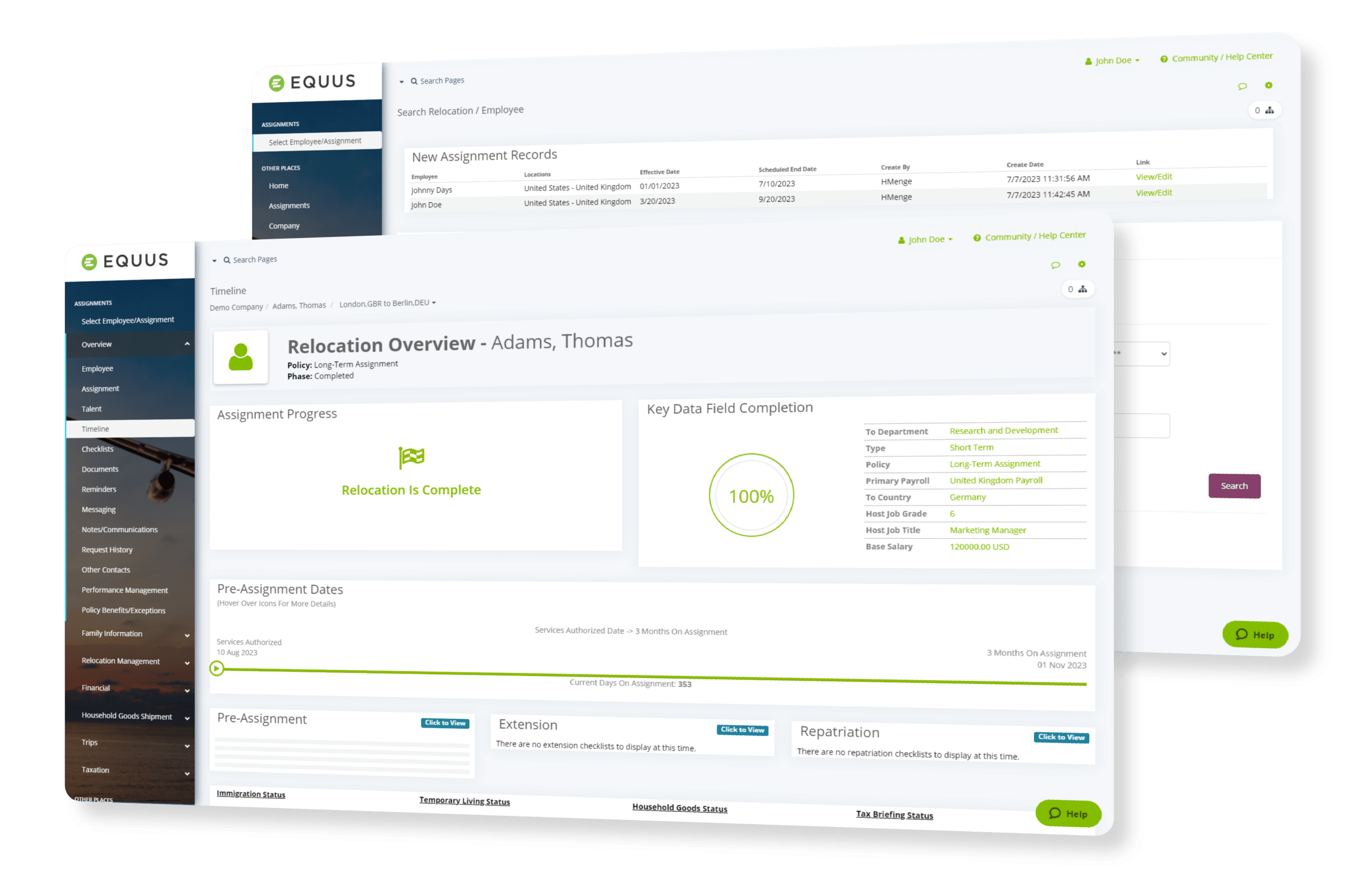
Equus’s platform gives those activities a shared record and configurable workflows. Teams can create compensation packages, calculate hypothetical and actual tax, generate payroll files, track expenses and compare instructions with actual payments. Business travel tools track employees and relevant tax or immigration thresholds. Remote-work requests can be routed or approved according to company policy.
A schematic, not a mandatory sequence. Equus connects the records and workflows around these jobs.
The software sits between an employer’s business systems and the specialist services involved in a move. It exchanges information with HR and payroll systems; it also connects providers. For the buyer, the attraction is fewer occasions on which an employee’s details must be re-entered or a status update chased by email.
Mark Thomas and Leonard Schuele founded Equus in 1999. Thomas had studied journalism and advertising, then worked in software sales, analysis, programming and consulting. In January 2025, long-serving president Tyler Reynolds became CEO; Thomas became executive chairman with a focus on product strategy. The founder’s earlier profession is a pleasing footnote: much of the company’s work concerns getting information to its proper destination.

02 / THE DATAContinental’s problem was already in the spreadsheet
Continental’s mobility team supported more than 1,700 employees worldwide without a formal global mobility management system. Calculating projections and assembling agreements took manual effort. Reporting global assignment costs was difficult. The company chose Equus to connect its program and providers.
Then came the awkward part. Individual assignees’ balance-sheet data lived in complex Excel files. Equus developed a way to reorganize that material for import without adding resource costs, according to the customer account. The implementation budget was tight. The practical response was to work with existing resources.
The resulting workflows could trigger vendor service orders when an assignment began, replacing forms tracked through email and re-keyed elsewhere. Reporting and standardized processes also supported a move toward regional mobility support. The lesson is tangible: inspect the data you already have before designing the system you want.
03 / THE CONTROLSPayroll comes home
JTI provides a different example. Its published case describes a mobility program serving more than 900 employees across 70 countries. A small team oversaw outsourced payroll, with manual processes, limited visibility and rising costs. Using Equus, JTI brought those payroll operations in-house.
The change involved automated workflows, access rights, checkpoints and validation reports. Equus reports lower reliance on external vendors and improved oversight. Those controls explain the operating model: bringing a process inside requires a way to check it, assign responsibility and see what is happening.
Professional services firms use the technology too. Grant Thornton paired the platform with a Tax Organizer application so employees could supply tax documents and teams could track cases and deadlines. Its customer account describes adoption growing from five member firms to nearly twenty over two years. Equus’s customers can therefore be employers or advisers administering work for employers.
04 / THE EXPERIENCEThe employee needs a next step
AssignmentPro became the Equus Mobile Workforce Platform in 2023. The broader name accompanied expanded coverage of remote work and business travel alongside assignments, immigration, relocations and international hires. Equus reports more than 2,000 organizations using its solutions. Workia provides a starting point for organizations new to mobility technology, with a route toward the larger platform.
The provider network is part of the proposition. Equus described more than 100 ecosystem providers in October 2025, when it also described bringing Workia into that network. AIRINC supplies mobility data used in allowances, compensation and benchmarking. A strategic agreement with Vialto combines the software with global service capabilities. These connections matter when the employer wants information to follow the work across organizational boundaries.
Equus Connect gives mobility professionals access to cases, tasks and service updates on desktop and mobile. Equus Guide concentrates on employees: next steps, documents, requests and timely guidance. A person preparing for a tax briefing needs a clear instruction. The professional managing the case needs visibility across the process. Separate experiences can serve both without making either audience read everything.
The 2026 releases extend that division. Guide gained an AI assistant in March and desktop access in May; Connect’s May tools include assignment summaries and cost-estimate explanations. The attraction is faster access to information already in the program. Accurate underlying records remain essential to getting a useful answer.
05 / THE PREPARATIONA purchase with a preparation bill
Equus operates as a business-to-business cloud software supplier, with implementation, training and ongoing customer support alongside the product. A sensible buying budget accounts for software, deployment work and the customer team’s time. The amount of preparation changes with the scope.
The insurer spent two to three months clarifying processes and policies, then seven months transitioning and learning. Its manager described learning through experimentation. Keeping configuration knowledge inside the team mattered to its ability to run the system afterwards.
“We learned by pressing buttons and getting it wrong.”
Global Mobility Manager / insurance customer
Two consecutive phases described by this customer. An effort timeline, not a promise for every deployment.
Equus also advertises accelerated platform onboarding in 30 days and a 90-day best-practice compensation and payroll implementation. Those offers describe particular scopes. A buyer should establish which policies, interfaces and migrated records a proposed timetable actually includes.
Topia offers a competing global mobility and compliance platform. Benivo combines relocation services with mobility technology. Feature lists overlap. Equus’s case rests on configurable compensation work, its provider connections and the experience of its implementation teams. To test that case, bring the awkward calculation, the existing vendor list and the spreadsheet that everyone dreads.
The approach is most useful when an organization has enough recurring work to justify configuration, usable data and people who can maintain its rules. Unclear policies or neglected records will make automation harder to trust. A small, occasional program may need a narrower tool. Anyone can copy the first move from the insurer’s investigation: count the repeated work before purchasing its replacement. Copy and paste is quick. Doing it indefinitely deserves a budget.