Bindiya Vakil had left her job. She had an idea for a company. Then came a less celebrated milestone in the life of an entrepreneur: sitting in front of a computer with no clear idea what to do next. She remembers staring at the screen for ten minutes. The future had arrived without an instruction manual.
It is a useful opening scene for someone whose career concerns what happens when plans meet the world. Vakil co-founded Resilinc in 2010 to help businesses understand the suppliers, factories and components on which they depended. She came from procurement, where a missing part has a way of making everyone’s priorities suddenly identical.
In her recollection of an early American job interview, she had already expressed an ambition to become a CEO. Founding a company was a route she discovered along the way. The blank screen belongs in that story alongside the eventual board seat. Confidence about the destination did not supply directions.
The assignment that refused to behave
At MIT, Vakil encountered a smaller version of the same difficulty. She arrived with practical supply-chain experience and a determination to master a demand-forecasting assignment. Surely, with the right method, she could get the number right. Her classmates wrestled with it too. After a stressful weekend, the class discovered that most of its answers were wrong.
The episode stayed with her. A forecast is useful; treating it as a promise is hazardous. Her master’s program, completed in 2005, gave that distinction a formal setting. She had chosen the intensive course partly because she already held a finance qualification and wanted deeper expertise without another two-year program.
There is a certain comedy in learning that the people blamed for bad forecasts are also dealing with an uncooperative universe. For a practitioner accustomed to catching up with demand, it widened the question. How should a business organize itself when even a calculated answer will need revising?
We should believe in ourselves a little more.
Bindiya Vakil, on women’s careers in supply chain, 2020
Four years close to the components
Vakil’s career included Cisco, Flextronics and Broadcom. At Cisco, she spent about four years leading a team concerned with reducing supply-chain risk. Its work involved identifying risky components, deciding which deserved attention first and putting mitigation plans in place. The problem had parts, priorities and consequences.
That experience helps explain the business she went on to build. A manufacturer may know its direct supplier quite well while knowing much less about the companies behind it. The direct supplier has suppliers of its own. A reassuringly diverse purchasing list can conceal a shared dependency several transactions away.
Consider the question from the buyer’s desk. Two approved vendors might appear to offer a choice. If both depend on one production site further upstream, the choice is less useful than it looks. Drawing those relationships changes the discussion from how many suppliers a company has to what could interrupt its production.
Two contracts. One point of exposure.
Conceptual illustration.
A map before the phone calls
Resilinc’s approach gave those relationships a place to live. Bindiya and co-founder Sumit Vakil were named as inventors on a supply-chain risk-analytics patent announced in 2017. It covered vulnerability metrics and ways of presenting exposure through interactive maps, charts and dashboards.
The invention addressed a stubborn information problem. An alert about a factory is useful only if someone can connect that factory to a part, a supplier and a product. Without the connection, the alert remains news. With it, a buyer has a reason to investigate, ask about stock or consider another source.
That is why the map matters before the phone starts ringing. During a disruption, every unanswered question competes with the time available to act. Gathering the information beforehand changes what a team can do with the first hour.
It also makes the work less theatrical. The satisfying emergency call has a familiar plot: a problem appears, someone improvises, the order goes out. Quietly establishing a supplier relationship in advance makes for less exciting conversation at dinner. It may make for a better working day.
The difficult business of selling a quiet day
Vakil has described resistance to the proposition. Companies and suppliers had to accept more open collaboration and the exchange of information. Prospective investors had to believe there was a business in it. Her account of fundraising runs past the thirty rejections she had been advised to expect, and beyond sixty.
Her own description of the accomplishment emphasizes changing minds. The software needed customers willing to treat preparation as part of running the business. Data collection needed suppliers willing to participate. A clear explanation of the problem did not automatically produce either.
There is an awkward feature of prevention: its expense is visible even when its benefit takes the form of an afternoon. A board can inspect the invoice. The interruption avoided does not send one. Vakil’s task was to make the case while buyers still had the luxury of debating it.
The people who stayed in the picture
Her account of leadership leaves room for other people’s strengths. In discussing the company she had built, Vakil advised identifying weaknesses and hiring people who could supply the missing abilities. Recruiting for a young company brought its own difficulty: candidates could quite reasonably prefer an established employer.
The team needed people interested enough in the work to stay through the normal reversals of a startup. That is a practical definition of belief. It concerns who will still be there when the task becomes tedious, the answer takes longer than expected or the founder needs help.
In 2020, she received Supply & Demand Chain Executive’s inaugural overall women-in-supply-chain recognition. She spoke of being an immigrant and a first-time entrepreneur, and credited the team behind the award. The recognition put a public face on work that depends on many people sharing information.
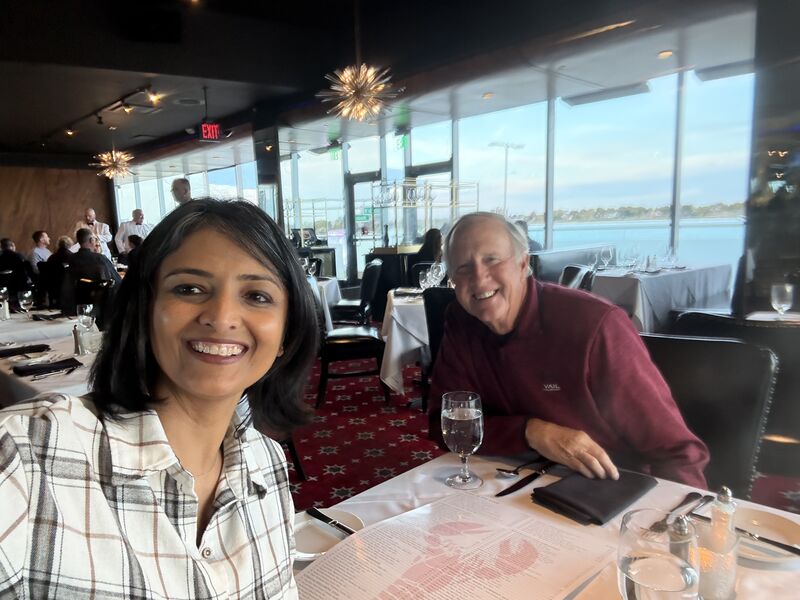
One of those people is Bill Hurles. In a public account of a visit to Wayne State University’s supply-chain case competition, she celebrated a reunion with him and described him as a mentor, friend and enduring supporter. The competition’s trophy carried his name.
She also described talking to students about a journey that had begun as a data analyst at Solectron. More than ten universities were participating, including a team from Mexico. For the students, supply chain was a career ahead of them. For Vakil, the gathering connected its beginning to the people who had helped her continue.
A million sites, then a different chair
By May 2023, when Vista Equity Partners announced its growth investment, Resilinc reported more than a million supplier sites mapped and coverage of over four million parts and raw materials. The figures describe the company’s network at that moment. Behind them lay years of collecting information fine-grained enough to connect a product with a place.
Resilinc’s reported network coverage at the May 2023 investment announcement.
Vista’s investment was intended to support product development, hiring and market expansion. Named customers included Danaher, Keysight Technologies and Stellantis. Preparation had become a software business serving multinational manufacturers. The details still mattered: which site, which component, which alternative?
In March 2024, Vakil received a Pros to Know Lifetime Achievement Award. She accepted it on behalf of the team and described the work as a shared commitment involving customers, suppliers, investors and partners. Her own public response gave the achievement a crowded cast.
On February 4, 2025, Resilinc announced Kamal Ahluwalia as its next CEO. Vakil became executive chairwoman, with a continuing role in strategy and growth. Ahluwalia brought experience from Ikigai Labs and Eightfold.ai as the company pursued more agentic AI capabilities.
The change marked the end of her period as chief executive. It also created a different vantage point on the business she had co-founded fifteen years earlier. Running the company each day and helping shape its direction from the board are different jobs, even when the underlying questions remain familiar.
Back to the drawing board, deliberately
Her next venture follows those questions further upstream. Vakil is now founder and CEO of Arcessio, the company formerly called Accio3D. Its initial focus on making additive manufacturing easier to adopt has expanded to include CNC machining, die casting and injection molding.
The name draws on Latin for summoning or calling forth. In her explanation, the ambition is to help companies call on manufacturing capabilities and obtain parts locally, on demand. It is an ambitious promise attached to a very physical problem: something has to be made, somewhere, to the right requirements.
Arcessio’s stated workflow begins with engineering data. Its agents analyze geometry, materials and tolerances, recommend manufacturing options and help with sourcing and execution. The company says engineers and procurement teams can review, validate and refine recommendations before production decisions are made.
The attraction for Vakil is apparent in her public writing about procurement. A material specification can restrict the available suppliers. An unnecessarily tight tolerance can complicate production. A choice that works for a prototype may become difficult at volume. By the time purchasing receives the request, important constraints may already be fixed.
Moving information into that earlier decision changes who can use it. A buyer negotiating a finished specification has one set of options. An engineer still considering the specification has another. Her new business seeks to bring manufacturing intelligence into the conversation while those choices are open.
That gives the two companies a recognizable connection. Resilinc helps organizations understand dependencies in a supply network. Arcessio seeks to inform the decisions that help create those dependencies. The distance between a drawing and a delivery is full of choices; Vakil keeps finding another place to ask a question.
The forecast will still require revising. The part will still need making. Somewhere between those two facts lies the work that has kept her occupied since the first ten minutes at the screen.