Bill Wise owed Michael Donovan an apology. For two years, running a company that competed with Donovan’s, he had treated the older entrepreneur as the enemy. Then they spent two hours finalizing a deal together. Wise leaned back and admitted what competition had done to his judgment. Across the table sat someone he had come to respect, with a business he now expected to help carry forward.
The encounter belongs to the creation of Mediaocean, announced in 2011 and launched in March 2012 through the merger of MediaBank and Donovan Data Systems. Wise became chief executive; Donovan became executive chairman. A campaign against an incumbent had turned into a partnership with him. There are more conventional ways to recruit a mentor.
That reversal offers a useful introduction to Wise. His working life crosses accounting, early internet advertising, search, programmatic exchanges, and the software agencies use to run their businesses. The connective tissue is the transaction: how an advertisement gets bought, delivered, checked, and paid for. He has spent much of his career moving along that chain, looking for the next connection that ought to work better.
“It comes down to plumbing.”
Bill Wise · 2012
Three days in recruiting
Wise graduated from the University at Albany with a bachelor’s degree in 1994. He trained in accounting and business and became a CPA. Arthur Andersen supplied an early professional foundation. The move into technology came by a less orderly route than the academic credentials might suggest.
After leaving accounting, he briefly tried recruiting accountants. The experiment lasted three days. Its notable placement was himself: a financial analyst’s job at DoubleClick. A career in matching other people with employers had produced an unusually prompt personal dividend.
At DoubleClick, finance opened into investor relations, operations, and sales. He worked through the company’s 1998 public offering. The business became an education in how young internet companies actually operated, with responsibilities expanding faster than anyone’s formal preparation. One memorable episode involved Kevin Ryan tearing up Wise’s Harvard Business School application and putting him to work on the performance advertising division Sonar.
Whatever the merits of that admissions intervention, the practical lesson was clear enough. Wise could learn by taking responsibility inside a business whose rules were still being written. His later career would keep returning to that setting: unfamiliar territory, familiar colleagues, and a market with something cumbersome to fix.
The back office gets a bigger job
By 2012, Wise had a remarkably unglamorous diagnosis for an industry devoted to attracting attention. Advertising had accumulated too much complexity between a purchase and its execution. At an industry panel, he reduced the issue to five words: “It comes down to plumbing.” A campaign could be inventive and still become a nuisance to administer.
The newly formed Mediaocean proposed opening its systems to outside developers. Agencies and technology companies, including competitors, would be able to connect applications to the platform. The ambition joined media workflow with the accounting machinery needed to settle the resulting obligations. A useful advertising operating system had to accommodate other people’s tools.
This helps explain why the merger mattered to Wise beyond the end of an exhausting rivalry. Combining the businesses gave him resources to invest in a platform spanning traditional and digital media. The customers already understood the importance of dependable processing. Now the same foundation would have to cope with more channels, more data, and more parties to a single campaign.
A career with returning characters
His route to that merger ran through a succession of internet businesses. After DoubleClick’s media operation moved into MaxOnline, Wise held CEO and COO responsibilities there. He later led search marketing company Didit and became president of Right Media, rejoining Mike Walrath. Yahoo acquired Right Media in 2007; Wise stayed for three years before taking charge at MediaBank.
The names in this history keep turning up together. Aaron Goldman, whom Wise met at MaxOnline, later became Mediaocean’s chief marketing officer. Stephanie Dorman was another connection from the Yahoo years who joined him at Mediaocean. Ramsey McGrory also belongs to the network stretching back to DoubleClick. Corporate ownership changed; working relationships survived.
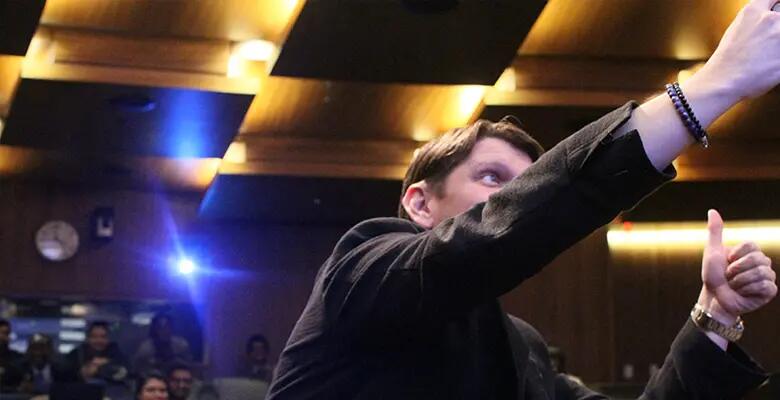
His advice to students reflected that experience. Visiting Rutgers Business School in March 2017, Wise encouraged calculated risks and movement early in a career. He recommended accounting as a foundation and storytelling as a skill worth developing. He also stressed knowing the people and direction of one’s industry. “Confidence,” he said, “is critical.” After the talk, he took a selfie with the audience.
There is something pleasingly practical about that combination. Learn the accounts. Learn to tell the story. Meet the people. For someone working in advertising technology, the advice gives roughly equal billing to the spreadsheet and the room.
Buying a place closer to the decision
Mediaocean’s expansion gathered financial backing as well as products. Vista Equity Partners announced a majority investment in 2015, with plans including product development and international growth. In 2021, CVC and TA announced an investment to acquire Vista’s stake. Wise described that next phase as support for an independent advertising technology platform able to operate at greater scale.
Between those changes in ownership, the company broadened its reach. The 2016 acquisition of INVISION added software used by broadcasters and other media sellers. It placed more of the selling workflow alongside the agency workflow. The underlying proposition was easier coordination between the two sides of a media transaction.
The 2020 purchase of 4C pushed into campaign intelligence and optimization. A partnership begun in 2017 became an acquisition, completed in July 2020. Wise wanted the company to participate earlier in the decision process, helping customers improve campaigns as well as administer them. The back office was acquiring opinions about what should happen before the invoice.
Flashtalking followed in 2021, adding ad serving, creative personalization, identity, and verification capabilities. Each addition addressed a different job in the life of an advertisement. Taken together, the purchases made Wise’s strategy more legible: bring the practical work of running advertising closer to the work of deciding how it should perform.
Closer to the campaign
- 2012Mediaocean formsMediaBank + Donovan Data Systems
- 20204C joinsCampaign intelligence & optimization
- 2021Flashtalking joinsAd serving & creative personalization
- 2025Innovid joinsVideo, measurement & delivery
Independence needs a balance sheet
The next substantial move was Innovid. Announced in November 2024 at an enterprise value of approximately $500 million, the acquisition closed on February 13, 2025. Innovid and Flashtalking came together under Mediaocean, combining functions across ad serving, creative, measurement, and optimization. Zvika Netter initially led the combined advertising technology organization, reporting to Wise.
At Marketecture Live in March 2025, Wise and Grant Parker discussed the resulting business with Ari Paparo. Wise’s case for scale was financial as well as technological: a company challenging Google needs revenue, profit, and the ability to keep investing. Independence is an appealing word on a conference stage. Making it useful to customers requires resources after everyone has gone home.
His competitive argument centers on incentives. Mediaocean positions itself as a technology provider without media inventory of its own to sell. Wise argues that this gives advertisers more choice over where budgets go and which tools they use. The proposition carries a continuing obligation: a platform promising choice has to keep working with the other systems its customers choose.
One of his earlier public forecasts supplies a useful corrective to the confident presentation. In 2017, Wise predicted the disappearance of supply-side platforms within a year. They survived. Revisiting the subject in 2025, he acknowledged their demonstrated value while continuing to question the prospects of standalone providers. He also admitted regretting an early opportunity to invest in The Trade Desk. Confidence, evidently, leaves room for an expensive footnote.
Approximate enterprise value announced in November 2024. The acquisition closed in February 2025.
The CEO who gives away the other jobs
Wise received the Tech Ascension Awards’ CEO of the Year recognition in 2024. Asked about leadership, he described a company that expects learning and delegates responsibility. His own account of the executive team was unusually economical: “The only one I’m qualified for is CEO.” The job, as he explained it, involves setting direction and removing obstacles for specialists.
His public activities also extend beyond running Mediaocean. He has invested through Click Ventures, and co-hosted the Superpowers Podcast with Chris Cunningham. A conversation with LUMA Partners founder Terence Kawaja explored storytelling and comedy in business. These are fitting interests for an executive whose work involves persuading very different businesses to cooperate.
Acquisitions make that responsibility concrete. Buying software also means bringing in people with their own habits, expertise, and customers. Wise repeatedly emphasizes the talent arriving with the transactions. The purchase agreement establishes ownership; getting capable people to build something together remains a separate management assignment.
From plumbing to the power grid
In May 2026, Wise reached for a different infrastructure metaphor. As AI made software features easier to reproduce, he argued that advertising’s durable value would sit in the connections underneath: operational relationships, financial controls, reliable data, and systems that could work together. “We are the grid,” he wrote of Mediaocean. The electrician had joined the plumber.
The argument is consistent with the company he has been assembling. An AI tool suggesting a campaign change becomes more useful when it can understand the campaign, operate within its permissions, and connect to the work required to carry out that change. Wise’s bet is that established infrastructure will matter more as new tools multiply.
The company introduced NIVO AI in June 2026. By September, Innovid was describing an integration with Meta’s advertising MCP server, using conversational workflows to examine performance and identify opportunities. The early testing described specific tasks: summarize campaigns, identify trends, and flag creative assets needing attention. That is a recognizable continuation of the effort to bring decisions and execution closer together.
Wise began with financial analysis and kept moving toward the places where advertising businesses have to coordinate. His career contains public offerings, acquisitions, disputed predictions, and a notably short spell in recruitment. It also contains that apology to Michael Donovan. The willingness to reconsider an adversary may be as useful to this project as the ability to read a balance sheet. Software can connect systems. Someone still has to get the people to agree.