The first thing to understand about Bilgiyi Ticarileştirme Merkezi is that the name is not coy. It means Knowledge Commercialization Center. In a startup industry fond of cosmic nouns and missing vowels, the Istanbul institution chose a label that sounds like an instruction: take what you know and make somebody pay for it. BTM, as everyone calls it, exists to shorten the awkward distance between an interesting idea and a working company.
The Istanbul Chamber of Commerce established the center in 2017 with support from the Istanbul Development Agency and Istanbul Commerce University. It began in Eminönü and later grew into a 3,000-square-meter campus in Fulya. Accepted founders can work there around the clock. They receive training, mentoring, one-to-one consulting, investor introductions, fair participation and a stage on which to pitch. The advertised price for those core services is zero.
Free is the attention-grabbing feature. The more consequential one sits behind it: the Chamber says it reaches more than 900,000 member businesses through 81 professional committees. Those are potential interview subjects, pilot customers, distribution partners, mentors and investors. A founder can hear polite applause almost anywhere. BTM is designed to put the founder near people capable of saying, with expensive specificity, why a product will or will not sell.
A curriculum built around evidence
BTM does not force every applicant into the same accelerator-shaped box. Its four main programs correspond to four different kinds of evidence. BTM Kamp is for the person still turning a value proposition into a business model. Pre-Incubation expects a modeled idea and an MVP. Incubation is for an incorporated startup with a first sale or proof of concept. Post-Incubation is for funded companies trying to scale into new revenue and investment.
BTM Kamp
Shape the proposition and business model.
Pre-Incubation
Put an MVP in front of customers and investors.
Incubation
Turn proof of concept and first sales into readiness.
Post-Incubation
Find new sales and capital for a funded company.
That sequencing is BTM's most copyable idea. Name the proof required at each stage, then match the teaching and introductions to it. Do not lecture a pre-idea founder about Series A mechanics. Do not make a company with customers repeat an elementary canvas exercise. A regional incubator could borrow the ladder tomorrow. Replicating the business network behind it would take decades.
“We work to bring together all the parties that make up the ecosystem and create benefit.”İbrahim Elbaşı, founding general manager, speaking in 2024
The Chamber is the product nobody can download
Most startup programs can source mentors, rent desks and teach a pitch deck. BTM's claim to difference is institutional plumbing. Startups can be presented to the Chamber's relevant industry committees, where established businesses supply target-market knowledge and, sometimes, the possibility of a deal. Investor dialogues and business-to-business meetings then widen that circle. Sahne XL, the center's twice-yearly demo day, is the public finale rather than the entire machine.
Idea, MVP, first sale, patent or a funded product looking for its next market.
Industry committees, member companies, mentors, investors, fairs and overseas networks.
BTM does not describe itself as a venture fund. It does not advertise writing the first check or taking equity for admission. Instead, it tries to make companies legible to the people who do write checks. In 2023, startups at the center attracted TL130 million in investment, according to its then-general manager. By October 2025, BTM said 22,000 people had applied, 11,000 entrepreneurs had been supported and the identified capital raised by its ventures exceeded $350 million. The center cautioned that the last number omits undisclosed deals.
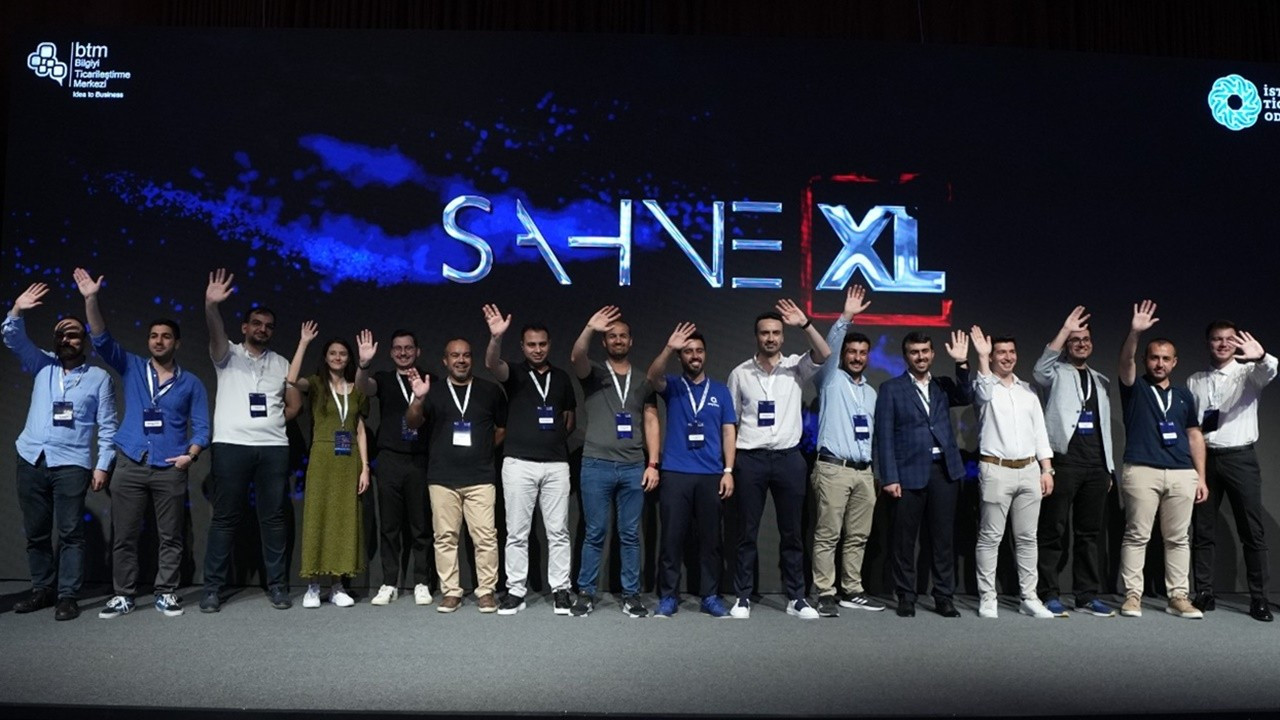
The portfolio is deliberately cross-sector. BTM's admissions language favors innovative, scalable products that use technology and answer a customer need, not a fashionable vertical. The center has supported logistics company Navlungo, agricultural technology venture ForFarming and a long list of software, marketplace, AI and industrial projects. An invention with a patent can enter the Inventor Entrepreneur program. A born-global startup can pursue Winglobal. Businesspeople who want to become more competent early-stage investors have their own accelerator.
The supporting menu is broad because commercialization fails in mundane ways. A founder may know the engineering and misunderstand the buyer, own a patent and lack a pricing model, or make a first sale without knowing how to finance inventory. BTM answers with workshops on market analysis, finance, digital marketing, business law, branding and intellectual property. Mentors and staff add one-to-one help; the campus adds meeting rooms, equipment and public-relations support. None of those elements is novel alone. The design matters because they arrive around a specific maturity milestone instead of as an inspirational buffet.
Competitors in Turkey include university-linked centers such as İTÜ Çekirdek, corporate programs such as Workup and Türk Telekom PILOT, independent accelerators and the country's technoparks. A university program may sit closer to laboratories. A corporate accelerator can offer a sharply defined industry customer. A technopark can provide a deeper R&D regime. BTM occupies the middle: sector-agnostic intake, a nonprofit mandate and unusually direct contact with established commerce. It is less a substitute for all of those organizations than a junction founders can use before moving to a specialist.
When the building stopped working
BTM's first obvious operational failure was shared by every place-based incubator in 2020: the place became unusable. The pandemic shut the physical stage and made a 24/7 campus a stranded asset. BTM moved its events and education online. Between March and July that year, it reported 3,156 attendees across 106 training sessions totaling 229 hours; another 580 people used its ten-module online system. A virtual Sahne XL mimicked registration, auditorium seating and even a campus tour.
Necessity changed the delivery model, and the workaround became infrastructure. BTM still runs an open online curriculum covering the lean canvas, business law, financial literacy, patents, market analysis, digital marketing and product development. The useful lesson is not “hold a webinar.” It is to preserve what widens access after the emergency ends, while bringing the high-friction moments - customer discovery, committee meetings, investor conversations - back into rooms where participants cannot mute themselves.
The economics are equally instructive. Founders are not BTM's paying customers, and portfolio investment is not BTM revenue. The center is a social institution supported by the Chamber, with projects assembled alongside public agencies, universities and private partners. Its return is therefore measured in companies commercialized, capital attracted, sales created and entrepreneurial capacity built in Istanbul. That structure removes the fee barrier for an early founder, but it also makes institutional commitment essential. A city cannot reproduce the offer merely by announcing that admission is free; somebody still has to fund the mentors, campus, events and introductions.
A commercialization center opens
BTM starts in Eminönü with a brief to connect innovative ideas, research and the commercial system.
The campus becomes a browser tab
Training and Sahne XL move online, turning a forced interruption into a durable education channel.
Global benchmarking notices
UBI Global lists BTM among its top three startup centers after a multi-month assessment.
BTM TEKMER opens
The new unit adds R&D infrastructure, tax advantages and dedicated support for technology ventures.
The tenth year travels
BTM hosts the Startup World Cup Türkiye final and takes startups to MWC Barcelona, JEC World, Hannover Messe and WIN Eurasia.
The next market is not another classroom
The center's later expansion follows the same logic as its committee access: put the founder closer to a market. With Yıldız Teknopark, BTM offers overseas office access in London's Battersea Power Station and the Dubai World Trade Center. It takes selected ventures to CES, Mobile World Congress, Hannover Messe and JEC World. In 2025 it opened BTM TEKMER at the Fulya campus, adding R&D infrastructure, mentoring, investor access and tax advantages for technology companies. The facility reportedly filled quickly.
This makes BTM part incubator, part market-access service and part civic development project. Its customers are founders, but its users also include investors hunting deal flow, corporations searching for solutions and universities trying to commercialize research. Galatasaray University signed a cooperation protocol in 2025 to route students and academics into BTM's network. Programs for 14-to-19-year-olds and university campus ambassadors push in the other direction, building the next applicant pool.
There are limits hiding inside the appealing price. Free does not mean effortless. The model rewards founders who can attend a structured program, accept repeated evaluation and demonstrate a scalable, technology-enabled answer to a real customer problem. A student with an inflexible schedule, a local service business with no scaling ambition or a founder looking only for cash may find the fit poor. Mentoring also creates value only when the founder does the interviews, revises the product and follows the introductions.
Nor can every city copy the entire apparatus. The four-stage curriculum travels well; the Chamber's density of buyers does not. Without active member companies willing to test products, an incubator risks becoming a pleasant office with a busy calendar. BTM works when the old economy treats the young one as more than entertainment. That is the bet beneath the free desks: knowledge becomes commerce only after somebody outside the building needs it.