The most revealing line on Benchmark Email's new website is not about artificial intelligence, deliverability or return on investment. It is three words long: “Zero B.S.” The phrase is doing heavy strategic work. After two decades of accumulating products and ambitions, the company is selling the absence of things - fewer menus, fewer setup chores, fewer reasons to postpone the newsletter that was due yesterday.
That is a curious destination for a company that followed the conventional SaaS map. Curt and Denise Keller started Benchmark Email in 2004, bootstrapped it into a profitable global business and, by the company's account, crossed $10 million in revenue without outside equity. In 2019, Benchmark merged with St. Louis CRM maker Hatchbuck. The combined business described a broad future of customer relationship management, email and sales automation. It had nearly 130 employees, a reported 150,000 users across 15 countries and a sensible cross-sell story.
Then came more. A $3 million credit facility from Texas Capital Bank in January 2021 funded acquisitions and development. Weeks later, Benchmark bought Contacts+ from FullContact, adding a contact book that synced across devices, scanned business cards and cleaned data. The financing choice was telling: CEO Jonathan Herrick said a profitable, cash-generating SaaS company did not need to surrender equity. Benchmark had earned the right to expand on its own terms.
The first thing to fail was focus
Nothing in the public record suggests a cinematic collapse. Email kept working. The business remained private. The failure was subtler: the all-in-one premise stopped feeling like an advantage. Every email company was becoming a CRM, automation engine, commerce layer and analytics console. Product breadth became table stakes and then became clutter. Benchmark's own 2025 launch language calls the category a “digital circus.”
The change of mind is written plainly in the rebuild. In October 2025, Benchmark launched a new brand and a platform built from the ground up. Its reason was almost heretical for SaaS: more features do not always create more value. The company doubled down on email and recentered the workflow on four jobs - create the message, organize contacts, collect subscribers and understand results.
“More features don't always mean more value.”Benchmark Email, explaining its 2025 rebuild
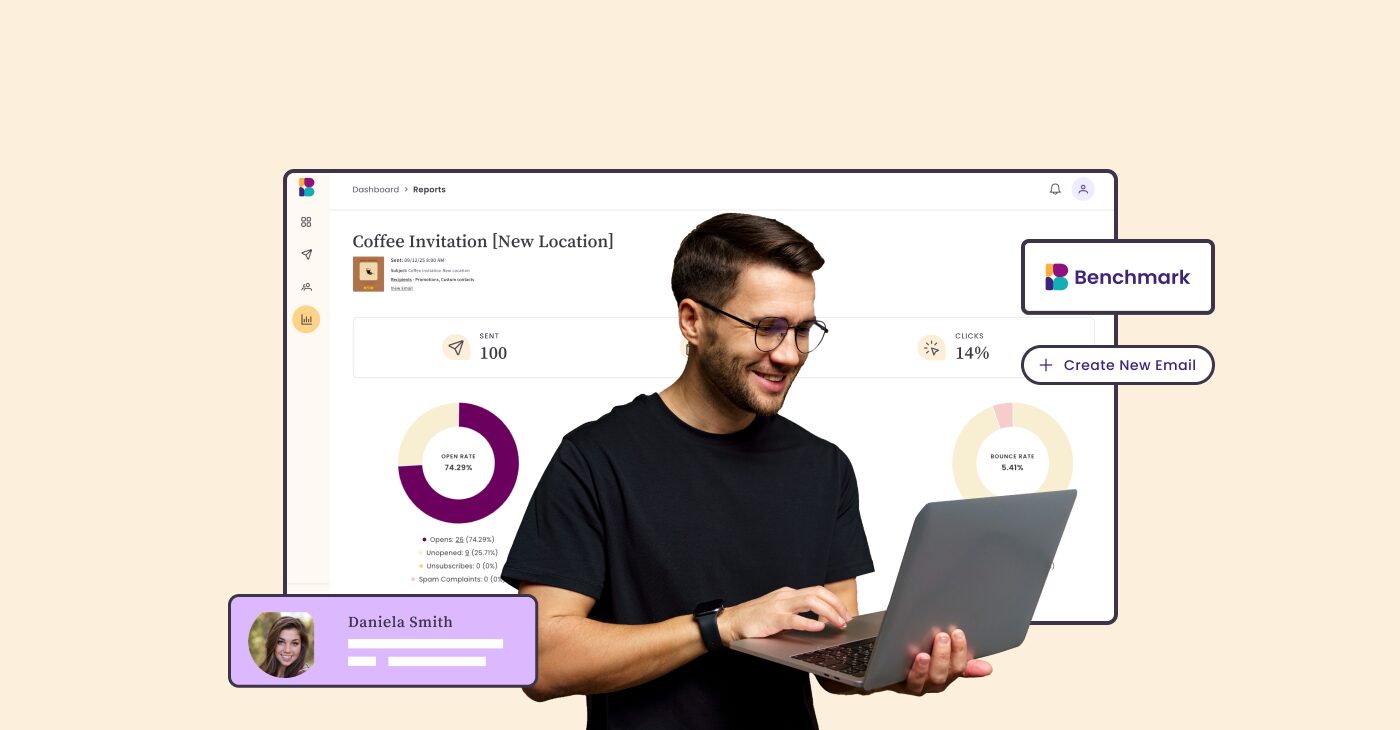
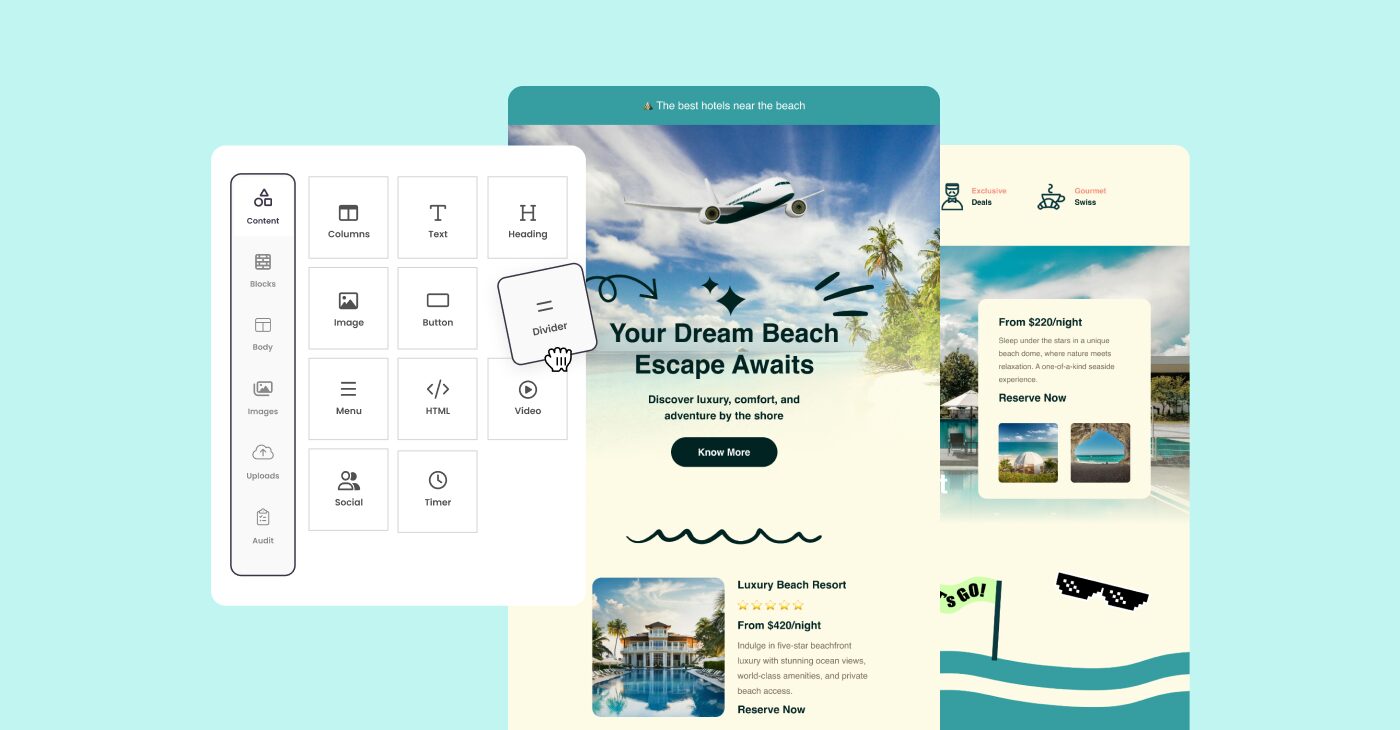
What does it actually do now? A marketer imports subscribers, sorts them with lists, tags and segments, builds a responsive email in a drag-and-drop editor, sends it and watches opens, clicks, bounces and contact activity. Signup forms grow the list. Personalization fields vary the message. Reports show what happened without demanding an analytics certification. Integrations and a REST API connect the focused product to a larger stack rather than forcing Benchmark to imitate every piece of that stack.
The distinction matters. Benchmark is not trying to beat HubSpot at being HubSpot. It competes more directly with Mailchimp, Constant Contact, Brevo, MailerLite and Campaign Monitor for the marketer who needs a polished campaign without an implementation project. G2 reviewers repeatedly praise its usability and templates; the recurring tradeoff is limited customization and feature depth. That weakness is also the boundary around the new product.
The product arc - ambition versus focus
AI that begins with a constraint
Benchmark did not ignore the industry's favorite new ingredient. It released Smart Content in September 2022 to generate and revise copy, then launched Smart Design globally in 2024. Give Smart Design a website or business description, choose a campaign goal, images and colors, and it assembles a branded draft. The promise is minutes instead of hours, not an autonomous marketing department.
The development story is more useful than the feature. Chief Product Officer Jeff Zimmerman and product designer Paul Rijnders said the team resisted overbuilding the beta on assumptions. It started with three common categories - promotional, newsletter and welcome emails - then used customer behavior to learn where AI belonged. In an era of decorative chatbots, constraining the first version was the grown-up choice.
It also exposes the limit. AI can shorten a paragraph and arrange a first draft. It cannot rescue a stale list, invent a worthwhile offer or create permission where none exists. Deliverability still depends on authentication, consent, list hygiene and engagement. Benchmark's Smart Sending machine learning is intended to protect inbox placement by favoring engaged recipients, but the boring operational disciplines still matter more than the sparkle in the composer.
A price for getting Tuesday back
The business model is standard SaaS with unusually legible edges. The free plan supports 500 contacts, 2,500 monthly sends, one user and one verified domain. It includes the editor, lists, tags, forms, reports and chat and email support. The main product page lists Pro from $19 a month for 1,000 contacts, with monthly sends capped at ten times the contact limit. Additional users cost $15 a month. Enterprise begins beyond 100,000 contacts with quoted pricing; send-based plans start at $40 for 10,000 emails.
This is not cheap because servers send email. It costs money because a local retailer, nonprofit director or real-estate broker wants the job done without becoming a deliverability engineer. Benchmark's customer gallery is full of precisely these people: a lobster seller announcing a sale, a community theater tracking opens, a naturalist reaching readers and a small nonprofit moving away from a clunky alternative. The current site says more than 10,000 customers use the platform.
The customer stories are refreshingly small-scale. Defiant Lobster Company owner Peter Tilton says roughly half of his messages are read and uses the tool when there is a sale or announcement. A Japanese retailer profiled by Benchmark reported that online-store sales doubled on campaign days. Others talk less about conversion theater and more about finally seeing open rates, replacing expensive direct mail or publishing an archive of past newsletters. These are not Fortune 500 transformation programs. They are modest communication loops that became visible and repeatable.
That also clarifies what customers are buying. The direct cost starts at zero and rises with the audience. The avoided cost is staff time, outside design help and the opportunity cost of a campaign that never ships. For a founder doing their own marketing, saving two hours may matter more than squeezing another decimal point from attribution. Benchmark's product story works only if it preserves that time advantage as the list and team grow.


Support is part of the product, not merely its warranty. Benchmark says customers on every plan can reach actual people. Local teams across 15 regions support nine languages, an expensive operating choice that makes more sense when an email campaign is time-sensitive and a sender-reputation problem feels opaque. Software can explain a bounce code. A calm person can explain what to do before the next send.
Five things a founder can copy
- Let free customers complete the core job; restrict scale, not comprehension.
- Write down the features you refuse to build, then turn the boundary into positioning.
- Ship AI inside an existing workflow and begin with three repeatable use cases.
- Price on the unit customers already understand - contacts or sends - and show the limits.
- Use integrations to borrow breadth while keeping the product itself narrow.
Who should choose it - and who should not
Benchmark fits the owner-operator or small marketing team whose email program is important but not baroque. If the weekly work is a newsletter, product announcement, event invitation or promotion to a sensibly segmented list, its narrower surface area can be an advantage. The product is also plausible for a larger sender that wants volume pricing, account guidance and an API without buying an entire customer-data platform.
Works when
The team values speed, clear reporting, responsive support and a short path from list to send. Campaigns are mostly scheduled broadcasts with practical segmentation.
Breaks when
The strategy depends on deep behavioral journeys, multichannel orchestration, elaborate A/B testing, advanced commerce personalization or a CRM as the central system of record.
That second group should look hard at ActiveCampaign, Klaviyo, HubSpot or another broader suite. Benchmark's bet will not work if the market rewards feature checklists more than completed jobs, or if integrations make a focused stack feel more fragmented than a unified one. It also weakens when customers outgrow broadcasts faster than Benchmark can serve their next level of automation.
Still, the bet has logic. Mature SaaS companies often confuse accumulated capability with customer value because deleting a feature feels like deleting progress. Benchmark had the more difficult realization: its history was not a roadmap. The merger, the acquisitions and the AI experiments all taught it something, but the useful product could still be smaller than the organization knew how to build.
The company now occupies an unfashionable middle. It is more established than a lightweight newsletter startup and less comprehensive than an enterprise marketing cloud. Its advantage is not that competitors cannot copy a clean editor. It is that a 21-year-old business chose to measure itself by how quickly a customer can leave the product and get back to work. For software, that is a wonderfully perverse benchmark.