Liviu Tanase’s business partners had a verdict on his new idea: email validation was a waste of time. This was around 2015, after the Romanian entrepreneur had moved to the United States and noticed the same irritation that haunts every aging mailing list. People leave jobs. They mistype addresses. Bots fill forms with nonsense. Disposable accounts vanish. The campaign still goes out, and the sender pays to discover the mess one bounce at a time.
Tanase took responsibility for the project anyway. A small team built a product, released it softly, listened to the market and made ZeroBounce fully operational in 2017. The original job was blunt: upload a list or connect an API, identify addresses likely to fail or cause trouble, and keep those addresses away from the Send button. It is digital plumbing, which is another way of saying customers notice it most when it breaks.
The first product was a bouncer for your database
ZeroBounce checks syntax, mail servers and risk signals, then labels addresses rather than pretending every result is a clean yes or no. It looks for invalid mailboxes, spam traps, disposable accounts, known complainers and toxic domains. Catch-all domains are the awkward guests: their servers may accept mail for any username, making the individual mailbox hard to prove. ZeroBounce flags and scores that uncertainty. The distinction matters. Verification is risk classification, not clairvoyance.
For a marketer, the immediate problem is cost and reputation. Email providers watch bounces and complaints. Send repeatedly to dead or hostile addresses and future mail can slide toward spam, including the mail sent to real customers. For a developer, the job happens earlier. The validation API can inspect an address at signup, preventing a typo or bot submission from entering the database at all.

“The whole idea is to have a scientific and data-driven way to get to the results.”Liviu Tanase, founder and CEO
Then came the $3 million search for distribution
A working product did not answer the harder question: how would the right customers find it? Tanase told SUCCESS that ZeroBounce spent roughly $3 million over about three years learning what worked. The company tried to be visible across search and social platforms, including LinkedIn, Facebook, Instagram, TikTok, Pinterest and X. Some experiments lost money. That was the fee for getting an answer.
The useful part is the kill rule. A keyword that converted poorly was not allowed to sit around for months because somebody had written a persuasive strategy memo about it. Platforms that missed the audience were cut by data, not sentiment. Profitable channels stayed. Tanase’s arithmetic was portfolio-like: even modest growth from several working platforms could compound into a larger result.
The ZeroBounce distribution loop
The first thing to fail, then, was not the product. It was a succession of acquisition bets. The change of mind was procedural: stop arguing about whether a channel ought to work and let customer behavior decide. What another company can copy is not the budget. It is a capped experiment, a conversion threshold, a deadline and permission to shut the test down. A $3,000 version can be more disciplined than a $3 million version.
There was another conversion mechanism hiding in plain sight: let the customer test the claim. ZeroBounce gives free accounts 100 validations each month, enough to inspect a small list and see what the tool classifies before buying. That is a natural fit for a product whose output can be compared against an existing database. Content marketing and round-the-clock support then catch two different buyers - the person still learning why mail bounces, and the operator staring at a live deliverability problem. Tanase has said the company tries to treat the smallest account like the household names. In a credit-priced business, that is both a cultural statement and a patient bet that today’s tiny list may grow.
One narrow wedge became the whole inbox workshop
Validation gave ZeroBounce a front-row seat to the problems immediately beside validation. A clean address can still receive a message in spam. A legitimate domain can still be misconfigured, blacklisted or spoofed. A new sending domain can still look suspicious. The company expanded along that chain rather than wandering into unrelated software.
Validate addresses, remove risks and score uncertain contacts.
Warm a domain and test server configuration before the campaign.
Check likely inbox placement across major mailbox providers.
Monitor blacklists, DMARC activity and overall sending health.
Today the catalog includes Email Scoring, Email Finder and Activity Data; Email Warmup; inbox-placement and server tests; blacklist and DMARC monitoring; a deliverability dashboard; APIs, integrations and consulting. In September 2025, ZeroBounce ONE bundled much of that stack into a subscription. The current entry plan is $99 per month, or $79 per month billed annually, with 10,000 validation or scoring credits and allocations for finder searches, tests, warmup and monitors. Pay-as-you-go starts at $39 for 2,000 credits. A free account includes 100 validations each month.
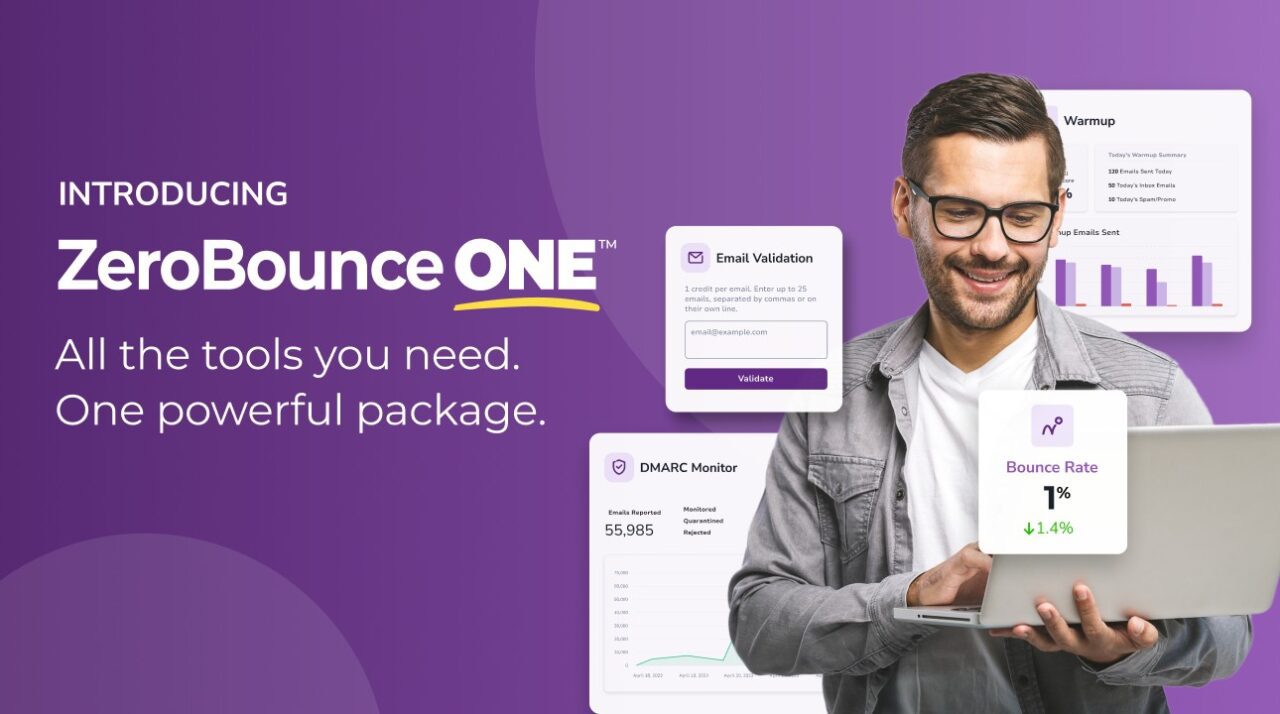
That makes the business model a three-lane road: freemium for proof, credits for episodic cleaning, and recurring subscriptions for teams managing deliverability continuously. Enterprise customers processing more than a million addresses can negotiate custom plans and receive onboarding and account support. More than 40 integrations connect the system with tools such as HubSpot, Salesforce, Shopify, Zapier and Klaviyo, while public GitHub wrappers cover common programming languages.
The customer buys fewer ugly surprises
ZeroBounce says more than 600,000 customers use the platform, from small businesses and agencies to developers and enterprise marketing teams. It displays brands including Airbnb, Intel, LinkedIn, PwC and Strava. The more revealing examples are less famous. The Workplace Depot, reviving older customer data for ecommerce, reported that its bounce rate fell from 4.6 percent to 0.4 percent. Labyrinth Digital used real-time validation to stop bot-generated checkout addresses and reported eliminating bounces in the affected flows.
Those figures come from company case studies, so they are examples, not forecasts. But they show the purchase logic. Customers are not shopping for a clever classification model. They are shopping for more usable contacts, fewer wasted sends, less damage to sender reputation and fewer mornings spent discovering that yesterday’s campaign went to spam.
The product does not make email glamorous. It makes failure arrive before the campaign does.
Trust is part of the product, not a badge shelf
List cleaning requires customers to hand over sensitive business data, sometimes millions of addresses at once. ZeroBounce’s answer is unusually infrastructure-heavy for a mid-sized SaaS company. Tanase says the company owns its infrastructure rather than placing the core service entirely on a third-party public cloud. Its public materials describe three proprietary data centers, encrypted transfer and storage, annual security reviews and deletion of uploaded customer data after 30 days.
The company holds ISO 27001 and SOC 2 Type II certifications and reports HIPAA, GDPR, CCPA and Data Privacy Framework compliance. It also promises 24/7 support. Those choices sharpen its position against validation specialists such as NeverBounce, BriteVerify, Kickbox, Emailable, MillionVerifier and DeBounce. The pitch is not merely accuracy. It is accuracy plus an adjacent toolset, integrations, human help and a security posture meant to survive enterprise procurement.
What to copy - and what to watch
Start with pain the customer can measure. Let a small free test demonstrate the delta. Expand only into the next unresolved step. Give acquisition experiments a budget, a conversion rule and an expiration date. This approach is weaker when results take months to appear, attribution is murky, the market is too small to support many channels, or the product cannot create a visible before-and-after. And no verifier can eliminate every bounce: catch-all behavior, mailbox changes, sender reputation and campaign content still matter.
The next mailbox may not have a person behind it
In September 2026, ZeroBounce announced a signal for detecting mailboxes managed primarily by autonomous AI agents. It is a small update with a larger implication. The original platform asked whether an address existed and whether sending to it was risky. The next version of email intelligence may also ask what - or who - will read the message.
That move keeps ZeroBounce in its lane while widening what the lane means. The market now overlaps data quality, marketing operations, developer tooling and email security. The company’s mission is still framed around reaching the inbox, but the inbox has become a system of identity, reputation, authentication and machine judgment. The humble list cleaner has grown into a control panel for all of it.
ZeroBounce’s most transferable lesson is not “spend $3 million.” It is to choose a problem with a scoreboard. Bounces can be counted. Invalid addresses can be removed. Inbox placement can be tested. A blacklist can be monitored. When a product makes failure legible, customers understand the bill - and the company knows where to build next.