An email can be beautifully written, carefully designed and addressed to a customer who wants it. Then it disappears. Somewhere between the campaign dashboard and the reader’s inbox, another system has made another decision. The marketing team sees a send. The customer sees nothing. Validity has made a business out of investigating that small, expensive discrepancy.
- Clean the records: DemandTools handles Salesforce duplicates, imports and bulk maintenance.
- Check the contacts: BriteVerify verifies addresses before bad data reaches a campaign.
- Inspect the journey: Litmus and deliverability tools test appearance, inbox placement and performance.
- Join the work: Engage, announced in February 2026, puts AI assistance across the email workflow.
There is something pleasingly unfashionable about this proposition. Marketing loves the moment of inspiration. Validity sells attention to the things that can spoil it: an obsolete address, a duplicate contact, a broken layout, a sender reputation the mailbox provider distrusts. Its customers include marketing departments, Salesforce administrators and sales operations teams. They buy help with the work that makes the more visible work possible.
The database has already voted
At Clear Capital, a real estate valuation technology company, Lisa Foster inherited a Salesforce database assembled from several internal systems. Hundreds of users had been able to enter information, leaving duplicates, inconsistent fields and incomplete records. The trouble began before anyone wrote a campaign.
Foster used DemandTools to standardize records and match incoming data against Salesforce before importing it. BriteVerify helped identify addresses that needed different treatment. In one episode, colleagues were manually fixing the capitalization of 5,000 account names. Foster reported completing the task in five minutes with DemandTools.
“I got to be a great wizard”Lisa Foster, Business Systems Administrator, Clear Capital
The case study is a vendor-published account, but the underlying lesson travels well. Decide how a record should look, check whether it already exists, then import it. Save the recurring procedure. A database is being changed every day; maintenance has to keep pace.
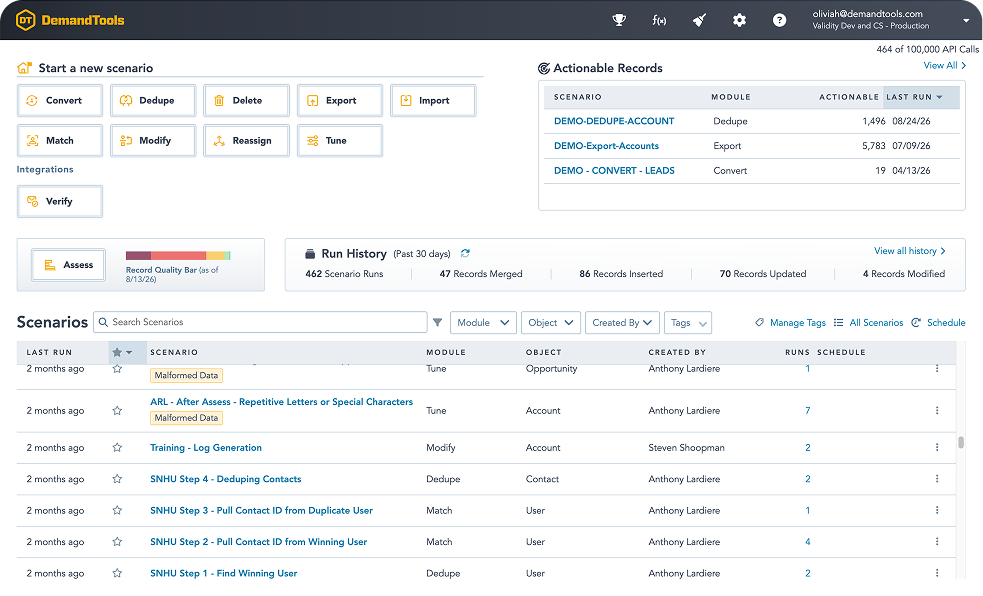
DemandTools is designed for that repetition. Its scope includes deduplication, standardization, imports and bulk record changes. Another public example, Thornburg Investment Management, reports saving 120 hours a week with DemandTools and BriteVerify. That is a customer’s operational result, rather than a forecast for the next buyer. Still, it suggests a sensible way to evaluate the software: count the recurring hours consumed by the current process.
A working address is only the first door
BriteVerify asks whether contact information is usable. Its email checks include syntax, the domain, mail exchange records and mailbox existence, returning statuses that a team can use to decide what to do next. Businesses can verify a bulk list or check a contact at the point of collection.
This is separate from the question of whether a campaign reaches the inbox. A working mailbox does not oblige its owner to read your message. Nor does it tell the receiving provider that your sending practices deserve trust. The distinction matters because a team can solve one problem and remain puzzled by the other.
A map of capabilities, not a guarantee of delivery.
The API documentation adds useful boundaries to the sales pitch. Phone and mailing-address verification are available for the United States and Canada. The real-time API has rate limits; bulk processing speeds can vary with network load and the domains being checked. For a developer, these are part of the integration design. A form needs to handle uncertainty and throttling gracefully.
Buying the rest of the journey
Validity began in 2018, founded by Mark Briggs in partnership with Silversmith Capital Partners. Its early acquisition of CRMfusion brought established Salesforce utilities into the company. BriteVerify followed that year. Growth equity helped assemble a business around products with customers and histories of their own.

The acquisition trail then moved deeper into email. Return Path joined in 2019; Validity announced its agreement to acquire 250ok in 2020. That August, it launched Everest, bringing capabilities from Return Path, 250ok and BriteVerify into an email optimization and analytics platform. MailCharts, acquired in 2022, added a view of competing campaigns.
Litmus arrived in April 2025, extending the portfolio into email creation, testing and personalization. The transaction announcement described software working with customers’ existing marketing systems and email service providers. This is where Validity fits in the market: alongside the systems that store customer records and send campaigns, improving the preparation and diagnosis around them.
Competitors overlap with portions of that work. ZeroBounce offers email verification and deliverability services. Salesforce administrators can consider specialist deduplication products such as Cloudingo. A buyer might assemble several tools. Validity’s distinguishing proposition is the breadth of its acquired capabilities, combined with email intelligence and relationships across the receiving ecosystem. Breadth is useful when the problems cross departments; a narrow task may deserve a narrow purchase.
When a fundraising email finally gets seen
Reading For Education depends on email to reach supporters of school fundraisers. Before its work with Validity, the company’s case study says inbox placement hovered around 30%. Poor visibility made diagnosis difficult, and a shared sending IP exposed it to other senders’ behavior.
The team first used Return Path, then moved to Everest and added BriteVerify. President Mike Thomas initially worried that learning a replacement system would consume time. The experience proved easier than expected. With Validity’s guidance, the company also moved to a dedicated IP.
Inbox placement reached this level after a series of changes, including monitoring, list verification and a dedicated IP.
It also reported a 200% year-over-year uplift in email revenue after the Everest migration. Several things changed together, so the figures do not isolate the contribution of any one tool. What readers can copy is the diagnostic sequence: establish where messages land, examine infrastructure and reputation, clean the list, then monitor the next sends.
The AI pitch meets the order form
In February 2026, Validity announced Engage. Its launch described four specialized agents: Ignite for pre-send rendering, code and compliance risks; Guardian for subscriber experience and deliverability; Expression for copy and variants; Insight for competitive analysis. The company says its proprietary network processes more than 2.5 billion data points daily. That is Validity’s stated scale, not an independent measurement.
The editorial reading of this move is straightforward: acquisitions supplied the individual instruments; Engage attempts to coordinate their use. It could make the workflow easier to navigate, particularly for teams already moving between data checks, creative tests and deliverability reports.
The commercial details deserve equal attention. The launch announcement introduced “unlimited” access language. The August 2026 Engage terms specify that some capabilities consume purchased credits, included products do not confer every feature, and API access is restricted to qualified customers. Sender Certification and professional services are excluded from the subscription. A useful budget therefore starts with expected tasks and contract entitlements, rather than a single comforting adjective.
There is a further limit that software cannot conveniently erase. Validity’s August 2026 survey of 500 marketing professionals across five countries found that only 21% considered their CRM data very well prepared for AI. Automation can act on bad inputs with impressive speed. Teams still need responsibility for data quality and review of the decisions that matter.
Reputation is supposed to be earned
Validity’s September 2026 Heatwave launch puts a sharper edge on its trust argument. The blocklist identifies patterns associated with synthetic domain warming: fake messages, opens, clicks and replies used to manufacture the appearance of legitimate engagement. Validity said more than a million domains had already been listed.
Its announcement described the signal as used or evaluated by mailbox and security partners, naming organizations including Comcast, Spamhaus and SURBL. This is a revealing second audience for the company. It helps marketers understand the inbox while supplying intelligence to organizations that decide what belongs there.
For a buyer, that makes the practical question more interesting than whether Validity can improve an email. Which stage is failing? If the records are wrong, start there. If the addresses work but messages disappear, investigate placement and reputation. If the email arrives broken, test the design. Giving each failure a name is a useful beginning. Buying the appropriate machinery is the next decision.