In late 2006, two Portland natives sat with a problem that had nothing to do with pixels and everything to do with people. Digital cameras were suddenly everywhere. Billions of photos were being taken. And almost nobody had a practical way to make those photos look good. The serious tool - Photoshop - cost hundreds of dollars, took months to learn, and treated a casual snapshot like a professional commission. Tekin Tatar and Kemal Ozisikcilar decided the gap was the business.
A year later, in September 2007, BeFunky launched from Istanbul with a website and a couple of playful effects. One turned your photo into a cartoon. Another made an avatar out of your face. It was not trying to replace Photoshop. It was trying to make photo editing feel like something you could do on a coffee break, in a browser, without buying anything. That framing - easy over powerful - is still the whole company nearly two decades later.
The geography of the company is part of its character. Tatar and Ozisikcilar were Portland natives who happened to start building in Istanbul, and for years BeFunky operated across two continents. In August 2009 the team moved its center of gravity to the United States, eventually settling operations in Portland, Oregon - the same restraint applied to a map. They consolidated instead of sprawling, choosing one focused location over a distributed org chart that would have been easier to justify than to run.
What it actually doesA design studio that opens in a browser tab
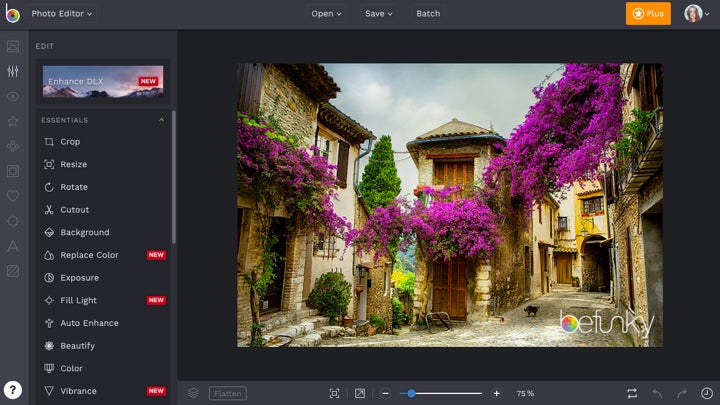
BeFunky is three tools wearing one coat. There is a Photo Editor for cropping, retouching, adjusting exposure, and running filters. There is a Collage Maker that stitches multiple images into a layout with one click. And there is a Graphic Designer for turning photos into social posts, cards, and marketing graphics using templates. Everything runs inside the browser - no install, no license key, no 4 GB download.
Over time the toolkit grew teeth. A one-click Background Remover uses AI to detect the subject and cut it out. Photo to Art converts an image into a painting or sketch with brush-stroke textures. A Batch Processor lets a photographer resize, enhance, and clean up hundreds of files at once. The through-line: each feature answers a specific, ordinary need, and each one is meant to work on the first try.
The engineering underneath is quietly modern. BeFunky runs on Amazon Web Services with a Fastly content-delivery network in front, a Python and Django backend, and Stripe handling subscriptions - the kind of stack that lets a small team serve a large audience without a large operations department. It is a reminder that "browser-based and easy" for the user usually means "disciplined and unglamorous" for the people building it.
Who uses itThe person Photoshop forgot
BeFunky's customer is the tens of millions of people who need a photo to look good by dinner and were never going to open a professional editor to get there. Bloggers and social-media creators making thumbnails. Small-business owners shooting their own product photos. Marketers who need a clean graphic without briefing a designer. Teachers, real-estate agents, Etsy sellers, parents. By 2015 the platform was pulling more than 45 million visits a month, and its mobile apps have passed 30 million downloads.
Photo editing and graphic design should be made easy - you shouldn't have to buy expensive, complicated software.Tekin Tatar, CEO and Co-Founder
That is the entire thesis, and it is also a positioning decision. BeFunky deliberately does not court the professional retoucher who wants layer masks and color science. It courts the beginner and the busy - the people most tools abandon once they add enough features to impress power users. Serving that person, at scale, turned out to be a durable place to stand.
The money storySixteen months on family money
The part of BeFunky's history worth stealing is how it got funded, because it mostly didn't. The founders self-funded for the first 16 months using personal savings and money from family. They built, shipped, and charged - reaching cash-flow positivity early enough that when the 2009 financial crisis arrived, the company simply kept operating while venture-backed peers ran out of runway.
Outside money came, but late and small. In June 2008, after a feature on Digg sent a wave of traffic that crashed their servers, Istanbul's Golden Horn Ventures put in $550,000 of seed capital - as much a reality check about infrastructure as a growth bet. A follow-on round of roughly $850,000 arrived a few years later. Total outside capital across the company's life sits around $1.65 million. For a consumer product with tens of millions of users, that number is almost suspiciously low.
Monthly-visit peak (2015), lifetime mobile downloads, and worldwide user base. Bars scaled for comparison, not to a shared axis.
The discipline behind that number is a rule Tatar has described plainly: if the team couldn't see a viable way a feature would earn back most of its cost quickly, the idea was shelved. In an industry that treats feature bloat as proof of ambition, BeFunky treated it as a liability. That filter is why a roughly 12-person team could run a product at this scale without a matching burn rate.
If we couldn't foresee a viable way it would earn back most of its cost quickly, that idea was shelved.Tekin Tatar, on how BeFunky picks what to build
Business modelFree enough to spread, cheap enough to say yes
BeFunky runs on freemium subscriptions. The free tier is genuinely useful, which is how the product spreads. Paying unlocks the premium effects, the AI background remover, the image enhancer, and the template library. The pricing floor is set low on purpose - the annual plan works out to only a few dollars a month - so the decision to upgrade is close to frictionless. A Pro tier adds batch AI editing and batch background removal for people processing images in volume.
No ad model, no data-broker side hustle, no venture subsidy propping up a below-cost price. Revenue - estimated around $12 million a year - comes from people who decided the tool was worth a few dollars. It is an unglamorous model, and that is the point.
The competitionThe third lane between Adobe and Canva
The obvious question is how a dozen people compete with Adobe, Canva, Fotor, Pixlr, and a dozen others. The answer is that BeFunky occupies a lane the giants tend to skip. Adobe owns professional depth and prices for it. Canva owns template-first design for teams and marketers. BeFunky sits between them as a fast, photo-first editor for the individual who wants to fix and finish an image - not run a design department. It got there years before "AI photo editor" was a marketing phrase, with a Cartoonizer that was doing photo-to-art before the term existed.
Where it fitsA quiet case for staying small
BeFunky's recognition has been steady rather than loud: a TechCrunch40 finalist slot in 2007, chosen from roughly 700 companies; a WebAward for Best Photography Website in 2015; a headquarters that moved from an Istanbul apartment to a Portland loft without ever adding the headcount you'd expect. The company stayed privately held, stayed profitable, and kept shipping AI tools into the 2020s while remaining independent.
There is also an expertise story hiding inside the simplicity. Making a tool feel effortless is harder than making it powerful - defaults have to be smart, a single click has to do the right thing, and the AI behind the background remover or photo-to-art filter has to be good enough that the user never sees the seams. BeFunky's real competency is compression: taking image-processing work that once demanded skill and folding it into a button that behaves predictably for someone who has never edited a photo before.
What a reader can copy is a short list. Charge early enough that the market tells you whether the thing is real. Keep the price low enough that saying yes is easy. Kill features that can't pay their own way. And pick the customer everyone else is too busy to serve. It won't produce a billion-dollar headline. Under different conditions - a market that rewards scale over margin, or a category where the free giants never leave a profitable gap - the same restraint could look like under-ambition. BeFunky's bet is that durability beats the headline, and 25 million users and 19 years suggest it has mostly been right.