Before Baskar Subramanian could build a software company, he needed a computer. His family in Coimbatore could not afford one. A chartered accountant had a machine, however, and the schoolboy had something to offer: he would spend four days writing financial software for the accountant in exchange for one day to work on his own ideas. Entrepreneurship began with a time-sharing agreement.
It is a wonderfully unglamorous opening for a career in television. There is no studio, no screen test, no invitation to lunch. There is a boy negotiating access to a keyboard. By Class 11, he was selling software. The pleasure was already in making something useful enough for another person to want it.
Decades later, as co-founder, managing director and CEO of Amagi, he works on the machinery behind other people's pictures. The company supplies software for preparing, running, distributing and earning advertising revenue from television and streaming channels. Viewers can spend an evening with its work without learning its name. For a business concerned with keeping programmes moving, that is a perfectly respectable arrangement.
A degree, a departure, a Bluetooth watch
Subramanian studied computer science at Government College of Technology, Coimbatore, then worked at Texas Instruments. He also enrolled in a master's programme at IIT Bombay, leaving before completing it. He has described finding the programme too academic for what he wanted to do. Building a business had a stronger pull than preparing for another job.
That decision is easily turned into a tidy dropout legend. His engineering education and employment deserve their place in the picture, too. He had studied the subject, worked in the industry and formed relationships that would outlast both the job and his first company. The departure was one decision within that education, rather than a substitute for it.
His next venture, Impulsesoft, worked on Bluetooth audio and embedded software. Subramanian was its co-founder and chief technology officer. Wireless stereo was an engineering problem with a consumer destination: get music from one device to another without the usual trailing cord. SiRF's acquisition announcement dates Impulsesoft's founding to 1999 and the completion of its purchase to December 2005.
There was also a Bluetooth watch. Subramanian has recalled a 2004 device that could take calls and display messages, and attempts to license the technology to watch companies. Today, the description sounds like a familiar shop-window item. At the time, it presented the less comfortable question of how to sell an unfamiliar possibility. A working invention still needs somebody else's buying decision.
The partners came with the next idea
Two people recur throughout this story: Srinivasan KA, often called Srini, and Srividhya Srinivasan. The three knew one another from college, worked at Texas Instruments, built Impulsesoft and went on to establish Amagi in 2008. A founder's second venture often arrives with a fresh cast. This one retained the people who already knew the engineering, and one another.
Subramanian described the decision to stay together as “an unwritten pact”. He said their backgrounds and principles aligned: technically minded people from middle-class families who believed in work and avoided shortcuts. The first business had carried the excitement of young founders. For the second, he wanted a company capable of lasting and growing.
“I believe in the power of partnership”
Baskar Subramanian, 2017
Srividhya has described a partnership in which opinions, fears and vulnerabilities could be spoken plainly. She and Baskar also married. Her account of the founders' complementary responsibilities gives the friendship some practical detail: Baskar handled product management, engineering and investor relations; Srini led sales and revenue; she led customer success at that time. Their roles have since evolved. The underlying arrangement gave different abilities room to work.
In 2017, Baskar described open workspaces without founder cubicles and visiting cards without designations. Today he holds the formal titles of a listed company's managing director and CEO. Both details belong in the portrait. An organisation can acquire the paperwork required by scale while its founder's earlier remarks still reveal what he valued: responsibility that did not need a private office to announce itself.
The television business they had to learn
Amagi began with a question about geography. Why should a business serving one city pay to advertise to an entire country? National television could deliver the audience in bulk. A regional advertiser needed a more selective delivery. The founders set out to make different advertisements appear in different places on the same television channel.
The attraction was easy to explain with two cities. A viewer in Mumbai and a viewer in Pune might watch the same programme but see different commercials. A local business could buy the audience near its customers. Larger brands could vary their messages by market. Geography, normally flattened by a national feed, became something an advertiser could choose.
The technology did not arrive with a ready-made commercial organisation. Broadcasters could admire the idea while lacking a business for selling local television advertisements. Amagi responded by building an ad-sales operation itself. Some prospective advertisers also needed help making television commercials, so the company established an in-house studio. Software had brought the founders into a business with rather more moving parts than software alone.
That detour matters to Subramanian's story. A product can be technically complete and commercially unfinished. He and his colleagues had to work through how advertising was bought, what broadcasters would accept and what local customers could actually use. The market required several pieces to fit together before the invention could earn its keep.
He later argued that outsiders could benefit from arriving without an industry's inherited assumptions. His advice included the wonderfully compact “Domain can be learnt but not common sense.” The experience at Amagi gave that argument a demanding qualification: the learning still had to happen. Being unfamiliar with a business did not spare the founders the work of selling inside it.
Two hours that opened another door
A customer request helped point Amagi towards a different business. An Indian broadcaster needed to replace two hours of programming on a pan-Asian feed to satisfy local requirements in Singapore. Technology used to substitute advertisements could address a longer stretch of content. Srividhya has identified that assignment as a turning point towards running whole channels.
The unit of work was expanding. First, replace an advertisement. Then, replace a programme. Eventually, manage a channel's continuous output. Around 2016, Amagi moved away from its ad-sales model towards a technology platform. The founders were taking what they had learned about broadcasting and selling the means to operate it.
Subramanian's explanation of the resulting business is disarmingly physical for a software executive: start with the glass of a camera and end with the glass of a television or phone. Between those two surfaces sit the jobs that turn footage into something watchable. Feeds need to be combined, graphics added, schedules managed and advertising inserted. The audience sees the finished picture.
Moving those operations into cloud software changes the choices available to a broadcaster. Capacity can be brought up for an event and reduced afterwards. A sports schedule that swells one day and shrinks the next is awkward to serve with permanently purchased equipment. Software makes it possible to arrange the infrastructure around the work as it arrives.
It also gives a media company a way to join television and streaming operations that developed separately. The same owner may have both kinds of audience, yet find itself paying for overlapping systems behind them. Subramanian has made that unification central to his explanation of Amagi. The interesting invention is often backstage, where duplicated work can quietly consume a budget.
The bell rings; the work continues
By March 2022, Amagi had raised $95 million in a round led by Accel at a valuation above $1 billion. In November, an investment announcement involving General Atlantic put the valuation at $1.4 billion and said the business had passed $100 million in annual recurring revenue. Those were company milestones, earned over years of changing what the company sold.
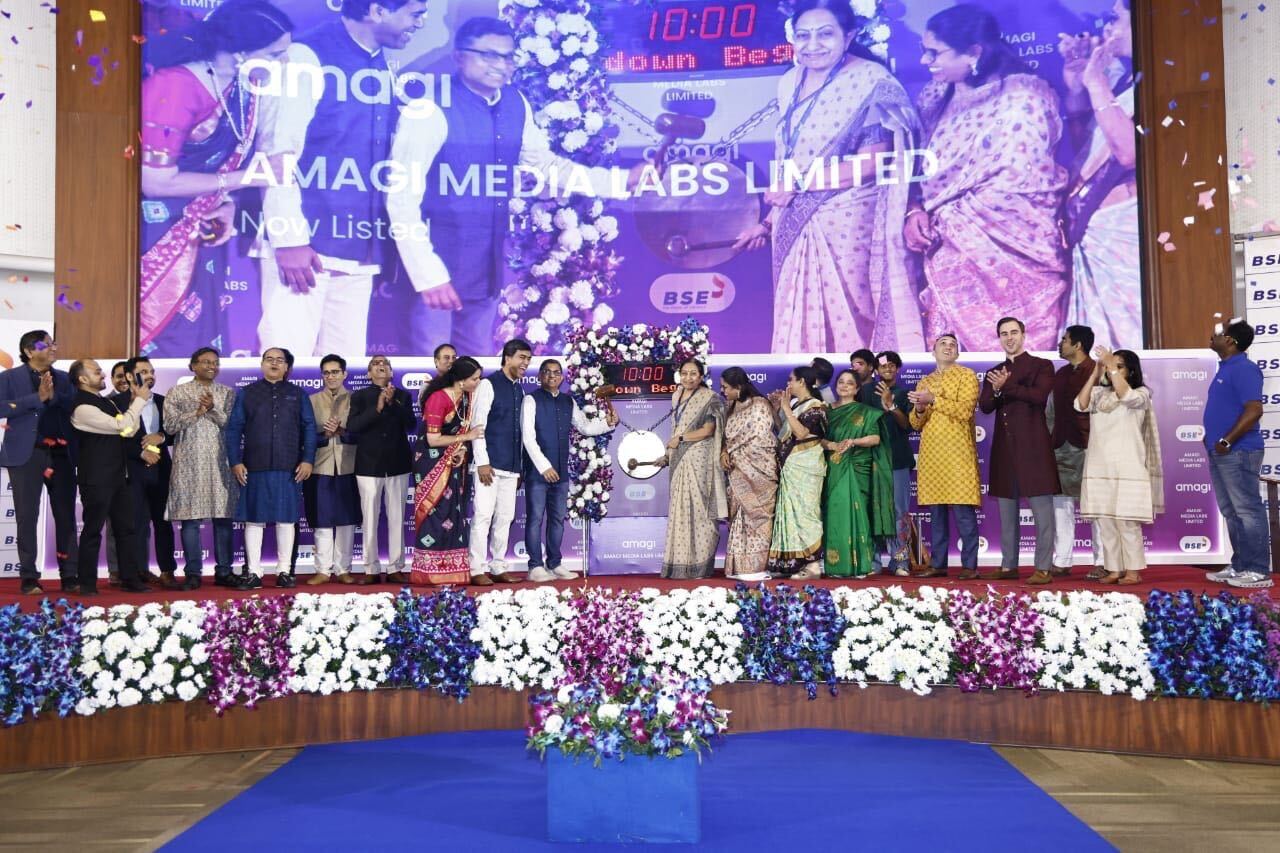
Amagi listed on India's BSE and NSE on January 21, 2026. At the listing ceremony, Subramanian emphasised how much media infrastructure remained to migrate to the cloud. He framed the public-market arrival as an early stage in a longer transformation. The celebration furnished a photograph; his argument concerned the work still available after everyone left the stage.
That work now has a public accounting. For the financial year ended March 2026, Amagi reported revenue of ₹1,506 crore and profit after tax of ₹72 crore, compared with a ₹69 crore loss the preceding year. The figures give the later chapter of his career a different texture from the early experiments: a business must keep turning its technical decisions into repeatable financial results.
Another unfamiliar possibility
Artificial intelligence is the next extension of that work. Subramanian has spoken about personalisation and improving the experience of finding content, alongside making media operations more efficient. The attraction follows the same commercial test as earlier products: help a customer do useful work, reach an audience or earn revenue.
In his August 2026 shareholder address, he reported that a major US news broadcaster had selected NEWSPULSE for newsroom AI transformation, with more than ten active pilots at news organisations globally. Amagi also reported quarterly revenue of about ₹437 crore. The pilots are an early commercial step, with the larger ambition still ahead: move more of media's operational work into software.
The distance from a borrowed computer in Coimbatore is considerable. The shape of the problem remains recognisable. There is something someone wants to do, a constraint preventing it, and a piece of software that might help. As a schoolboy, Subramanian negotiated for a day at the machine. He has spent the intervening years giving that day increasingly complicated things to accomplish.
Keep the conversation going
Interviews, ideas and the business behind the broadcasts.