The request was only two hours long. An Indian broadcaster had a pan-Asia television feed, but Singapore’s local rules required a different slice of programming. Could Amagi replace those two hours? The company already knew how to substitute regional advertisements into a shared satellite feed. Now a customer was asking it to substitute television itself. In co-founder Srividhya Srinivasan’s account, that small exception opened the route to an entirely different business.
- Amagi sells the software behind broadcast and streaming channels.
- Its customers bring content; Amagi connects operations, distribution and advertising.
- The opportunity is fewer repeated tasks. The constraint is still finding viewers and paying advertisers.
A two-hour exception
Founded in 2008 by Baskar Subramanian, Srinivasan KA and Srividhya Srinivasan, Amagi began with an Indian advertising problem. A business serving Mumbai could buy a national television spot, but much of its money would reach people elsewhere. Amagi made different cities see different advertisements on the same feed. The Singapore request suggested that its underlying skill could serve programming, too.
The founders had previously built Bluetooth software at Impulsesoft. Television was unfamiliar territory. “None of us in the company had broadcast industry background,” Srinivasan recalled. Their advantage came from approaching a broadcaster’s equipment problem as a software problem. A useful lesson hides here: listen closely when a customer asks for something adjacent to the thing you thought you sold.
 Baskar Subramanian
 Srividhya Srinivasan
 Srinivasan KA
The channel is a workflow
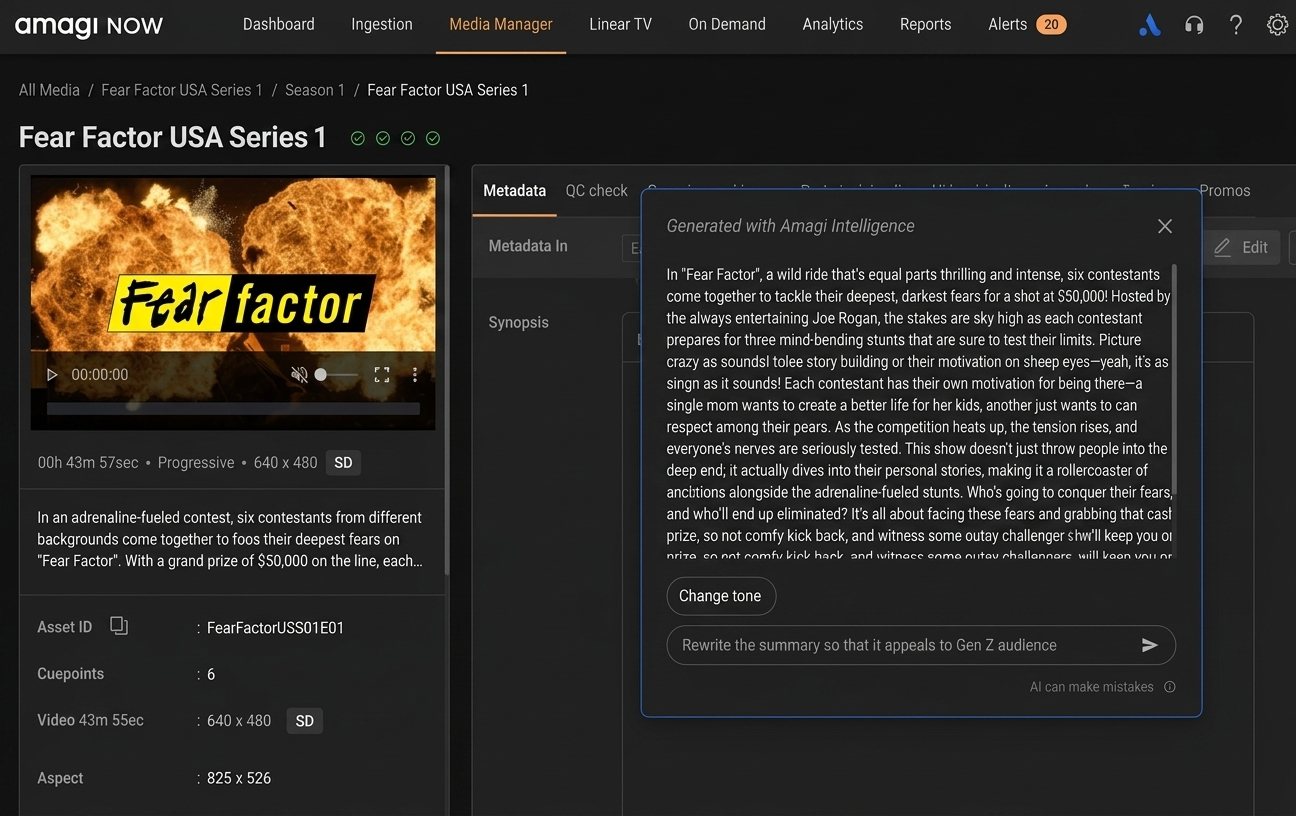
A television channel is a collection of promises: this program at this time, these graphics, that language, the correct commercial break. Amagi sells tools for keeping those promises. CLOUDPORT handles channel playout, including schedules, graphics and live controls. NOW connects media operations. THUNDERSTORM inserts advertising into video streams. CONNECT helps content partners and platforms find distribution relationships; ADS PLUS supplies advertising sales services.
The buyers are broadcasters, studios, sports organizations and streaming platforms. Publicly named customers include NBCUniversal, DAZN and Tastemade. In March 2025, FC Barcelona announced Spanish and English TOP BARÇA FAST channels using NOW, drawing on interviews, behind-the-scenes material and historical highlights. FAST means free ad-supported streaming television: scheduled viewing, financed by commercials, delivered over the internet.
- 01Prepare
the video - 02Schedule
the channel - 03Deliver
the feed - 04Insert ads.
Measure.
One workflow. Many destinations.
Cloud software alone is no longer an unusual proposition. Grass Valley’s AMPP-based Playout X also supports cloud and hybrid operations. Amagi’s pitch rests on connecting the work around the channel, including monetization. The useful comparison is how much coordination remains between systems after the software arrives.
Eight minutes of advertising
AccuWeather NOW makes the work tangible. For its Roku channel, AccuWeather needed distinctive graphics, live weather information and compliance with the platform’s advertising requirements. Amagi built an HTML5 application that queried weather APIs every few seconds and fed the results into an on-screen ticker. The system delivered weather information for about 25 American cities.
Then came the arithmetic: four commercial breaks, totaling eight minutes. Amagi masked alternate breaks to fit Roku’s requirements, while CLOUDPORT and THUNDERSTORM handled channel assembly and ad insertion. The case study says the channel launched in under two months. Reusing a feed still required adapting it to the destination.
The migration needed people
Court TV offers a useful corrective to the idea that automation removes operational anxiety. After acquiring the network, Law&Crime had five months to bring operations in-house. The channel carried roughly ten hours of live programming each weekday. A migration had to preserve that service while replacing disconnected, manual systems.
Amagi tested playlists, metadata feeds and distribution endpoints. When Law&Crime raised late readiness concerns, it added ten days of intensive support and an onboarding specialist on-site for the first week. The August 2026 announcement reports no disruption to live service. The repeatable lesson is the preparation: rehearse the handoffs, examine the metadata, and budget for people when the switch becomes real.
“We had five months to take on Court TV and no room for downtime.”Debasish Mishra / CTO, Law&Crime
Rent the capacity. Earn the audience.
Amagi earns money through business software and managed services, with advertising arrangements adding inventory and revenue sharing. One concrete price appears on AWS Marketplace: CLOUDPORT’s one-month contract lists $2,100 per feed per month for license only, or $3,000 for a playout subscription. Additional AWS infrastructure costs may apply. DYNAMIC illustrates one way the economics can change: it provisions resources for live events and releases unused capacity afterward. Occasional productions can avoid keeping the same infrastructure running continuously.
Building the supplier took substantial capital. A $95 million round in March 2022 was followed by an investment exceeding $100 million from General Atlantic, including $80 million in primary capital. That November transaction valued Amagi at $1.4 billion. Those are financing figures, rather than a price for operating a channel.
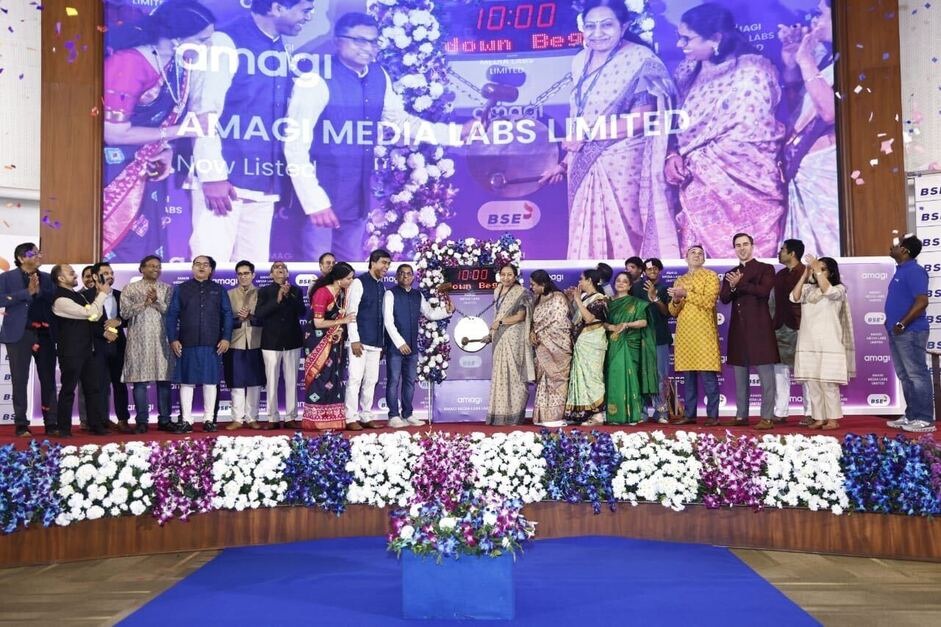
Amagi listed on India’s exchanges in January 2026. It reported FY26 revenue of ₹1,506 crore, up 29.5%, and profit after tax of ₹72 crore, compared with a ₹69 crore loss a year earlier. The financial progression matters: expanding distribution is valuable only if the operating model can eventually pay for itself.
Rounded reported revenue. Fiscal years end March 31.
More screens, same hard arithmetic
The next effort is AI-assisted production and operations. In September 2026, Amagi announced demonstrations spanning Studio, sports storytelling tool Fanpulse, localization and network operations. Its newer Studio capability was in pilot. The direction follows the original Singapore problem: produce more useful versions of existing content without multiplying every task.
There are limits. Distribution requires the appropriate rights and platform agreements. Live operations need dependable connections and fallback plans. Advertising needs demand: ADS PLUS terms explicitly decline to guarantee inventory sales or fill rates. For a content owner with a viable audience and repetitive operations, Amagi offers practical machinery. For a library without viewers, automation leaves the central problem untouched. The channel can run perfectly. Somebody still has to want to watch.