A television camera can now leave the building with a backpack. The building’s complications have proved rather more reluctant to leave. Somebody still has to connect the feeds, synchronize the pictures, arrange the audio and make sure the person speaking can hear the person giving instructions. Then somebody has to get the finished program to the audience. The truck was conspicuous. The work inside it was the real purchase.
- TVU supplies the equipment and software behind live video, from camera to distribution.
- Its customers include newsrooms, sports producers and teams keeping existing studios in service.
- Bonded connections make field production mobile; connected cloud tools move more work off-site.
- The hard question is total operating cost, including setup, coordination and the fallback.
TVU Networks has spent two decades working on that journey. Its portfolio runs from portable transmitters to browser-based production, video search and channel playout. The company reports more than 4,000 media organizations using its technology. This is an industrial business with an unusually public consequence: the customer’s success appears on television, while the machinery that made it possible ought to remain invisible.
The camera can leave; the complexity follows
Consider a small piece of arithmetic from TVU’s September 2026 announcement. In research involving more than ten live-production organizations, the company described a representative 90-minute cloud production needing approximately $15 of compute infrastructure and $890 of specialist configuration work. The example is TVU’s own research, and the company says the ratio varies. It is nevertheless a splendidly awkward number for anyone who thought renting a computer would settle the economics.
These two costs alone total $905. Configuration accounts for about 98%. This is an example, not an industry average or an all-in show budget.
TVU’s answer is MediaMesh Build, Operate and Observe: tools for constructing workflows, giving operators suitable controls and monitoring the system. They were announced in limited availability, a distinction that matters to buyers. The calculation suggests a useful question for any technology purchase: how much skilled work does this supposedly convenient machine require before it becomes convenient?
A backpack with a complicated job
The portable part of the proposition is TVU One, a transmitter supporting HD and 4K HDR contribution. It uses TVU’s ISX transport technology to combine available connections. Cellular bonding is the central idea: several network links contribute to delivering a live picture instead of assigning the whole job to one connection. TVU advertises latency as low as 0.3 seconds. That is a product claim to test in the intended conditions, rather than a stopwatch reading promised for every location.
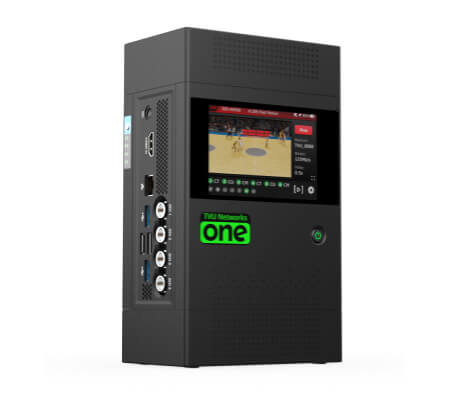
The company’s expertise lies in the unglamorous details of transport, timing and media processing. Founder and CEO Paul Shen previously built Imedia, whose CherryPicker technology supported digital television distribution. His background includes digital-TV architecture and MPEG standards work. TVU’s 2020 Technology and Engineering Emmy recognized video over bonded cellular internet, an engineering achievement rather than an award for a program’s editorial content.

Once the picture arrives, TVU Producer handles switching, graphics, audio and remote collaboration in the cloud. RPS and RPS Link serve synchronized multicamera remote production. MediaHub handles routing and conversion; Grid distributes live feeds. These are different jobs with different buyers inside a production organization. Their connection is the sales proposition: fewer disconnected decisions between acquiring a shot and putting it on air.
- 01 / AcquireOne · Anywhere
- 02 / ConnectMediaHub · MediaMesh
- 03 / ProduceProducer · RPS
- 04 / DeliverGrid · Channel
The boat was a rehearsal for a different geography
France Télévisions offered a particularly good demonstration in July 2023. Its Paris countdown broadcast included cameras on boats, a motorcycle and separate live locations. Seven feeds were synchronized through TVU Producer. The mobile setup combined 5G with two Starlink Maritime units, addressing cellular-bandwidth challenges on the water. Much of the production happened remotely, and feeds also went to the studio as a backup.
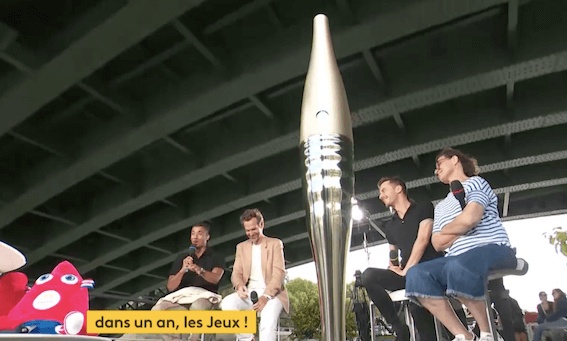
The broadcaster estimated technology-cost savings of at least 30% for that approach. It was an estimate tied to this production, not TVU’s price list. The important operational change was mobility: the production could follow the event while more of its people stayed elsewhere. For 2024, France Télévisions announced a dedicated Paris channel with cloud-based torch-relay coverage using TVU, AWS, 5G and Starlink.
Remote Commentator extends that separation to the announcer’s chair. TVU describes a golf-production customer using English-, Spanish- and Portuguese-speaking teams remotely. The tool keeps commentary synchronized and separates private producer instructions from audio intended for the audience. A producer can build several language versions without placing every voice at the venue. The internet connection remains part of the job, as does the discipline of knowing which microphone is on air.
The channel plan meets breaking news
Reuters illustrates a different constraint. A fixed number of distribution channels is an awkward match for several stories breaking at once. In March 2026, Reuters and TVU began moving Reuters Live Service from its historic satellite distribution toward cloud-managed IP delivery. Their September announcement described another step: assembling processing and distribution services around the needs of each live event.
MediaMesh connects TVU and third-party capabilities in that environment. Frame-rate conversion and watermarking can join a workflow when needed. Open interfaces matter here because the news agency wanted room for specialist partners. The Reuters project won IBC’s 2026 Content Distribution Innovation Award. That recognition is for a collaborative deployment, not evidence that every broadcaster should copy its entire architecture.
“The future of live production depends on collaboration, not closed ecosystems.”
Paul Shen, announcing MediaMesh in September 2025
MediaMesh’s shared-media model aims to let authorized tools and teams work with the same live material. TVU introduced it in 2025 with an advisory board including broadcast-technology partners. Its significance is organizational as much as technical: a media operation needs its chosen tools to cooperate. Replacing one complicated collection of equipment with another complicated collection of subscriptions would be a rather expensive change of furniture.
The archive joins the live desk
The next bottleneck can appear after the video has arrived safely. Cortex, introduced in September 2026, targets news organizations whose footage lives across local systems, archives and feeds. Its AI agents organize and cross-reference material so journalists can look by subject rather than hunt for a file’s whereabouts. TVU says it works alongside existing newsroom systems. The intended buyer has a distribution problem inside the organization before it has a distribution problem outside it.
That same month brought TVU Pocket, developed with vivo, combining dual active 5G and dual Wi-Fi in a phone-sized broadcast device. The company also announced a Frequency integration for TVU Channel, with Entravision the first deployer. Channel covers scheduling, playout and monetization; the integration widens distribution opportunities. The portfolio is stretching at both ends: smaller equipment at the camera, more destinations for the finished program.
Buy the rehearsal, too
TVU earns money through hardware, rentals, subscriptions and usage-based cloud services. It advertises Producer starting at $35 an hour. An entry rate is useful for planning a trial; it does not price the cameras, connectivity, staffing, integration or support for a complete show. Event rentals and on-site assistance are also part of the offering. For a broadcaster, those people may be as consequential as the software.
The alternatives are substantial. LiveU supplies cellular contribution equipment and its own cloud-production Studio. Haivision’s Pro460 supports bonded transmission and synchronized multicamera contribution. TVU’s connected portfolio deserves evaluation, but a broad catalog alone cannot determine the winner. The existing receiver estate, required formats, crew familiarity and destination requirements all influence the purchase.
A useful rehearsal follows one real program from source to audience. Measure the setup time as well as the delay. Check how the director talks to the field. Interrupt a connection and observe the recovery. Include the studio equipment that has to remain. If connectivity is inadequate, integration takes too much labor or a regular local show already runs economically, remote production may offer little advantage. Copy the method of testing, rather than somebody else’s savings percentage.
TVU’s most interesting promise is that more live television can fit around the story. Whether that promise pays depends on the work surrounding the picture. The camera has learned to travel light. The rest of the production is still packing.
See the machinery at work
Explore TVU’s website, its company news and customer stories. Watch the France Télévisions mobile-production video or visit TVU’s demos and videos on YouTube.