In 2012, Frequency wanted your thumb. Its iPhone app gathered free video from YouTube, Vimeo and whatever friends were passing around on Facebook and Twitter, then arranged the torrent into personalized channels. The company said it was indexing more than 500 million social posts and adding 250,000 videos a day. It was an admirably ambitious answer to a problem that now feels quaint: the internet had too much video, and somebody needed to make a guide.
That Frequency is gone. The current company does not ask viewers to download anything. It sells enterprise software to the people who own the shows, local newscasts, sports rights and movie libraries. Its cloud platform turns those assets into linear streams, keeps them running around the clock, and sends them to destinations such as Pluto TV, Samsung TV Plus, Roku, Tubi and Prime Video. The brand stayed. The user moved from the couch to the control room.
This is the useful tension in Frequency’s 16-year life. The first product tried to win attention in a crowded consumer market. The durable product manages an unglamorous operational burden that media companies cannot ignore. Frequency did not abandon video. It walked backward through its own stack until it found a customer with a budget.
The product is the whole Tuesday
A free ad-supported streaming television channel, or FAST channel, looks simple to the viewer: select a tile and something starts playing. Behind the tile is a calendar with no mercy. A 24/7 channel needs roughly 730 hours of programming each month. Every episode needs usable media, correct metadata, valid regional rights, an electronic program guide entry, ad markers and a place in the schedule. Live events arrive late, run long and break neat plans. Distributors have their own technical requirements. Dead air is not a charming product quirk.
Frequency Studio collects that work in one multi-tenant SaaS platform. INGEST automates feeds from sources including S3 and MRSS. MANAGE handles the library, metadata and rights. SCHEDULE uses a familiar calendar interface and automation for repetitive blocks. GRAPHICS+ triggers overlays, tickers and squeeze-backs. LIVE handles source previews, switching, ad triggers and failover. ANALYZE reports on content, advertising and distribution. CONNECT gives operators a portfolio view of stream health and delivery status.
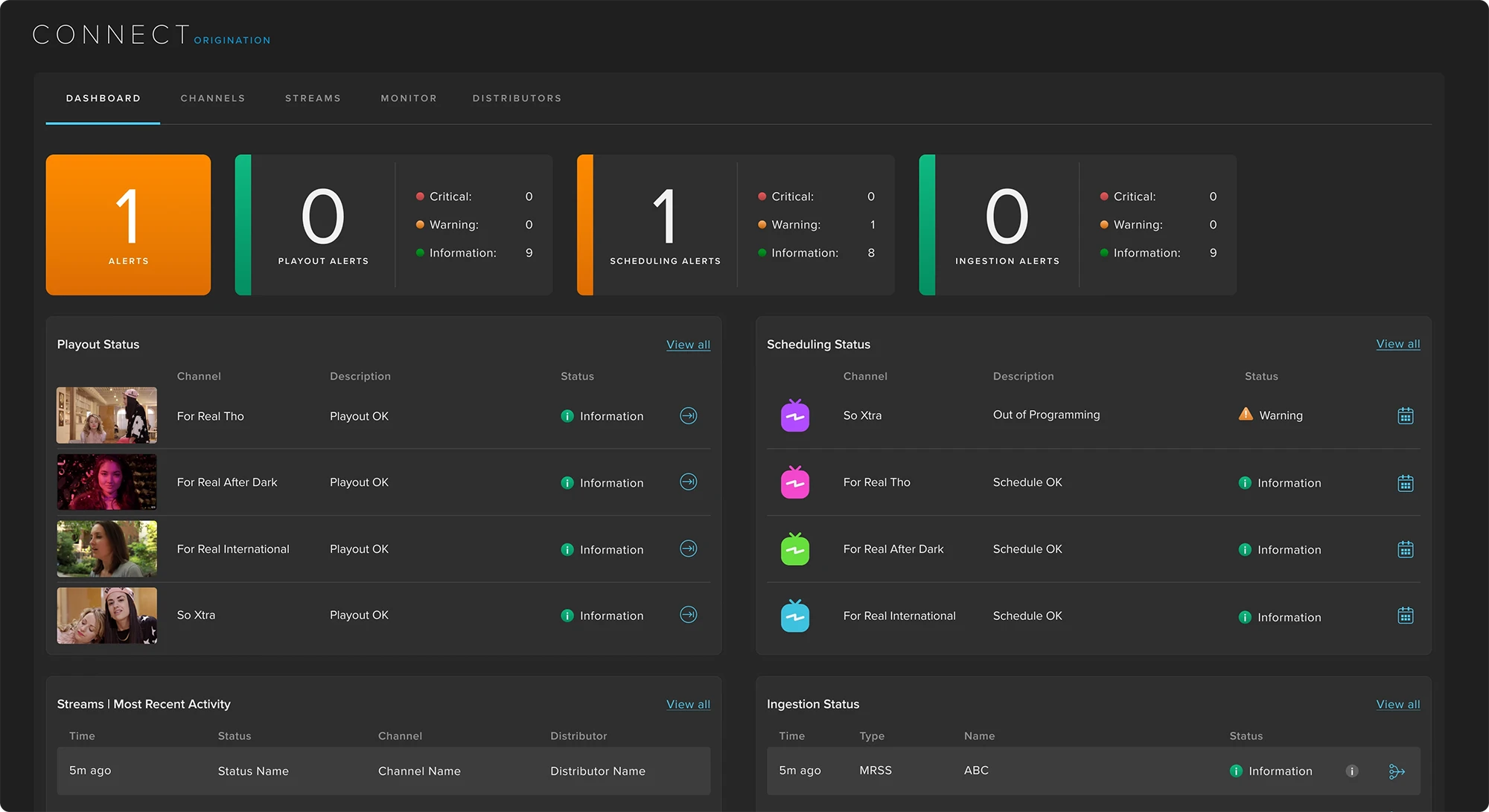
The distinction is not merely cloud hosting. Frequency argues that every customer runs on one version of the same software, which lets it push workflow changes across the system and, now, expose core services to AI agents. Compared with a chain of separate scheduling, playout, graphics and monitoring tools, the attraction is shared context. A rights restriction entered at the asset level can stop a programmer from placing the show in the wrong country before the stream goes live.
What customers actually buy
Frequency’s buyers include traditional broadcasters, film and television libraries, digital studios, sports organizations and brands. Hearst Television used it to make digital linear channels from local stations. Revry said it grew to seven channels across more than 20 platforms. Public announcements name Scripps, ROXi, Cineflix, Cineverse, X Games, Dyn Media, PokerGO, Bleav and Tony Robbins Network. These customers are not buying a generic video player. They are buying fewer handoffs between a library and the living room.
The company’s business model is unusually legible for enterprise media software. Frequency has described a flat monthly charge per channel, without an extra connector fee each time that channel goes to another supported destination. The dollar amount is negotiated rather than posted. The incentive is clear: customers can widen distribution without watching a connector meter spin, while Frequency earns a recurring fee for the operating layer.
Managed Channel Services, launched in 2024, expands the billable work. A rights holder can buy help with content review, channel identity, programming, dayparting, promos, scheduling, platform setup and ongoing optimization. This is software with grown-ups attached. It works for a company that owns valuable footage but does not employ a miniature television network to turn that footage into a channel.
How far Frequency will follow the workload
The first thing to fail was the front door
Frequency’s consumer era is more than trivia. It tells us what failed first: the front door, not the plumbing. Personalized video guides were competing with platforms that owned both the audience and much of the content. YouTube improved its recommendations. Social networks put video directly into feeds. Smart-TV operating systems became guides themselves. An independent app sitting between viewers and giant platforms had a precarious seat.
The historical record shows the company moving steadily toward distribution and infrastructure rather than one dramatic pivot announcement. By 2016, when Frequency raised an $11 million round led by Liberty Global Ventures, it was already described as providing video services to more than 100 million subscribers and distribution for more than 120 multi-channel content providers. The market had supplied the answer: the reusable technology was more defensible than the consumer destination.
What did the reinvention cost? Public company databases put Frequency’s total outside funding around $20 million, including a reported $3 million round in 2011, the $11 million round in 2016 and later equity and debt filings. That is enough capital to support a long migration, but modest beside the sums burned trying to become a household-name streaming service. The company ended up selling shovels in a gold rush it had once entered as a prospector.
When a front-end product stalls, inventory the systems built behind it. Look for a workflow with an identifiable operator, a recurring deadline, expensive failure and a budget owner. Frequency found all four in linear channel operations.
A modular bet in an all-in-one market
Frequency competes with Amagi, Wurl, Veset, OTTera, Zype, MuxIP, Bitcentral and internal stacks assembled from cloud encoders, CDNs and ad systems. Its pitch is not that every adjacent service must belong to Frequency. In 2023 it partnered with Wurl, pairing Frequency’s channel creation and playout with Wurl’s monetization and performance marketing. Brightcove customers gained a route from their existing video libraries into Frequency. Endeavor Streaming paired direct-to-consumer products with FAST distribution.
That modular posture is a practical differentiator. A content owner can keep its ad relationships and choose specialist components, while using Frequency as the operational spine. It is also a tension. Large rivals sell broad end-to-end stacks, and integrations can become another dependency. Frequency has responded by widening its own center: first services, then rights, graphics and live, and now intelligence and advertising.
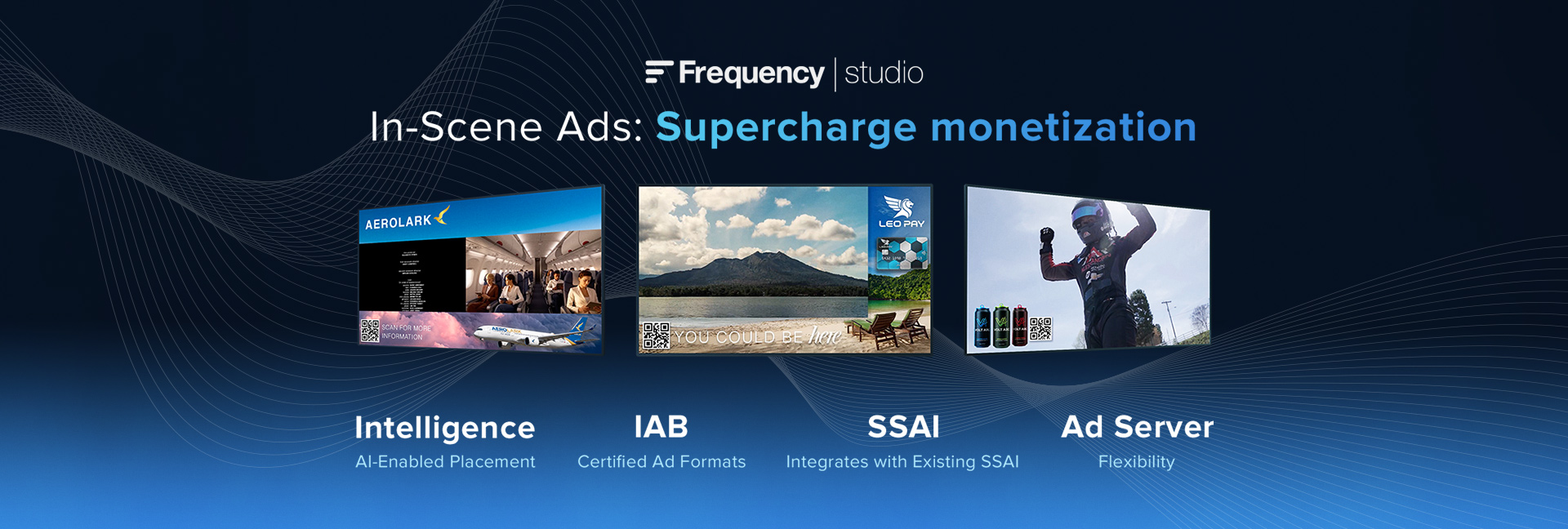
In-Scene Advertising, launched in June 2026, is the boldest boundary move. Frequency analyzes scenes for context, visual clarity, sentiment, attention and brand safety, then renders formats such as L-shapes or picture-in-picture into the viewing experience. It says the system works with existing server-side ad insertion, ad servers and measurement tools. The pitch is incremental inventory without another interruption, and publisher control rather than a compulsory central marketplace.
Can a paragraph program television?
Studio AI is the other new frontier. Its Blueprints describe a channel’s identity, editorial rules and optimization goals in natural language. A Blueprint might begin as a paragraph, a spreadsheet schedule or a conversation. AI Scheduling turns that description into a continuously programmed channel while observing rights windows and audience patterns. Frequency said in April 2026 that Blueprints were in private beta with a global media company and that AI-operated channels would reach major platforms in the second quarter.
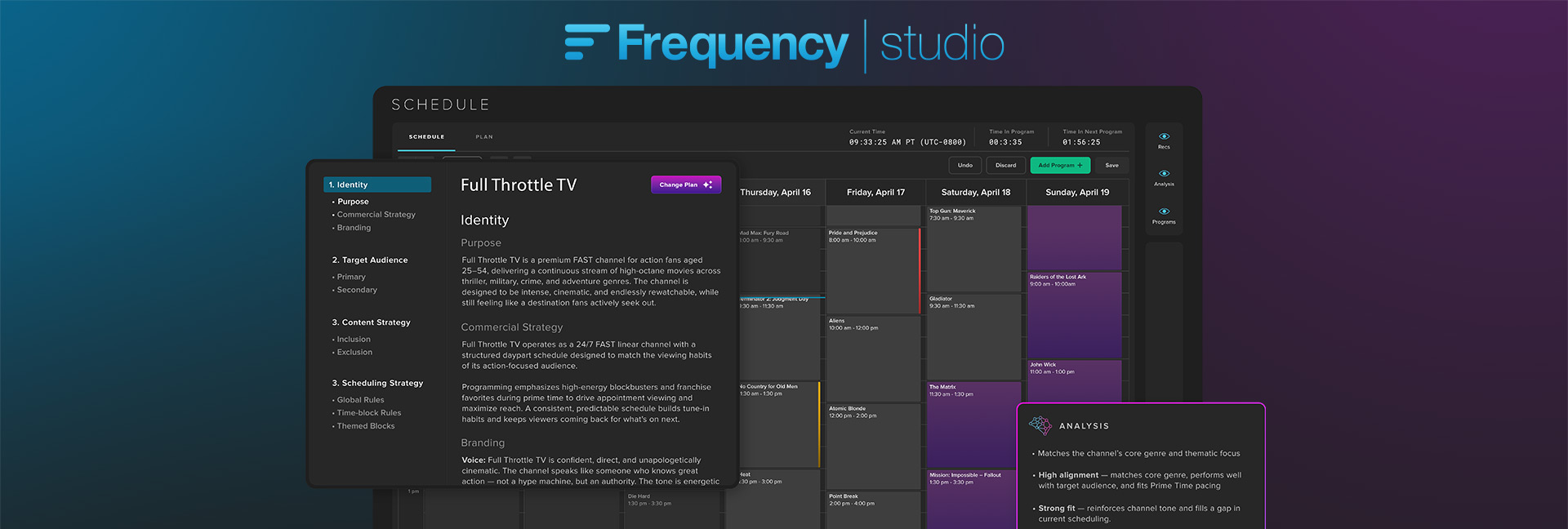
The condition matters. Automation works when a library has clean metadata, explicit rights, enough depth and a programming strategy that can be expressed as rules. It works less well when taste depends on undocumented instinct, source files arrive broken, rights are ambiguous or a live event rewrites the evening. AI can place the blocks; it cannot manufacture a reason to watch.
The same caveat applies to Frequency itself. The platform is a poor fit for a creator with twelve clips, no path onto a major FAST service and no advertising demand. A channel is not automatically a business. Distribution partners still decide what to carry, audiences still have to find it, and ad fill determines whether free viewing produces useful revenue. Frequency reduces operating cost and complexity. It does not repeal television economics.
The quiet company behind the glass
Frequency now says its network supports more than 500 channels, 2,500 distributed streams and 200 destinations. Its live workload includes thousands of newscasts and sports events. Those are company-reported figures, but they describe the shape of the achievement: the startup that once chased individual viewers became useful by disappearing from their view.
Founders can copy the method, not the market. Stay close to the hard recurring work. Notice which internal capabilities customers ask to buy. Price in a way that encourages the behavior that makes the product more valuable. Add services when tools alone cannot cross the implementation gap. And keep the old expertise: Frequency’s consumer app needed ingestion, metadata, personalization and delivery. Those muscles did not become irrelevant. They became enterprise features.
It is a less cinematic startup story than conquering the living room. It is also more instructive. Frequency did not win the remote. It built a business making sure the remote always has something to land on.