At Roland-Garros in 2025, France Télévisions gave tennis another place to live: an interactive digital channel that stayed on around the clock. There were match streams, highlights, backstage material and live chat. The revealing detail was behind the screen. The broadcaster said its digital channel started with three people per shift and reached one in the final week. Backlight’s Wildmoka supplied the production tools. A second screen had acquired a surprisingly small control room.
- What it sells: software for the jobs between a script and a stream.
- How it got here: five acquired brands, backed by more than $200 million in PSG-led investment.
- Why pay attention: its newer integrations tackle the handoffs that separate finding, reviewing and publishing media.
The tennis channel that shrank its shift
France Télévisions combined streams from all 16 courts, rapid social clipping and an interactive channel built with Wildmoka. Its September 2025 announcement reported seven million digital-channel viewers. Those numbers belong to a broadcaster, a tournament and an editorial strategy working together. They cannot sensibly be assigned to a software license alone. Yet the staffing detail gives the technology a concrete job: making additional coverage practical.
“It’s the best of both worlds.”
Nicolas Vinoy, France Télévisions, on reaching digital audiences alongside traditional viewers
That is a useful entrance to Backlight. The company sells tools for people whose work produces more media than their old routines can comfortably handle. A sports team needs yesterday’s footage for today’s promotion. A producer needs everyone looking at the same frame. A publisher needs an approved clip in several formats. Each request sounds small. Together, they become a second occupation.
A shopping list with a theory
Backlight began assembling its businesses in 2021. At its public launch in April 2022, it announced five acquisitions: Ftrack, Iconik, Celtx, Wildmoka and Zype. PSG led an investment of more than $200 million. The money supported the portfolio and further acquisitions; it was not a disclosed price tag for each purchase.
The list followed the life of a piece of media. Celtx helped develop and plan it. Ftrack helped coordinate production. Iconik organized the resulting assets. Wildmoka turned content into timely digital output. Zype supplied streaming infrastructure. Buying established specialists also brought people who understood their particular corner of production.
PSG-led investment behind five acquired media software businesses.
There was a boundary to the ambition. In a 2023 interview, then-CEO Ben Kaplan rejected a model in which “customers have to use all of our software or none of our software.” Specialist products could remain useful on their own. The portfolio’s appeal rested on giving adjacent tools a reason to cooperate.
The organization followed that logic. In February 2023, Backlight grouped its complementary businesses into Creative and Streaming divisions. Kathleen Barrett, previously CEO of Mosaic Group and an executive at Vimeo, became Backlight’s CEO in April 2024. By 2026, its product announcements were increasingly about connected operations: what happens when media management and publishing share a working surface.

Six tools, six different jobs
Backlight’s current range contains six products because Cinesync, associated with Ftrack, has its own place in the lineup. The useful way to read the range is as a set of jobs. Buyers can start where their work is getting stuck.
Scripts and pre-production
Tasks, shots and production tracking
Assets, metadata and shared access
Synchronized, frame-accurate feedback
Live clips and digital distribution
Video services and monetization
Celtx serves writers, educators and production teams. Ftrack addresses the interdependent tasks of studios and creative departments. Cinesync lets dispersed reviewers examine footage together with the fidelity demanding productions require. Iconik manages the library; Wildmoka helps broadcasters and sports teams cut and publish; Zype helps content owners build streaming services without constructing every technical component themselves.
The customers consequently extend beyond television. Backlight’s public examples include sports organizations, publishers, nonprofits and corporate teams. Its market is the operational layer of media production. A company can acquire the same coordination problems as a studio long before anyone gives it a studio’s name.
The archive is heavier than it looks
The 2026 Iconik Media Stats Report offers an excellent rebuke to counting files as though they weigh the same. Video accounted for 14 percent of assets in the dataset and 64 percent of storage. A library full of small images and a library full of footage present very different bills.
Different denominators: asset count and storage volume. Iconik dataset, 2026 report.
Iconik’s hybrid architecture makes that distinction useful. Its Storage Gateway indexes local media. Cloud connections bring customer-controlled buckets into the same catalog. Metadata, permissions and lightweight viewing proxies make media accessible while originals can remain where the owner keeps them. An editor can discover a file without first migrating the entire archive.
That separation is a meaningful part of Backlight’s positioning. It connects storage and creative work without treating storage as one compulsory destination. Teams can connect local infrastructure with cloud services, retaining choices about where large originals belong. The practical work is deciding permissions, connections and metadata that people will actually use.
The review folder that won the argument
Morning Brew’s switch to Iconik in early 2025 began with a familiar irritation. A remote podcast producer needed a recording; somebody else fetched it from local storage, uploaded it for review and shared it. About 50 people used the relevant platforms. The existing arrangement involved Frame.io, Signiant Jet and Media Shuttle.
The obstacle was adoption. Head of post-production Sam Wolf described the team as “a little apprehensive” about learning a new product. The rollout started with a simple review folder. Once people were comfortable, the team expanded media management, connected local storage through Iconik’s gateway and integrated Wasabi storage.
Iconik’s customer story reports a 69 percent reduction in annual media management costs after replacing the three tools. That is a customer result, not a forecast for the next buyer. The method is more portable than the percentage: start with a familiar task, prove it works, then widen the change.
The Atlanta Hawks offer another useful preparation step. Before selecting their system, their asset-management lead spent six to eight weeks reviewing workflows across business units. Integrator IMT helped evaluate the options. The eventual setup connected Iconik with other infrastructure, including CloudSoda for moving data. Software selection followed an account of the work.
Price the handoff, then the subscription
Backlight earns money through software subscriptions, usage-based services and enterprise arrangements. Prices belong to individual products and plans. On Iconik’s published Starter schedule, browse users cost $9 per month, standard users $65 and power users $120. Collaborators are listed at $0. Professional and Enterprise plans use custom pricing.
Seat prices are only part of the calculation. Processing, AI services and storage-related usage can consume credits. Connecting systems and training people also take work. Some capabilities sit in higher plans or paid add-ons. A purchasing comparison should include the complete workflow and the services it uses.
The benefit is most plausible where recurring handoffs and fragmented access already cost time. A small team sharing a modest folder may gain little from a broader system. Poor permissions or inconsistent metadata can undermine discovery even after the software arrives. Backlight’s own channel program includes implementation and customization, a sensible acknowledgement that a product still needs a working environment.
The portfolio starts behaving like a platform
In August 2026, Backlight announced general availability of the Iconik Publish Panel, placing Wildmoka publishing inside the asset-management interface. Approved content could move toward destinations such as YouTube and Instagram without a separate export-and-upload routine. The announcement also described a Brand Portal, AI-assisted discovery and an MCP Server for connecting AI applications to a customer’s library.
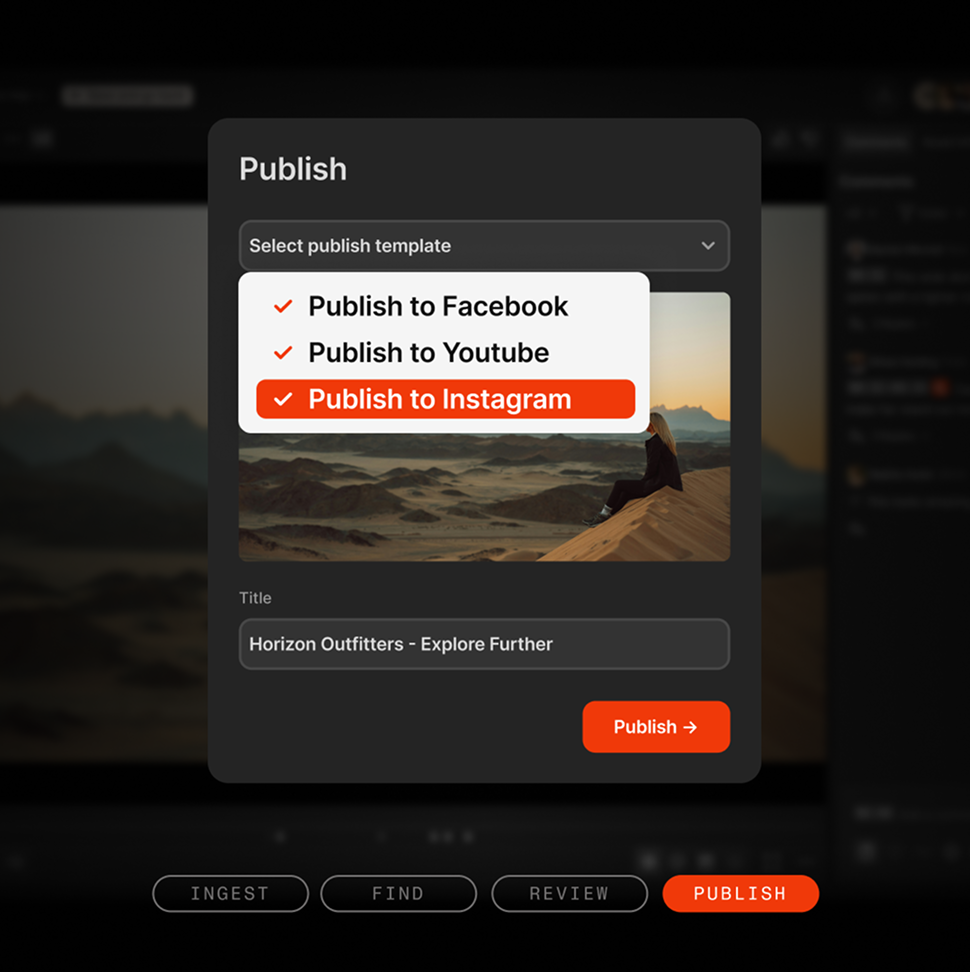
Wildmoka’s AI Moments was in beta in that announcement, designed to surface noteworthy moments from live feeds. It gives an editor a starting point; editorial judgment still belongs to the editor. The more immediate change is structural: two acquired specialists can remove a step between their respective jobs.
For anyone considering this kind of software, the useful exercise is wonderfully unglamorous. Follow one asset from capture to publication. Count the uploads, requests, approvals and waiting periods. Choose a repeated interruption that a team can recognize, then measure what changes. Backlight’s story makes the interval between creative acts worth inspecting. Quite a lot of the working day can disappear there.