In 2001, before an office webcast could be mistaken for ordinary work, the White House bought ten Vbrick systems for its Situation Room. Each cost $5,000. The boxes took live and stored television feeds, compressed them, and sent them over a secure computer network to desktop screens. It was a clean answer to a gloriously turn-of-the-century question: How do you put TV on the LAN?
Nearly three decades later, the box has disappeared, the company has moved from Connecticut to Herndon, Virginia, and the question has become stranger. Vbrick now asks what a business can learn from every town hall, training session, repair demonstration, customer call, and executive broadcast it has already recorded. Its software stores the video, guards it, distributes it, transcribes it, translates it, searches it, summarizes it, and increasingly serves its contents to AI applications.
That makes Vbrick easy to misread. It is not quite a video-conferencing company, not quite a corporate YouTube, and not merely cloud storage with a play button. It is plumbing for organizations where video has become a regulated data type - plentiful, expensive to move, awkward to search, and occasionally important enough that 100,000 employees need to see the same frame at once.
The first product was the name
Rich Mavrogeanes founded VBrick Systems in 1997, when MPEG compression, IP networks, and broadband were beginning to converge. The flagship was a “network-attached video appliance” - a literal brick of hardware that could turn video into bandwidth-efficient streams. Schools used the boxes to connect nursing demonstrations across campuses. Government agencies used them for secure feeds. In 2001, Vbrick raised $22 million; a year earlier, it had raised $9 million to push the appliance model.
What failed first was not demand for video. It was the assumption that every new video problem should arrive with another physical box. Hardware required capital, installation, maintenance, and specialist attention. Browsers got better, mobile screens spread, cloud infrastructure matured, and employees learned from consumer sites that finding and playing a video should feel effortless. Vbrick's old strength - engineering video into private networks - risked becoming trapped inside the old delivery model.
The revenue mix flipped
Shelly Heiden, appointed chief executive in 2013, led the pivot. By the end of 2017, Vbrick said it had reversed a business that had been roughly 80 percent hardware and 20 percent software. Rev, its cloud-native platform launched in 2015, was the hinge. Customers could deploy in the cloud, on premises, or in a hybrid setup without building the whole stack themselves. By the 2018 funding round, Vbrick said Rev had added more than 300 customers and annual subscription revenue had grown by more than 100 percent.
The clever move was not abandoning the old problem. It was turning the brick into a service.YesPress analysis
Zoom runs the meeting. Vbrick runs the afterlife.
Microsoft Teams, Zoom, Webex, and Pexip are built for people talking to one another in real time. Vbrick integrates with all four. It can take that meeting, broadcast it beyond the practical audience of a conference call, move the recording into a central library, enforce access and retention policies, create captions and translations, measure viewing, and embed the result in another application.
The distinction matters at enterprise scale. A financial-services customer profiled by Vbrick supports more than 80,000 employees, stores 576 terabytes of video, adds roughly 75,000 recordings a year, and runs about 3,500 live events annually. Another financial institution moved more than 115,000 users from a legacy on-premises system to Vbrick's cloud platform and eCDN in one month, after completing a proof of concept and information-security review.
The public customer strip is a tour of organizations that cannot shrug at a failed broadcast: Boeing, NASA, Visa, Cisco, Ford, FedEx, Cigna, Honda, Tesco, the U.S. Army, and WWE. Their use cases differ, but the buying committee tends to look familiar. Corporate communications wants a polished event. Network engineering wants the stream contained. Security wants permissions and encryption. Legal wants retention. Learning teams want completion data. Accessibility teams want captions. Vbrick's expertise is less about winning any one of those arguments than keeping all six from turning a webcast into a committee-built contraption. That also explains why many of its richest case studies hide the customer's name. The workloads reveal a bank or a media group; the security posture discourages a victory lap.
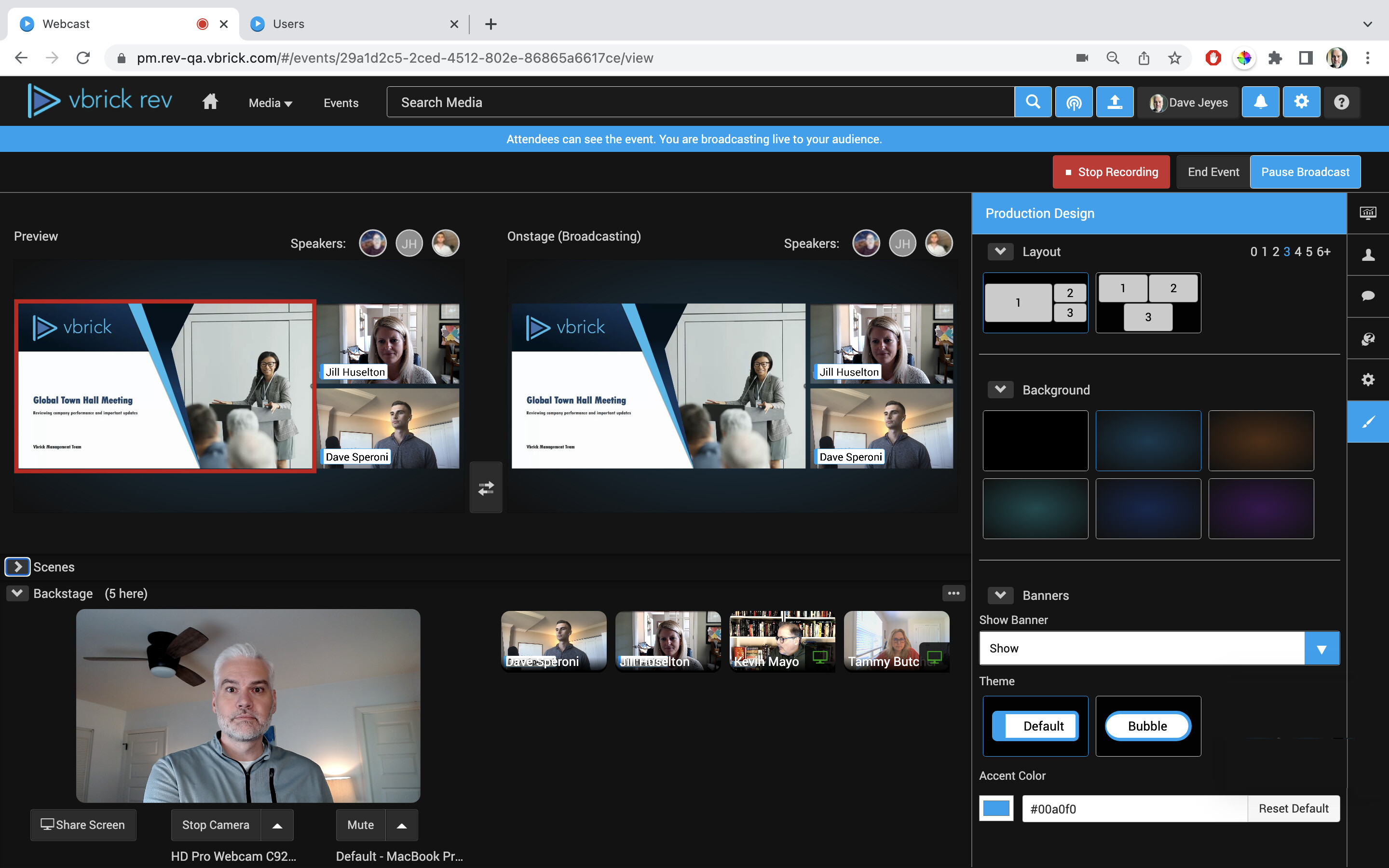
Vbrick's built-in enterprise content delivery network is the less photogenic half of the product. It uses peer-to-peer delivery, edge caching, and multicast so thousands of employees do not each pull an identical stream through the same corporate connection. Producer, the browser control room shown above, stages as many as nine presenters without separate production software. The content-management layer adds channels, categories, permissions, analytics, editing, and governance. APIs and a platform-as-a-service offering let customers build those capabilities into their own systems.
The problem it solves
Video is scattered across meeting tools, shared drives, intranets, and departmental sites. Search is poor, permissions drift, and a popular live stream can punish the network.
The enterprise difference
One platform combines live broadcast, a governed library, eCDN, AI enrichment, analytics, integrations, and compliance controls such as FedRAMP authorization and SOC 2 Type II auditing.
The archive would like a second career
Vbrick's current repositioning is from enterprise video platform to video intelligence layer. Its AI reads speech, visuals, slides, speakers, and contextual metadata. It generates titles, chapters, tags, and summaries; searches by meaning rather than exact keywords; and transcribes, translates, or produces audio in more than 100 languages. A user can ask a Video Assistant a question about one recording instead of scrubbing through 58 minutes of throat-clearing.
The more consequential step is moving the answer elsewhere. Vbrick's ServiceNow integration can surface a permission-aware video segment inside an employee portal or support ticket. Now Assist can draw on video alongside written knowledge. An MCP server and open APIs are designed to let outside AI tools retrieve the same governed material. In this framing, a recorded repair demonstration is not media waiting for an audience. It is evidence waiting for a workflow.
That promise depends on trust. In February 2026, Vbrick became the first enterprise video platform recognized as a Content Credentials Generator under the C2PA conformance program. Video created or edited in the platform can carry a tamper-evident manifest showing origin and changes. Cybersecurity controls who gets the file; provenance helps show whether the file itself changed. For executive communications, compliance training, and the deepfake-shaped future, those are different jobs.
There is still no price tag
The old product had a wonderfully legible price. Ten Situation Room systems cost $50,000. The new product is custom-scoped annual software. Vbrick says the quote depends on five things: users, peak concurrent viewers, stored video, desired AI capabilities, and the network-delivery technology required. It does not publish a list price. Professional services, integrations, and licensed developer support can widen the engagement.
This is a sales model for consequential deployments, not casual browsing. Vbrick competes with Kaltura, Brightcove, Panopto, Qumu, MediaPlatform, Vimeo Enterprise, movingimage, Wowza, and Microsoft's video stack. Its argument is consolidation: replace separate tools for hosting, live events, content delivery, and search with one governed platform. That can reduce integration work, but only if the buyer actually has all four problems.
What a buyer can copy - and when not to
The transferable playbook is more disciplined than “add AI.” First, centralize the recordings. Preserve identity and access rules during migration. Add transcripts, translations, metadata, retention, and analytics. Fix distribution so a successful event does not become a network incident. Only then connect the library to search, service desks, and agents. Vbrick's own history follows the same order: delivery first, governance next, intelligence last.
The copyable sequence
- Inventory video across conferencing tools, drives, portals, and local servers.
- Run a proof of concept with security, network, legal, and records teams in the room.
- Migrate the content with metadata, transcripts, permissions, and analytics intact.
- Measure one useful outcome - case deflection, training completion, search time, or webcast reliability.
- Expose trusted video to AI only after retrieval respects the viewer's permissions.
The conditions where it will not work are equally clear. A 50-person company with a small library, ordinary Zoom recordings, few simultaneous viewers, and no unusual compliance burden may be buying an aircraft carrier for a pond. AI search will disappoint if transcripts are poor, permissions are chaotic, or nobody owns retention. Peer-to-peer delivery can be unnecessary when every viewer is remote. And consolidation fails when departments refuse to give up their point tools or the migration strips away the metadata that made old recordings intelligible.
Vbrick's durability comes from keeping one unfashionable fact in view: video is heavy. It consumes bandwidth, storage, attention, and administrative patience. The company's appliances solved the first two. Its cloud platform took on the third and fourth. Now it is trying to make the backlog useful enough that machines, not employees with an afternoon to lose, do the watching. The brick is gone. The weight remains.