A telephone number is a small possession until somebody tries to move it. Then it acquires a surprising social life: carriers, orders, records, permissions, exceptions. Bangalore S. Shivacharan has spent much of his working life in the machinery behind that apparently simple transaction. The customer wants the number to work. The engineer has to make a collection of institutions agree.
It is a useful introduction to the co-founder and chief executive of Turning Point Global Solutions. His territory is the place where an ordinary request becomes an elaborate systems problem. There is little glamour in a reconciled invoice. There is considerable relief. Across telecommunications software, federal technology work and a business established in Rockville in 2002, his career has kept returning to the practical business of making complicated arrangements function.
Another introduction is available in Washington: DC Central Kitchen. By February 2020, Shivacharan had volunteered there for more than a decade. The detail gives the corporate biography a welcome change of scenery. Here, too, the work depends on people, organization and sustained participation. A charitable gesture can fit into an afternoon. A decade takes rather more room in the diary.
The engineer before the chief executive
Shivacharan studied electronics engineering at the University of Bangalore and computer sciences at Stevens Institute of Technology in Hoboken, New Jersey. His professional background includes technology roles at Hughes Network Systems, Data General, Electronic Data Systems and Cap Gemini. At EDS and Cap Gemini, his work included federal contracts. Those institutions supplied different settings for a common subject: software expected to carry real operational responsibility.
Before TurningPoint, he co-founded Wisor Telecom and served as its chief technology officer, building operational support software for telecommunications businesses. He subsequently moved into the chief executive role at TurningPoint, with responsibility for growth and operations. There is a meaningful progression here, from designing the system to helping run the organization that delivers it. The diagrams become larger. People acquire an increasingly prominent place in them.
The distinction matters because enterprise software has a peculiar relationship with success. A spectacular demonstration lasts minutes. The system that follows must survive routine use, awkward cases and the next change in requirements. A career in this field is an education in consequences. The elegant answer still has to work when somebody submits an inelegant request.
Two founders, a second enterprise
David R. Hughes joined Shivacharan in founding TurningPoint in 2002. Hughes was also a Wisor co-founder, making TurningPoint another chapter in an existing professional connection. Their partnership brought technical and commercial experience into the same business. Building software and finding customers are related occupations, although each occasionally suspects the other of enjoying the easier half.
The company began in Rockville with a handful of employees. That is an appealingly modest unit of measurement: people one might reasonably gather around a table. It also makes the later expansion intelligible. The story begins with a small organization doing work, rather than a large organization announcing that it has a vision.
For Shivacharan, the venture connected prior experience in telecommunications and government projects with the responsibilities of ownership. A founder has to think about the next assignment and the ability to deliver it. Hiring, sales and execution cease to be separate entries in someone else's organizational chart. They become parts of the same promise.
A trophy, then the need for more desks
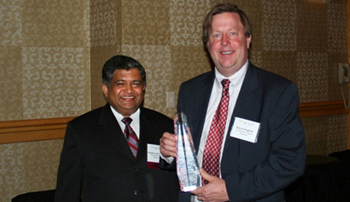
In April 2012, TurningPoint won the Technology Council of Maryland's Technology Firm of the Year award. Among the other finalists were Comcast, Broadsoft and GlobalNet Services. The award photograph catches the two founders together, holding a trophy whose transparency seems particularly appropriate for a business concerned with making operations easier to see.
Shivacharan's response directed attention toward the employees: “This was truly a team effort by all of our employees.” It is a conventional sentiment with a concrete setting. Software services depend on the people who carry out the work after the presentation is over. The customer does not receive an award photograph in place of a functioning system.
By January 2016, the company reported more than 500 employees and moved its headquarters into larger premises in Rockville. It also had an office in Baltimore and an office in India. Shivacharan welcomed the additional jobs in the local community. A growing company had produced an unusually literal management problem: finding somewhere to put everyone.
in Rockville
firm award
reported that January
The work hiding inside a phone number
The telecommunications thread remains visible in TurningPoint's later work. In August 2025, cloud communications company NUSO selected TurningPoint and numbering software business 10x People to support its number porting and provisioning operations. TurningPoint's O2CI platform was part of that arrangement. Moving a number between providers sounds like an administrative footnote until the transfer becomes your own.
The work involves business rules, compliance requirements and connections between trading partners. These are the details that make a familiar service possible. They also explain why software for operational coordination has a market. Behind a customer's short request may stand several companies, each with its own records and procedures.
There is an understated continuity between this assignment and Shivacharan's earlier telecommunications work. The vocabulary changes; the obligation to coordinate persists. Number portability offers a small, useful corrective to the notion that technological progress always arrives as a new object. Sometimes progress means keeping something you already have, with less administrative drama attached.
Conceptual illustration, not a product architecture.
Making reliability a repeatable habit
December 2025 brought another milestone: TurningPoint announced FedRAMP authorization for its Network Inventory & Optimization Solution, NiOS. The application supports telecommunications expense management and managed mobility, and is hosted on AWS GovCloud. For an agency trying to manage devices, services and spending, the attraction is a coordinated view of information that might otherwise live in several places.
The preceding December, the company had announced an “In Process” listing with the General Services Administration as sponsor. Read together, the two milestones show a sequence of preparation and authorization. Government software has to answer questions about how information is protected as well as what the application can do. An attractive interface cannot volunteer to take the examination on the system's behalf.
In September 2026, TurningPoint announced its fourth CMMI Maturity Level 3 appraisal for services, complementing its existing Level 5 development rating. Shivacharan described the company's philosophy in four words: “Proven Process. Expected Results.” The phrase has the appeal of a well-written instruction. It places the emphasis on work that can be carried out consistently, even when nobody is preparing a speech about it.
That emphasis makes sense of the business he leads. Organizations buying operational software need a result they can depend on again tomorrow. Novelty has its place, but an invoice reconciled correctly for the hundredth time remains a respectable achievement. Reliability rarely receives a standing ovation. Its absence is considerably more theatrical.
“Proven Process. Expected Results.”Bangalore Shivacharan / September 2026
A decade is a different sort of donation
The DC Central Kitchen connection adds a personal measure of continuity. In the holiday fundraising effort described in February 2020, TurningPoint's partners matched employee donations, raising more than $5,300. It was the fifth year of company and employee giving to the organization. Shivacharan's own volunteering already extended beyond ten years.
His explanation focused on the organization's combination of food assistance and culinary job training. That interest gives the commitment a specific shape: support for immediate needs alongside opportunities to earn a living. The fundraising was a shared undertaking, with employees contributing and partners adding their match. It put a company relationship to use beyond the customer contract.
The duration deserves attention without a decorative moral attached. Showing up over years requires repetition, and repetition is easily overlooked in a culture fond of announcements. The useful question is often what continues after the announcement. In Shivacharan's case, the volunteering supplies an answer measured in time.
Maryland, from recognition to a new assignment
On May 28, 2025, Maryland Comptroller Brooke Lierman presented Shivacharan with a Business Leader award during the inaugural AAPI Heritage Awards in Annapolis. Fifteen recipients were recognized across the event's categories. His fellow Business Leader honorees included restaurateur Peter Chang and community organization executive Elizabeth Chung. The gathering placed a software entrepreneur in a broader picture of Maryland's working and civic life.
In September 2026, TurningPoint announced a contract with the Maryland State Department of Education to design and develop a statewide Local Food Exchange. The planned cloud marketplace would connect local producers with schools and participating agencies, supporting activities from product listings and orders to invoicing. It was an announced development assignment, with implementation work ahead.
The project gives this career an apt present-tense setting. A farmer and a school buyer need to find each other; software must help the transaction proceed. The subject is different from a telephone number, but the need for coordination is familiar. Shivacharan's next chapter includes the same demanding ambition that runs through his earlier ones: make the arrangement work for the people who depend on it.