A curious thing happens when a technology becomes universal: its absence grows more expensive than its presence. The internet began as an amenity, matured into infrastructure and quietly became oxygen. A bank, a port, a factory or a defense unit does not merely become inconvenienced when its network disappears. It becomes blind. Logos Space is built around that unpleasant little fact.
The signal in 30 seconds
- Logos is planning a 4,178-satellite low Earth orbit network for enterprises and governments, not household broadband.
- Its service is designed as private Layer 2 and MPLS transport with symmetric multi-gigabit links and end-to-end encryption.
- The company raised a $50 million Series A from US Innovative Technologies and won FCC authorization in February 2026.
- The clever part is path independence. The sobering part is that the hardware, terminals, launches and operating network still have to be built.
The Mountain View company calls its idea “orbital fiber.” That phrase is marketing, of course, but good marketing performs the courtesy of being useful. Picture two company buildings joined by a wire so long and elastic that it rises into space, hops across a mesh of satellites and comes down precisely where instructed. The wire does not need to inspect the packet or invite it onto the public internet. It simply moves it.
The business hiding inside the bandwidth
Consumer broadband is lopsided because consumers are lopsided. We download films, feeds and files far more eagerly than we upload them. Enterprise networks are different. A cloud region replicates data. A ship sends telemetry. A remote operation pushes video, sensor readings and backups. Equal capacity in both directions is not a decorative feature. It is a clue to the customer.
Logos intends to sell service to commercial enterprises, governments, military users, sovereign networks and telecommunications partners. The terminals could be fixed to roofs, ships or aircraft. Contracts would be judged by the language big organizations already understand - capacity, availability and agreed performance - rather than by how many films a family can stream on holiday.
site A
LEO mesh
site B
The public internet can be an option, not an obligation. Optical crosslinks are intended to keep more of the journey off terrestrial infrastructure.
A founder returns to an old problem
Milo Medin has spent four decades near the plumbing of connectivity. He worked on satellite networking at NASA, helped build early cable broadband and later led Google Fiber’s first gigabit deployments and Google’s wireless access work. In 2023 he began Logos in stealth. Thomas Tull, whose US Innovative Technologies fund backs civilian and national-security technologies, nudged him toward the problem and supplied the capital.
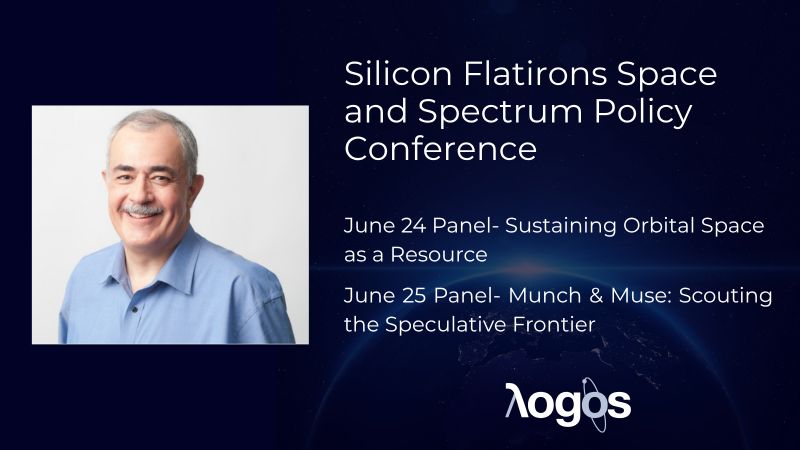
What changed Medin’s mind about returning to satellites was not the disappearance of fiber but its success. Cloud computing concentrated essential work behind connections that organizations do not fully control. The richer the terrestrial network became, the more costly a severed link became. Logos is therefore not a crusade against fiber. It is an expensive insurance policy for fiber’s worst afternoon.
Engineering chief Rama Akella supplies a complementary loop. He led wireless engineering during Starlink’s early commercial architecture, helped seed its direct-to-cell work, then ran silicon efforts at Amazon’s satellite project. He left scale for a startup because private enterprise networking looked like a distinct vertical, not a smaller imitation of consumer broadband.
The spectrum is the strategy
The plan uses K, Ka, Q and V band spectrum, narrow beams, spread control signals and optical links between satellites. Higher frequencies can offer broad channels and tightly directed energy. They also dislike weather, demand new terminals and remain less mature than familiar consumer-satellite bands. Logos argues that techniques developed during the terrestrial 5G millimeter-wave push can be adapted for space.
Consumer LEO broadband
- Public internet access
- Download-heavy traffic
- Mass-market terminals
- Ubiquitous coverage
Logos thesis
- Private Layer 2 or MPLS transport
- Symmetric traffic
- Throughput-first roof terminals
- Assured routes for critical sites
The same architecture is meant to resist jamming. Narrow beams make a signal harder to disturb; control waveforms and the geometry of communicating toward satellites overhead add defenses; optical crosslinks reduce the number of terrestrial handoffs. These properties appeal to militaries, but the company’s wager is that electronic warfare is no longer merely a military concern. Ports, grids and businesses can be attacked too, deliberately or by collateral interference.
Permission is not a constellation
Logos emerged publicly in October 2024 with a proposed 3,960 satellites. A $50 million Series A followed in June 2025, earmarked for engineering, prototypes, hiring and integration. In February 2026 the FCC authorized a revised network of 4,178 spacecraft across seven shells roughly 860 to 925 kilometers above Earth. The company also reached a technical compatibility agreement with Iridium for part of its Ka-band operation.
This is what the project has cost in public view: $50 million in disclosed Series A capital, plus earlier backing whose size remains private. It is enough to make design choices. It is not the disclosed price of building and launching thousands of satellites, a bill likely to require far more capital and binding customers.
Not a Logos satellite - none is operating. The prior failure was terrestrial millimeter wave as a broad 5G access strategy. Logos wants to reuse the resulting component advances in orbit, where line-of-sight links and roof-mounted enterprise terminals change the conditions.
By May 2026, Logos was paying five prospective satellite-bus suppliers to study its requirements. It plans to select a commercial bus, build payload technology in-house and design a terminal because no off-the-shelf unit works for the chosen Q and V bands. The spacecraft will be comparatively large and function-rich. Bus choice and launch choice must fit together because the satellites are supposed to stack flat inside a fairing.
The audacious decision is to skip a demonstration satellite. That can save a cycle, but it transfers the burden to simulation, component tests, flatsats, supplier discipline and ground qualification. Copy that approach only when the architecture can be decomposed and tested convincingly on Earth, the team has flown adjacent systems before, and capital can absorb redesign. It is a poor recipe for an unproven payload, a thin test program or a team learning orbital operations for the first time.
A category must earn its noun
Logos calls the category “Provable Path Independence.” The phrase is grand, but the buyer’s question is pleasingly mundane: can you prove that my data took the independent path I paid for? If the company can answer with service-level evidence, path visibility and dependable capacity, it may give network chiefs a new item to buy. If it cannot, orbital fiber becomes ordinary satellite bandwidth in a handsome suit.
The competitive field is not empty. Starlink and Starshield possess operational scale. Eutelsat OneWeb serves enterprise and government markets. Amazon Leo, Telesat Lightspeed, Rivada’s proposed network and Blue Origin’s TeraWave crowd the horizon. Logos’s advantage is focus: it is not retrofitting a private-network product onto a consumer architecture. Its disadvantage is everything that incumbency buys - factories, launch contracts, ground networks, operational history and cash.
The reusable lesson is not “launch 4,178 satellites.” It is to define a customer by traffic shape and failure cost. Logos noticed that enterprises upload, require controlled endpoints and can place an inelegant terminal on a roof. It then designed backward from those facts. The strategy works when downtime is costly, an independent path is genuinely independent, terminals have clear sky and customers will pay enterprise prices. It weakens where fiber is already diverse, weather degrades high-frequency links, roofs cannot see enough sky, or ordinary encrypted internet service is good enough.
For now, Logos Space is a licensed argument with money, patents and experienced engineers behind it. The argument is that the internet’s greatest virtue - its vast, shared reach - can also be a liability for critical operations. Somewhere between isolation and connection sits a private road across the sky. Logos has permission to build it. The next proof will not be rhetorical.