The most revealing number in Baker Electric’s history fits on an old-fashioned check: $4,000. That is what LeRoy Baker paid for an Escondido electrical business in 1938. The most revealing number in its present is a percentage: 100. Since 2020, the company says, its employees have owned the whole business through an employee stock ownership plan.
Between those numbers lies an unusually physical account of California’s economic changes. Baker’s work now reaches into cruise terminals, college buildings, sports venues and desert battery installations. The company sells the expertise required to make expensive electrical equipment work together. You can buy a battery cabinet. Getting it connected to the rest of the world is another assignment.
That distinction puts Baker in an interesting corner of the clean-energy market. It earns its place through construction, engineering coordination and service. Its customers need projects that can actually operate: a ship plugged into shore power, a campus with functioning controls, an arena with solar on its roof. The equipment attracts attention. Baker works on the connections.
A family business changes the family
LeRoy and Constance Baker moved from Montana to Southern California in 1937. He was an electrical engineer; her family had roots in Escondido. The business he purchased the following year became Escondido Electric, then adopted the Baker Electric name in 1950. Four generations of the family became involved. There is something pleasingly literal about a company growing alongside the town it helped wire.
The ownership transition changed who would share in the business’s future. Baker dates the ESOP to 2020; its public announcement followed in October 2021. The Beyster Institute at UC San Diego’s Rady School of Management advised the process. Ted Baker described having considered the move for several years, with employee benefit and the company’s long-term future central to the decision.
The published mechanics matter more than the celebratory language. Baker says employees become eligible after working 500 hours within a six-month period, receive company contributions without buying in, and become fully vested after six years. Those details make ownership a benefit with a timetable. They also explain why a company concerned with retaining experience might find the structure appealing.
“Our ESOP has done exactly what we hoped it would.”
Ted Baker, company update, September 2025
That is management’s assessment, and it belongs in that category. Employee ownership gives people a financial stake; customers still have to judge the execution. For a contractor, the practical test takes place in estimates, coordination meetings and fieldwork. A shared interest in the business becomes useful when it carries through to those ordinary decisions.
The cruise ship needs an outlet
At San Diego’s waterfront, Baker’s role came with an unusually clear price tag. In January 2022, port commissioners awarded the company a $268,000 contract for work at the B Street and Broadway piers. Baker would install equipment supplied by the Port and remove, replace and terminate medium-voltage cables. The wider shore-power expansion had a $4.6 million budget.
Those are two different numbers for two different things. Treating the entire investment as Baker’s revenue would turn an electrical contract into a much larger financial claim. The assignment illustrates how infrastructure gets bought: an owner funds a program, purchases equipment and assigns specific construction responsibilities. The cable work is a defined piece of that program.
About 5.8% of the wider investment. Contract award and project budget are different measures.
The result was easy to understand from the pier: two cruise ships could use shore power simultaneously. A subsequent completion announcement identified Disney Wonder and Insignia as the first pair to do so. Cochrane Marine handled equipment-related and commissioning responsibilities; Baker supplied the described installation work. The industry calls this cold ironing. The phrase has more romance than “electrical infrastructure upgrade,” but the usefulness is real.
Behind the battery cabinets
LeConte, in Calexico, takes the same connection problem to utility scale. The storage facility is rated at 125 megawatts and 250 megawatt-hours. It sits beside the Centinela solar installation, positioning stored electricity to help balance renewable production and demand. RTM Engineering Consultants describes its purpose as firming renewable output and shifting energy into more useful periods.
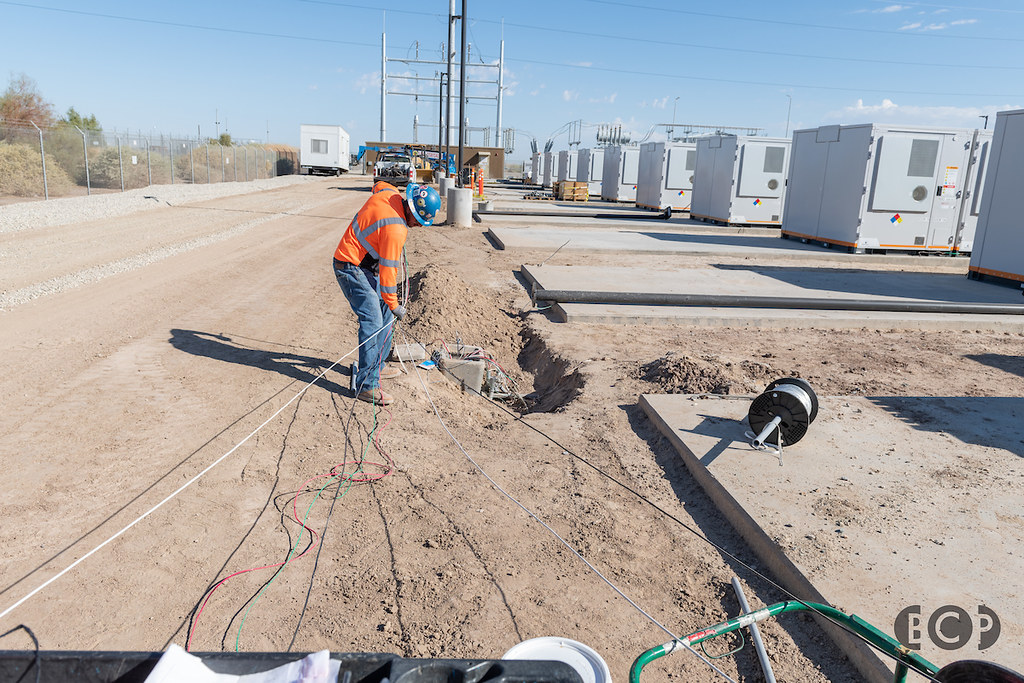
Baker’s project description puts its scope in specific terms: medium-voltage switchgear, auxiliary power systems and a fire-water storage tank, with engineering, procurement and construction responsibilities. It lists Wärtsilä as general contractor. RTM separately identifies Baker as its client for electrical engineering. The arrangement is a useful reminder that an integrated project can still involve several specialized companies.
Baker lists a $108 million project value for LeConte. Read that as a project figure. The capacity numbers tell a different story: megawatts measure power, while megawatt-hours measure stored energy. Dividing 250 by 125 gives a nominal two-hour duration at rated output, before operational limits and losses. A battery’s usefulness depends on both quantities.
Nominal duration calculated from the published ratings. Actual dispatch depends on operating conditions.
The rooftop and the ownership paperwork
Frontwave Arena in Oceanside offers another view of the business model. In July 2025, DSD Renewables announced completion of a 797.07-kilowatt rooftop solar system paired with 1,146.88 kilowatt-hours of battery storage. The installation has 1,350 panels. DSD put approximate annual generation at 1.25 million kilowatt-hours, a production estimate rather than a guaranteed bill reduction.
Baker designed and installed the system. DSD would own and operate it over the long term. Baker participates in DSD’s Developer Network, which combines project resources with regional construction expertise. For the venue, that creates a separation between the company delivering the physical installation and the company responsible for the energy asset afterward.
That division is worth copying into a buyer’s questions. Who owns the equipment? Who maintains it? Who is accountable when construction ends? A solar proposal becomes easier to assess when each responsibility has a name attached. The Frontwave arrangement shows one available structure; the right arrangement for another facility depends on that owner’s needs and project terms.
One campus, six groups, plenty of handoffs
Baker calls its coordinated operating approach “One Baker.” College of the Desert supplies a concrete example. In an August 2026 update, the company described six groups working on the new satellite campus: construction, controls, audiovisual, data and security, renewables, and transportation. Its scope includes electrical distribution, lighting, equipment connections, specialty systems and renewable installation.
The company also calls the campus one of its largest prefabrication efforts to date. The first building is scheduled for fall 2027, with other facilities expected afterward. This is work in progress, not a completed-campus victory lap. But it demonstrates what the coordination pitch means: several kinds of electrical and technical work planned around the same facility.
For an owner, the attraction is understandable. Separate specialists can each deliver their assigned equipment and still leave questions between them. Baker’s stated approach emphasizes clear scope, centralized communication and visibility into what the next team needs. The business proposition is fewer loose ends between disciplines. That promise earns its value in the project plan and the finished building.
Where the contractor earns its place
The service range stretches beyond renewable installations. Baker offers tenant improvements, building automation, structured cabling, security infrastructure, emergency electrical response and maintenance. Its special-projects group works with general contractors, developers and owners across education, healthcare, industrial and public-sector settings. A facility manager can use that breadth for an upgrade; a developer can use it for a larger construction package.
Utility solar adds another distinction. Baker advertises full engineering, procurement and construction delivery for projects up to 100 megawatts, alongside electrical subcontracting on larger developments. It reports seven gigawatts of completed utility-solar work. That is a cumulative company claim, not annual generation or ownership of seven gigawatts of power plants. The important point is the range of delivery roles.
The competitive field includes specialists such as BEI Construction, J.F. Electric and New Era Electric. Solar Power World’s 2026 California list places Baker sixth across all listed contractor types, with approximately 230.7 megawatts installed in the state during 2025. Categories matter: Baker separately announced second place among California electrical subcontractors. Both rankings can be true because they compare different groups.
The useful part is the handoff
Baker’s example offers a practical lesson without requiring anyone to duplicate an 88-year company history. Start with the work between the products. Specify who designs the connection, who supplies the equipment, who installs it and who supports it later. The port, battery site and arena each make that division visible in a different way.
An integrated contractor makes sense when a project benefits from several related capabilities. A narrowly defined job may need a smaller specialist. A battery also has finite duration, and a rooftop system has a site-specific output. Breadth of service cannot remove those physical constraints. It can help an owner organize the work around them.
The ownership story follows a similar logic. Baker has placed a long-term interest in the company with the people expected to carry its experience forward. The next test is quite tangible: another campus opening, another system commissioned, another service call answered. Somewhere between the drawing and the switch, the company has to make the connection.